Seven Continents

Global Perspectives

Explore people, economies, resources and opportunities across seven continents.

Seven portraits set against landscapes representing Asia, Europe, Africa, North America, South America, Oceania and Antarctica.

Explore Seven Continents

Latest Perspectives

Asia

Countries

MaMeeFarm™ Global Perspectives · ASIA 001

India's Semiconductor Transition: From Electronics Assembly to Industrial Capability

Semiconductor cleanroom illustration showing a technician holding a silicon wafer, representing India's developing semiconductor industry.
Editorial illustration · ASIA 001 · India

MaMeeFarm™ Global Perspectives | Asia / India
23 October 2026

A New Stage in India's Industrial Development

India is entering a new stage of industrial development as it seeks to expand beyond electronics assembly and strengthen its position in semiconductor manufacturing.

The transition is significant because semiconductors are essential components of modern economic activity. They support telecommunications, automobiles, industrial machinery, consumer electronics, digital infrastructure and increasingly sophisticated technologies.

India already has an established electronics manufacturing sector and a substantial base of semiconductor design expertise. Its next challenge is to develop more of the industrial capabilities required to manufacture, package and test chips domestically.

This requires more than investment in factories. Semiconductor production depends on specialised equipment, reliable infrastructure, precision materials, experienced workers and commercial relationships extending across international supply chains.

India has begun building these capabilities. However, the development of a comprehensive domestic semiconductor industry remains incomplete.

From Electronics Manufacturing to Semiconductor Production

India's semiconductor programme began with a major policy commitment in December 2021, when the government approved the original Semicon India Programme with an allocation of ₹76,000 crore.

The programme was designed to encourage domestic semiconductor and display manufacturing while supporting related industrial development.

On 15 July 2026, the Union Cabinet approved Semicon 2.0 with a total budget outlay of ₹1,27,500 crore.

The new programme broadens India's industrial ambitions across six areas: semiconductor design, manufacturing equipment and materials, fabrication facilities, advanced packaging, research and development, and talent development.

The expansion reflects the complexity of semiconductor production.

A fabrication plant cannot operate independently of the machinery, chemicals, gases, testing systems and technical services required to maintain manufacturing standards.

India's policy direction therefore extends beyond constructing individual factories towards establishing a wider industrial ecosystem.

The distinction is important. A country can attract semiconductor investment without immediately developing the full range of capabilities required for competitive production.

Source: Government of India, Press Information Bureau, 15 July 2026.

What Has Actually Been Established?

India's progress can be observed in both approved investments and manufacturing facilities that have begun commercial operations.

According to the Indian government's September 2026 reporting, twelve semiconductor manufacturing units had been approved, representing cumulative investment commitments exceeding ₹1.64 lakh crore.

The approved projects included one silicon fabrication facility, one silicon carbide fabrication facility, an integrated gallium nitride micro-LED display fabrication facility, and nine assembly, testing, marking and packaging facilities.

These projects were distributed across Gujarat, Assam, Uttar Pradesh, Odisha, Punjab and Andhra Pradesh.

By September 2026, the government reported that five semiconductor manufacturing units had commenced commercial production.

This marks a significant development beyond investment announcements. Commercial operations indicate that parts of the approved industrial programme have progressed into manufacturing activity.

However, different semiconductor facilities perform different functions.

Packaging and testing operations are not equivalent to large-scale silicon wafer fabrication. Their commercial operation does not establish that India has already developed a complete domestic semiconductor production chain.

The government's July 2026 announcement indicated that the first silicon fabrication plant was scheduled for commissioning in 2028.

India has therefore achieved early operational progress while substantial fabrication capabilities remain under development.

The distinction between approved investment, operational facilities and sustained production is essential for understanding the country's current industrial position.

Sources: Government of India, Press Information Bureau, 15 July and 17–18 September 2026.

People: Building a Specialised Industrial Workforce

Semiconductor development creates demand for a workforce with capabilities extending well beyond conventional electronics assembly.

Manufacturing facilities require engineers and technicians specialising in electronic design, materials, process control, equipment maintenance, contamination management and quality assurance.

India already possesses significant engineering and semiconductor design expertise. Its emerging manufacturing sector creates opportunities to connect these capabilities with domestic industrial operations.

Under government-supported semiconductor design initiatives, more than 68,000 students had received training by August 2026.

The government also reported that 24 semiconductor design projects had been approved for financial support, while 105 startups and smaller enterprises had received access to electronic design automation tools.

These initiatives expand participation in semiconductor design and technical development.

Nevertheless, training participation and manufacturing experience are not interchangeable.

Operating a semiconductor fabrication facility requires specialised practical knowledge, technical discipline and experience with demanding production environments.

As manufacturing capacity develops, the availability of experienced personnel will influence how effectively new facilities can operate.

For workers and educational institutions, the transition creates opportunities in technical education, industrial employment, applied research and specialised services.

The longer-term significance will depend on how successfully these opportunities translate into sustainable professional and industrial capabilities.

Sources: Government of India, Press Information Bureau, 15 July and 14 August 2026.

Economy: Expanding Participation in Higher-Value Manufacturing

India's semiconductor transition could expand the range of industrial activities undertaken within its economy.

Electronics assembly, semiconductor design, wafer fabrication, packaging and testing each represent different stages of production.

They involve distinct technologies, capital requirements, workforce capabilities and commercial relationships.

Developing additional stages domestically could allow India to participate in a wider range of semiconductor-related economic activities.

The opportunities extend beyond chip manufacturers.

Specialised equipment suppliers, industrial service providers, materials producers, testing companies and technical maintenance businesses may benefit from the development of a larger manufacturing ecosystem.

Such activities can contribute to industrial diversification and create demand for specialised employment.

However, approved investment commitments should not be confused with realised economic performance.

The reported investment commitments exceeding ₹1.64 lakh crore describe the scale of approved projects. They do not establish equivalent completed expenditure, commercial revenue, profitability or export performance.

The economic contribution of India's semiconductor programme will become clearer as facilities reach sustained production and establish durable relationships with customers and suppliers.

The central economic opportunity is not simply the construction of new plants. It is the possibility of developing a broader base of commercially productive industrial activity.

Resources: The Foundations of Semiconductor Manufacturing

Semiconductor manufacturing depends on demanding physical and industrial infrastructure.

Fabrication facilities require reliable electricity, process water, controlled environments, precision machinery and specialised chemical inputs.

The quality and consistency of these resources directly affect manufacturing operations.

A facility may possess advanced equipment while remaining dependent on external suppliers for essential materials, components and technical services.

India's Semicon 2.0 programme includes support for semiconductor manufacturing machinery, materials, chemicals and gases.

This broadens the programme beyond finished semiconductor products to the industrial activities that make production possible.

For India's domestic economy, developing these supporting industries could create opportunities in precision manufacturing, specialised materials, engineering services and industrial infrastructure.

International suppliers may also find opportunities to participate in India's expanding manufacturing network.

Yet the establishment of policy incentives does not mean that every required capability is already available domestically.

Semiconductor production remains internationally interconnected, and dependence on imported equipment or specialised inputs may continue even as domestic manufacturing expands.

India's industrial development will therefore involve both the creation of new local capabilities and continued participation in global supply networks.

Opportunities: India's Position in Global Semiconductor Supply Chains

The semiconductor industry is one of the most internationally specialised manufacturing sectors.

Design, fabrication, production equipment, materials, packaging and final electronics manufacturing are frequently distributed across different economies.

India's expanding semiconductor activities could provide additional locations for selected stages of this international production system.

The development of packaging and testing facilities may create opportunities for commercial relationships with international chip manufacturers and electronics companies.

Future fabrication capacity could broaden those opportunities, depending on technical performance, production economics and customer requirements.

India has also pursued semiconductor cooperation with international partners, including the United States, Japan, the European Union, Singapore and the Netherlands.

These relationships provide channels for industrial cooperation, investment and technical engagement.

However, international agreements and diplomatic cooperation do not automatically establish commercial production outcomes.

Companies considering India as a manufacturing or sourcing location will still need to evaluate production reliability, technical capabilities, operating costs, infrastructure and supplier availability.

India's potential contribution to global supply-chain diversification is therefore meaningful but conditional.

Additional manufacturing locations can provide companies with more options. Whether those options improve supply-chain resilience depends on their operational performance and integration into existing production networks.

For international businesses, India's semiconductor development represents an emerging industrial market rather than a fully established substitute for existing semiconductor manufacturing centres.

Source: Government of India, Press Information Bureau, September 2026.

The Difference Between Industrial Ambition and Industrial Capability

India's semiconductor transition illustrates a broader reality of industrial development.

Government programmes can provide incentives, attract investment and support the construction of manufacturing facilities.

They can also expand access to education, research infrastructure and industrial partnerships.

But competitive manufacturing requires capabilities that must be demonstrated through sustained operations.

Factories need to produce reliably. Workers need practical expertise. Suppliers need to meet technical specifications. Products need to satisfy commercial customers.

India's progress is visible in approved manufacturing projects, operational semiconductor-related facilities, expanding design initiatives and the broader industrial support introduced through Semicon 2.0.

At the same time, substantial fabrication capacity, domestic supplier depth, production scale and long-term commercial performance remain areas where further development and evidence are required.

These limitations do not negate the significance of India's progress. They help define its present stage.

India is no longer operating solely at the level of semiconductor policy announcements. Parts of its industrial programme have entered commercial production, while a wider manufacturing ecosystem continues to develop.

Global Perspective

India's semiconductor transition is part of a wider international shift in the geography of advanced manufacturing.

Countries are seeking to develop industrial capabilities in technologies that support economic activity across multiple sectors.

For India, the transition represents an opportunity to build upon its electronics manufacturing base and established design expertise.

For people, it creates demand for specialised education, technical skills and industrial employment.

For the economy, it offers the possibility of greater manufacturing diversification and participation in additional stages of semiconductor production.

For resources, it highlights the importance of reliable infrastructure, precision materials and supporting industries.

For businesses, it creates potential opportunities in equipment supply, manufacturing partnerships, engineering services and international production networks.

The country's progress is measurable, but the broader transition remains underway.

India's future position in the semiconductor industry will depend not only on the number of projects approved, but on the industrial capabilities that become operational, commercially sustainable and integrated into global markets.

People • Economy • Resources • Opportunities


References

  1. Government of India, Press Information Bureau. Cabinet Approves Semicon 2.0. 15 July 2026.
    https://www.pib.gov.in/PressReleasePage.aspx?PRID=2284796
  2. Government of India, Press Information Bureau. India Building Semiconductor Future: Emerging Capabilities Across Design, Manufacturing, Packaging, Materials and Talent. 17 September 2026.
    https://www.pib.gov.in/PressReleasePage.aspx?PRID=2311220
  3. Government of India, Press Information Bureau. Precision Manufacturing Ecosystem Emerging as Key Enabler for India's Semiconductor Industry. 18 September 2026.
    https://www.pib.gov.in/PressReleaseIframePage.aspx?PRID=2312207
  4. Government of India, Press Information Bureau. Chips to Start-ups Programme Strengthens India's Semiconductor Design Ecosystem and Industry Ready Talent. 14 August 2026.
    https://www.pib.gov.in/PressReleasePage.aspx?PRID=2299338

Rights Holder: P’Toh
Position: System Architect
Framework: DGCP™
License: DGCP | MMFARM-POL-2025

Back to Asia ↑

MaMeeFarm™ Global Perspectives · ASIA 002

Indonesia's Nickel Transition: From Mineral Processing to Battery Supply Chains

Nickel processing and industrial manufacturing facilities illustrating Indonesia's expanding downstream mineral supply chains
Editorial illustration · ASIA 002 · Indonesia

MaMeeFarm™ Global Perspectives | ASIA 002

Editorial Date: 27 October 2026
Country: Indonesia
Geographic Classification: Asia / Indonesia

From Mineral Resources to Industrial Production

Indonesia has become one of the most important countries in the global nickel industry.

Its significance extends beyond mineral extraction. Investment in smelting, refining and industrial processing has expanded the country's role in international manufacturing supply chains.

Nickel is used in stainless steel and certain rechargeable battery technologies. These markets have different technical requirements, production processes and commercial conditions.

The ability to mine nickel does not automatically establish the ability to manufacture battery materials, battery cells or finished electric vehicles.

Each additional stage requires equipment, technical expertise, financing, reliable infrastructure and customers willing to purchase the resulting products.

Indonesia's industrial strategy seeks to develop more of these activities domestically.

Developments announced in October 2026 illustrate that ambition while showing why industrial progress must be understood through operating capabilities rather than investment announcements alone.

The October 2026 Industrial Development

On 8 October 2026, Indonesia's government launched 11 downstream industrial projects at the Indonesia Weda Bay Industrial Park in Central Halmahera, North Maluku.

The announced combined investment value was approximately US$10.2 billion, equivalent to around Rp180 trillion.

The event marked the commencement of commercial operations at four industrial projects and the groundbreaking of seven additional projects.

The four projects entering commercial operations were associated with Blue Sparking Energy, REPT Battero Indonesia, Pioneer Aluminum Industries and XCMG Indonesia Manufacturing.

The seven projects entering construction included activities related to nickel and cobalt processing, battery materials, aluminium, solar-related manufacturing and commercial vehicles.

The government also marked an inaugural export of electric vehicle batteries from the industrial park.

These developments are significant because they demonstrate efforts to establish industrial activities beyond mineral extraction and basic refining.

However, the announced combined investment value should not be interpreted as expenditure already completed across all 11 projects.

The projects were at different stages of development.

Facilities entering commercial operations and projects beginning construction do not represent equivalent levels of productive capacity.

Likewise, an inaugural export demonstrates a specific commercial milestone. It does not independently establish sustained production volumes, profitability or international market share.

The longer-term importance of the projects will depend on operating performance, customer relationships and their ability to participate consistently in industrial supply chains.

Source: Cabinet Secretariat of the Republic of Indonesia, 8 October 2026.

Indonesia's Position in Global Nickel Supply

Indonesia occupies an unusually concentrated position in the international nickel market.

According to the International Energy Agency, Indonesia accounted for approximately 63% of global mined nickel supply and more than 40% of refined nickel output in 2024.

These figures demonstrate the country's importance at both extraction and processing stages.

They do not mean that Indonesia produces the same share of global batteries or electric vehicles.

The distinction matters because the nickel supply chain contains several separate industrial activities.

Nickel ore may be processed into products used by stainless steel manufacturers or further refined into materials appropriate for particular battery chemistries.

Manufacturing battery precursors, cathode materials and battery cells requires additional capabilities.

Indonesia's industrial transition therefore involves developing successive stages of production rather than simply increasing mineral output.

The economic opportunity lies in establishing activities that can operate reliably, meet customer specifications and remain commercially sustainable.

Source: International Energy Agency, ASEAN Energy Security Review, 2026.

Processing Capacity and Industrial Value

Mineral processing changes the physical or chemical form of raw materials so that they can meet industrial specifications.

This transformation can involve smelting, hydrometallurgical treatment, purification and the production of intermediate materials.

Different processing routes produce different outputs.

Rotary kiln electric furnace operations commonly support ferronickel or nickel pig iron production, materials closely associated with stainless steel supply chains.

High-pressure acid leaching can process certain nickel ores to produce intermediate materials that may undergo further refining for battery applications.

The choice of technology depends on ore characteristics, desired products, operating costs and environmental requirements.

Additional processing can support industrial development, but commercial value does not arise simply from locating more factories near mines.

Facilities must achieve consistent product quality, reliable production and acceptable operating costs.

Manufacturers also need technical systems capable of meeting customer requirements.

A larger downstream industry can support additional economic activity, but its contribution depends on which production stages are established and how effectively they operate.

Moving Towards Battery Materials

Indonesia's industrial ambitions include greater participation in battery supply chains.

Battery manufacturing involves multiple activities, including refining mineral inputs, producing precursor materials, manufacturing cathode materials, assembling cells and integrating battery systems.

Not every battery requires nickel.

Lithium iron phosphate batteries, for example, use a different cathode chemistry from nickel-containing lithium-ion batteries.

This distinction has important commercial implications.

Investment in nickel processing does not guarantee equivalent demand growth across all battery technologies.

Manufacturers must respond to changing battery chemistries, product specifications, production costs and customer requirements.

In June 2026, Indonesia's Ministry of Investment and Downstream Industry reported discussions with Australia's Pure Battery Technologies concerning potential domestic production of precursor cathode active material.

The proposal involved using mixed hydroxide precipitate produced through domestic processing facilities.

It reflected an effort to connect existing intermediate-material production with more advanced battery supply activities.

However, the discussions represented a proposed investment direction, not evidence that the planned facility had been completed or entered commercial operation.

Indonesia's opportunity lies in expanding its industrial participation while remaining responsive to changes in battery technology and demand.

Source: Ministry of Investment and Downstream Industry/BKPM, 29 June 2026.

The Economy Beyond Export Volumes

Developing additional processing and manufacturing activities can create economic opportunities beyond raw material exports.

Industrial operations require construction, equipment, maintenance, transport and technical services.

They may also create demand for domestic suppliers and specialised workers.

Indonesia's Ministry of Investment and Downstream Industry reported Rp300.1 trillion in realised downstream investment during the first half of 2026.

This represented 29.7% of the country's total reported investment realisation for that period.

The figure covered downstream industries broadly, not nickel alone.

The ministry identified several mineral commodities receiving investment, including bauxite, nickel and copper.

Consequently, the total should not be presented as investment exclusively in nickel processing or battery manufacturing.

The data demonstrate the scale of Indonesia's downstream investment activity and the wider scope of its industrial development strategy.

However, investment expenditure is not the same as lasting economic value.

Domestic procurement, employment quality, technological capabilities, productivity and the distribution of income influence the benefits realised within the economy.

A project may generate substantial exports without creating an equivalent level of domestic technological independence.

Source: Ministry of Investment and Downstream Industry/BKPM, July 2026.

People, Employment and Local Communities

Industrial development changes employment requirements.

Mining, refining and battery-material production depend on different combinations of technical skills.

These include engineering, metallurgical processing, industrial automation, laboratory analysis, maintenance, environmental management and occupational safety.

New facilities can create employment opportunities and demand for training.

They may also encourage additional businesses to provide equipment, logistics and technical services.

However, the number of jobs created does not independently establish their quality, accessibility or long-term sustainability.

Local economic outcomes depend on recruitment practices, workforce development, health and safety arrangements, and opportunities available to surrounding communities.

Industrial expansion also affects land use, infrastructure demand and environmental conditions.

Communities near mining and processing operations may experience both economic benefits and operational pressures.

The International Energy Agency identifies environmental and social performance as an important consideration for the resilience of Southeast Asian critical mineral supply chains.

Industrial development therefore has implications for the people affected by production, not only for investors and export markets.

Electricity and the Environmental Challenge

Nickel processing is energy-intensive.

Facilities require dependable electricity and, depending on their processes, additional sources of heat and industrial inputs.

Indonesia's rapid expansion of processing has been supported partly by dedicated coal-fired electricity generation.

This creates a challenge for industrial products intended for use in certain clean-energy technologies.

The International Energy Agency identifies captive coal-fired power as an important environmental concern associated with Indonesia's nickel refining industry.

Access to lower-emission electricity could improve the emissions profile of some processing operations.

However, changes in electricity supply alone would not eliminate all emissions or environmental impacts.

Mining, transport, chemical processing, industrial residues and other activities also influence environmental performance.

Different production routes have different operating characteristics.

Nickel produced for battery applications should not automatically be described as low-carbon simply because batteries can support electric transportation.

Its environmental performance depends on the industrial processes and energy sources involved.

Water, Chemicals and Supporting Infrastructure

Nickel processing also depends on water, chemical inputs, transport systems and waste management.

Requirements differ across processing technologies.

High-pressure acid leaching, for example, relies on specialised chemical processes and access to appropriate industrial inputs.

The International Energy Agency identifies sulphur and sulphuric acid supply as areas of vulnerability for Indonesian nickel processing.

Disruptions to international shipping or changes in input prices can affect operating conditions even when the underlying mineral resource is domestic.

This illustrates an important limitation of resource-based industrial development.

Local access to ore does not eliminate dependence on imported equipment, chemicals, technology or external markets.

Industrial operations also require ports, roads, electricity infrastructure, water management and environmental safeguards.

The benefits of processing capacity may be constrained when these supporting systems do not develop at the same pace.

International Investment and Supply-Chain Concentration

Indonesia's nickel industry has attracted substantial international investment.

Foreign companies have contributed capital, processing technologies and access to overseas markets.

These relationships have supported the rapid development of refining capacity.

They also create questions about the concentration of ownership, technology and commercial relationships.

According to the IEA's ASEAN Energy Security Review, a large share of Indonesian nickel refining capacity is associated with Chinese investment, while processed output is strongly oriented towards the Chinese market.

These links demonstrate how industrial development can strengthen domestic production while maintaining dependence on particular international partners.

Diversification is therefore more complex than increasing the number of factories operating domestically.

It can also involve broader access to technology, supplier development, additional customers and a more varied investment base.

Such diversification cannot be assumed from new project announcements.

Its commercial significance depends on actual operating capabilities and the relationships connecting producers with international markets.

Business Opportunities and Commercial Risks

The expansion of downstream industries creates potential demand for products and services.

Engineering companies may participate in plant development and industrial modifications.

Equipment suppliers may provide machinery, automation and monitoring systems.

Logistics providers may support the movement of raw materials, intermediate products and finished goods.

Laboratories, maintenance specialists and environmental service providers may support operating facilities.

Manufacturers may develop supply arrangements for battery materials, stainless steel and other industrial products.

These opportunities are not guaranteed commercial outcomes.

Potential suppliers must meet procurement requirements, technical standards and competitive pricing conditions.

Investors also face exposure to nickel price movements, changing battery technologies, production costs and regulatory requirements.

Indonesia's industrial strategy must remain responsive to both battery-related opportunities and the continuing importance of stainless steel markets.

The presence of substantial mineral resources can support higher-value industrial activity, but commercial success depends on the markets that purchase the resulting products.

Industrial Capability Beyond Project Announcements

Indonesia's October 2026 development marks an important stage in its downstream industrial strategy.

Four projects entered commercial operations, seven additional projects began construction, and an inaugural export of electric vehicle batteries was announced.

These developments demonstrate industrial activity at different stages.

They should not be treated as evidence that every project has reached full-scale production or achieved long-term commercial success.

The expansion of Indonesia's nickel industry has already strengthened its position in global mineral processing.

The development of a broader battery and advanced manufacturing ecosystem remains an ongoing process.

Its economic significance will depend on reliable production, competitive costs, technical capabilities and sustained customer demand.

The central issue extends beyond how much nickel Indonesia can produce.

It concerns the country's ability to connect mineral resources with manufacturing capabilities that can remain productive over time.

Global Perspective

Indonesia's nickel transition illustrates both the opportunities and limitations of resource-based industrial development.

Mineral abundance can attract investment and support processing activity.

It does not automatically produce technological independence, diversified markets or environmentally sustainable manufacturing.

For people, industrial development creates potential demand for technical skills, employment and local services, alongside responsibilities for health, safety and communities.

For the economy, it offers opportunities to expand production beyond extraction and deepen industrial supply chains.

For resources, it highlights the relationship between mineral deposits, energy, water, chemical inputs and environmental management.

For business, it creates potential opportunities in processing, equipment, logistics, advanced materials and international manufacturing partnerships.

The October 2026 developments demonstrate Indonesia's effort to participate in more stages of industrial production.

Their lasting value will depend on operational performance, competitive markets and the capabilities developed within the domestic economy.

The wider significance is relevant to resource-producing countries around the world.

Natural resources can support industrial development, but lasting economic value depends on the skills, infrastructure and productive capabilities required to transform those resources into reliable goods and services.

People • Economy • Resources • Opportunities


References

  1. Cabinet Secretariat of the Republic of Indonesia. President Prabowo Launches 11 Downstreaming Projects Worth Rp180 Trillion in North Maluku. 8 October 2026.
    https://setkab.go.id/en/president-prabowo-launches-11-downstreaming-projects-worth-rp180-trillion-in-north-maluku/
  2. Cabinet Secretariat of the Republic of Indonesia. Remarks of President of the Republic of Indonesia at the Groundbreaking Ceremony for 11 Nickel Downstreaming Ecosystem Projects and the Inaugural Export of Electric Vehicle Batteries. 8 October 2026.
    https://setkab.go.id/en/remarks-of-president-of-the-republic-of-indonesia-at-the-groundbreaking-ceremony-for-11-nickel-downstreaming-ecosystem-projects-and-the-inaugural-export-of-electric-vehicle-batteries-at-the-indonesia/
  3. International Energy Agency. ASEAN Energy Security Review: Critical Minerals Security Review. 2026.
    https://www.iea.org/reports/asean-energy-security-review/critical-minerals-security-review
  4. Ministry of Investment and Downstream Industry/BKPM. Investment Realization Reaches IDR 1,010.6 Trillion in the First Half of 2026, Creating 1.4 Million Jobs. July 2026.
    https://bkpm.go.id/id/info/siaran-pers/investment-realization-reaches-idr-1-010-6-trillion-in-the-first-half-of-2026-creating-1-4-million-jobs
  5. Ministry of Investment and Downstream Industry/BKPM. Investor Australia Minati Peluang Rantai Pasok Baterai RI. 29 June 2026.
    https://bkpm.go.id/id/info/siaran-pers/investor-australia-minati-peluang-rantai-pasok-baterai-ri
  6. PT Indonesia Weda Bay Industrial Park. IWIP Memasuki Babak Baru Hilirisasi Nikel, Presiden RI Luncurkan 11 Proyek dan Lepas Ekspor Perdana Baterai EV. 9 October 2026.
    https://iwip.co.id/iwip-memasuki-babak-baru-hilirisasi-nikel-presiden-ri-luncurkan-11-proyek-dan-lepas-ekspor-perdana-baterai-ev/

Rights Holder: P'Toh
Position: System Architect
Framework: DGCP™
License: DGCP | MMFARM-POL-2025

Back to Asia ↑

MaMeeFarm™ Global Perspectives · ASIA 003

The Philippines' Urban Transition: From Isolated Cities to Connected Economic Corridors

Editorial illustration of a Philippine coastal port with a roll-on/roll-off ferry, freight trucks, warehouses and roads connecting the waterfront with nearby communities.
Editorial illustration · ASIA 003 · Philippines

MaMeeFarm™ Global Perspectives | ASIA 003

Editorial Production Date: 1 November 2026
Country: Philippines
Geographic Classification: Asia / Philippines

When Economic Growth Depends on Connections Between Places

Economic development is often described through the growth of individual cities.

Urban centres attract businesses, workers, investment and public services. They bring producers and customers closer together and create opportunities for greater productivity.

Yet the economic influence of a city does not end at its administrative boundary.

Workers may live in one municipality and work in another. Agricultural products may move from rural production areas through urban processing facilities and ports. Manufacturers may depend on suppliers, transport services and customers located across several jurisdictions.

These relationships create regional economies that extend beyond individual local governments.

For the Philippines, strengthening those connections has become an important development priority.

On 27 October 2026, the World Bank released From Cities to Corridors: Unlocking the Philippines' Urban Growth Potential.

The report examines how cities and municipalities can contribute to stronger regional economies through better infrastructure, institutional coordination and productive investment.

Its central message is that economic development should consider how places function together, rather than treating each urban centre as an isolated unit.

A National Assessment of Urban Economic Potential

The World Bank's analysis covers all 1,642 cities and municipalities in the Philippines.

It identifies 26 clusters of neighbouring cities and municipalities, covering 112 urban local governments, with potential to support broader regional growth.

Each cluster includes an urban centre and nearby urban areas that could contribute to a larger economic system.

The analysis considers locations across Luzon, the Visayas and Mindanao.

This geographic scope is particularly important for an archipelagic country.

Economic connections depend on roads, ports, shipping services, digital infrastructure and the ability of institutions to coordinate investment.

A productive city may face limitations when suppliers or customers are difficult to reach.

A rural producer may have commercially valuable goods but limited access to larger markets.

The World Bank's findings identify opportunities to strengthen these relationships.

However, the 26 clusters are analytical findings.

They do not represent 26 completed infrastructure corridors or establish that all proposed investments have received financing.

Their development potential depends on subsequent planning, investment and implementation.

Economic Growth Beyond the Capital Region

The Philippines has achieved substantial economic progress.

In 2026, the World Bank confirmed that the country had entered the upper-middle-income category, based on its 2025 gross national income per capita.

This classification represents an important national milestone.

However, national income status does not mean that economic opportunities are evenly distributed.

The World Bank reports that the National Capital Region accounts for more than 31% of national GDP while containing approximately 12% of the population.

By comparison, 17 highly urbanised cities outside the capital region collectively account for approximately 11% of national GDP.

These figures illustrate the geographic concentration of economic activity.

Concentration can create economic advantages.

Businesses benefit when workers, suppliers, infrastructure and customers are located close together.

However, surrounding regions may remain disconnected from these advantages.

Limited transport connections, infrastructure gaps and differences in local government capacity can restrict participation in larger economic markets.

The development challenge is therefore not simply to move economic activity away from successful cities.

It is to strengthen the connections that allow other places to benefit from regional growth.

Ports and the Economic Value of Connectivity

Transport infrastructure plays an important role in the Philippines' regional economy.

The World Bank reports that municipalities within 100 kilometres of a roll-on/roll-off port experienced a 12% increase in firms and wage jobs in the analysis presented with its October 2026 report.

This finding provides evidence of the relationship between transport accessibility and local economic activity.

Roll-on/roll-off ports allow vehicles and freight to move between islands.

They connect production areas with domestic markets and wider logistics networks.

For businesses, improved access may reduce transport difficulties and expand the range of potential customers and suppliers.

For workers, better connections may increase access to employment opportunities across municipal boundaries.

However, the reported 12% result should not be treated as a universal prediction.

It does not establish that constructing any new port will automatically increase firms or wage employment by exactly 12%.

The economic effects of transport infrastructure depend on location, existing market conditions, service reliability and complementary investment.

Connectivity creates opportunities.

Its value becomes visible through the economic activity that uses it.

From Administrative Boundaries to Functional Economic Regions

A central argument of the World Bank's report is that economic regions frequently extend beyond local government boundaries.

A manufacturing company may recruit workers from several municipalities.

A port may serve producers across multiple provinces.

A transport corridor may connect cities, agricultural areas, industrial zones and distribution centres.

Yet planning, budgeting and public investment decisions are often organised within separate administrative jurisdictions.

This can create coordination difficulties.

One municipality may improve a road while an adjacent municipality lacks resources to complete the connection.

A city may expand employment without coordinating transport or housing services with surrounding communities.

Infrastructure may serve several jurisdictions even though responsibility for its development is divided among different institutions.

The World Bank recommends aligning planning, financing and institutional arrangements more closely with the economic functions of cities and municipalities.

This requires more than physical infrastructure.

It also requires cooperation among public institutions with different budgets, responsibilities and priorities.

A functioning economic corridor depends on governance as well as transport.

People and Access to Employment

Urban development affects people through employment, transport, housing and access to services.

The World Bank reports that 78% of urban workers in the Philippines hold wage jobs.

Of those wage workers, 94% are employed in non-primary sectors, including manufacturing and services.

These figures illustrate the importance of urban economies as centres of employment.

However, economic opportunities are not equally accessible to every household.

Transport costs, travel times, housing conditions and workforce skills influence whether people can participate in growing labour markets.

Better connections between municipalities may expand the range of employment opportunities available to workers.

Businesses may also gain access to a wider pool of employees.

Yet improved infrastructure alone cannot guarantee inclusive employment.

Businesses must create commercially sustainable jobs.

Workers must have the skills and practical ability to access them.

Regional development therefore requires attention to both physical connectivity and human capabilities.

Resources, Production and Regional Markets

The Philippines' economic geography connects cities with agricultural areas, fisheries, manufacturing locations and ports.

These relationships are important for producers outside major urban centres.

Agricultural goods require transport, storage and access to buyers.

Fishery products may depend on cold-chain infrastructure and reliable shipment schedules.

Manufactured products require materials, components, electricity and logistics services.

When connections are unreliable, producers can face higher costs and fewer opportunities to participate in larger markets.

Improved regional corridors may help address some of these constraints.

However, roads and ports are not sufficient on their own.

Businesses also require electricity, water, communications infrastructure and dependable commercial services.

The World Bank identifies internet connectivity and access to health services among the factors associated with stronger local economic potential.

This demonstrates that regional development involves several connected systems.

Infrastructure becomes economically useful when transport, services and productive activity reinforce one another.

Local Government Capacity and Infrastructure Delivery

Identifying investment opportunities is different from delivering functioning infrastructure.

Local governments must prepare projects, arrange financing, manage procurement and maintain completed assets.

The World Bank identifies project preparation, execution and maintenance as important challenges for Philippine local governments.

A proposed road may require feasibility studies, engineering designs, environmental assessment, construction supervision and maintenance funding.

A public facility may require equipment, qualified personnel and operating budgets.

Weaknesses in any of these areas can delay delivery or reduce the effectiveness of public investment.

Infrastructure spending should therefore not be treated as equivalent to infrastructure performance.

A completed road may deliver limited economic benefits if it does not connect effectively with the wider transport network.

A public facility may struggle to provide services without adequate staffing or maintenance.

The World Bank recommends strengthening local government capacity to prepare and execute productive investments.

This is important because regional economic potential can only be realised when planned infrastructure and services become operational.

Align, Enable and Connect

The World Bank proposes a reform agenda organised around three principles: Align, Enable and Connect.

Align concerns the relationship between government policies, financing arrangements and the economic functions of cities and municipalities.

Local governments have different roles within regional economies.

Planning and fiscal arrangements should recognise those differences rather than relying only on administrative classifications.

Enable focuses on strengthening the capacity of local governments to prepare, finance, deliver and maintain productive investments.

This includes project preparation, technical capabilities and incentives for effective implementation.

Connect addresses the integration of cities, municipalities, production areas and markets through infrastructure and institutional cooperation.

Roads, ports, public transport, digital connections and logistics networks can support regional integration.

However, these systems must be accompanied by coordination across jurisdictions.

The three principles are complementary.

Improved transport may have limited economic effects when institutions do not coordinate planning.

Institutional cooperation may also achieve limited results without sufficient investment and implementation capacity.

The reform agenda therefore treats regional development as a combined infrastructure and governance challenge.

Institutional Cooperation Across Local Governments

Economic corridors frequently serve more than one local government.

This creates a need for arrangements that allow institutions to plan and maintain shared infrastructure and services.

The World Bank identifies longer-term agreements, shared management arrangements and dedicated financing mechanisms as possible ways to sustain cooperation.

Such arrangements may help governments coordinate investment beyond annual budget cycles or changes in local leadership.

They may also support projects whose benefits extend across administrative boundaries.

However, these are policy recommendations.

They do not establish that every proposed arrangement has been adopted throughout the Philippines.

Their effectiveness will depend on legal authority, institutional capacity, financing and the willingness of participating governments to cooperate.

The development of economic corridors is therefore partly a question of how public institutions manage shared responsibilities.

Business Opportunities in Connected Regional Economies

Stronger regional connections may create opportunities for businesses across several sectors.

Logistics providers may serve additional routes between production areas, ports and urban markets.

Manufacturers may gain access to wider supplier networks and labour markets.

Agricultural enterprises may reach processing facilities and customers beyond their immediate localities.

Engineering and construction companies may participate in infrastructure projects when those projects receive approval and financing.

Digital service providers may support business communication, payment systems and logistics coordination.

These opportunities depend on actual market conditions.

The identification of a potential economic corridor does not guarantee that infrastructure contracts will be awarded or that businesses will generate additional revenue.

Commercial value depends on reliable services, customer demand, investment decisions and the ability of enterprises to operate competitively.

Regional integration can expand economic possibilities, but those possibilities must be converted into functioning commercial relationships.

Urban Growth and Rural Inclusion

Regional development involves a balance between economic concentration and broader participation.

Large urban centres can support productivity because businesses, workers and services operate close together.

However, the benefits of growth may remain limited when surrounding communities cannot access these markets.

The World Bank reports that rural poverty declined faster between 2018 and 2023 in provinces with better access to major cities.

This finding supports the importance of examining connections between urban economic activity and surrounding rural areas.

It does not mean that one road, port or transport investment caused the entire difference in poverty outcomes.

Poverty reduction depends on multiple factors, including employment, income, public services and wider economic conditions.

The significance of regional integration lies in improving the opportunities available to households and businesses outside major urban centres.

The benefits should ultimately be assessed through actual employment, income, productivity and access to essential services.

From Urban Potential to Productive Corridors

The World Bank's October 2026 report provides an evidence-based assessment of the Philippines' urban development potential.

It identifies economic clusters and proposes reforms intended to strengthen regional integration.

These findings can inform investment and policy decisions.

However, research findings are not equivalent to completed development.

Identified opportunities must be translated into suitable plans.

Projects require approval, financing and implementation.

Infrastructure and services must become operational.

Businesses and communities must then be able to use those connections productively.

The long-term significance of the report will depend on how effectively these steps are carried out.

The Philippines has an opportunity to strengthen regional economies by connecting cities, production areas, ports and surrounding communities.

Whether that potential becomes sustained economic growth will depend on implementation and measurable results.

Global Perspective

The Philippines' urban transition illustrates why economic development cannot be understood through individual cities alone.

Businesses operate across municipal boundaries.

Workers travel between communities.

Agricultural products, fishery resources and manufactured goods move through networks connecting production areas with processing facilities, ports and markets.

For people, regional integration may improve access to employment and essential services.

For the economy, it can support productivity, investment and stronger regional labour and product markets.

For resources, it concerns the infrastructure required to move agricultural, fishery and manufactured goods efficiently.

For business, it creates potential opportunities in logistics, manufacturing, services and regional supply chains.

The World Bank's October 2026 analysis demonstrates that the Philippines has significant urban economic potential beyond its capital region.

The central challenge is not to make every municipality into a major city.

It is to connect places according to their economic roles and strengthen the institutions responsible for delivering shared infrastructure and services.

The broader lesson extends beyond the Philippines.

Economic development depends not only on the resources and capabilities located within individual places, but also on the connections that allow people, businesses and markets to function together.

People • Economy • Resources • Opportunities


References

  1. World Bank Group. From Cities to Corridors: Unlocking the Philippines' Urban Growth Potential. Report No. 216165. Released 27 October 2026.
    https://documents.worldbank.org/en/publication/documents-reports/documentdetail/099101926100568681
  2. World Bank Group. Connecting Cities across the Philippines Can Drive Growth and Create Jobs. 27 October 2026.
    https://www.worldbank.org/en/news/press-release/2026/10/27/connecting-cities-across-the-philippines-can-drive-growth-and-create-jobs
  3. World Bank Group. From Cities to Corridors: Unlocking the Philippines' Urban Growth Potential. Publication overview and key findings.
    https://www.worldbank.org/en/country/philippines/publication/from-cities-to-corridors-unlocking-the-philippines-urban-growth-potential
  4. World Bank Group. Philippines Reaches Upper-Middle-Income Status; Bolder Reforms Critical for More Inclusive Growth and Job Creation. 3 August 2026.
    https://www.worldbank.org/en/news/press-release/2026/08/03/ph-reaches-upper-middle-income-status-bolder-reforms-critical-for-more-inclusive

Rights Holder: P'Toh
Position: System Architect
Framework: DGCP™
License: DGCP | MMFARM-POL-2025

Back to Asia ↑

Europe

Countries

MaMeeFarm™ Global Perspectives · EUROPE 001

Germany's Industrial Energy Transition: Energy Costs, Manufacturing Capacity and Competitiveness

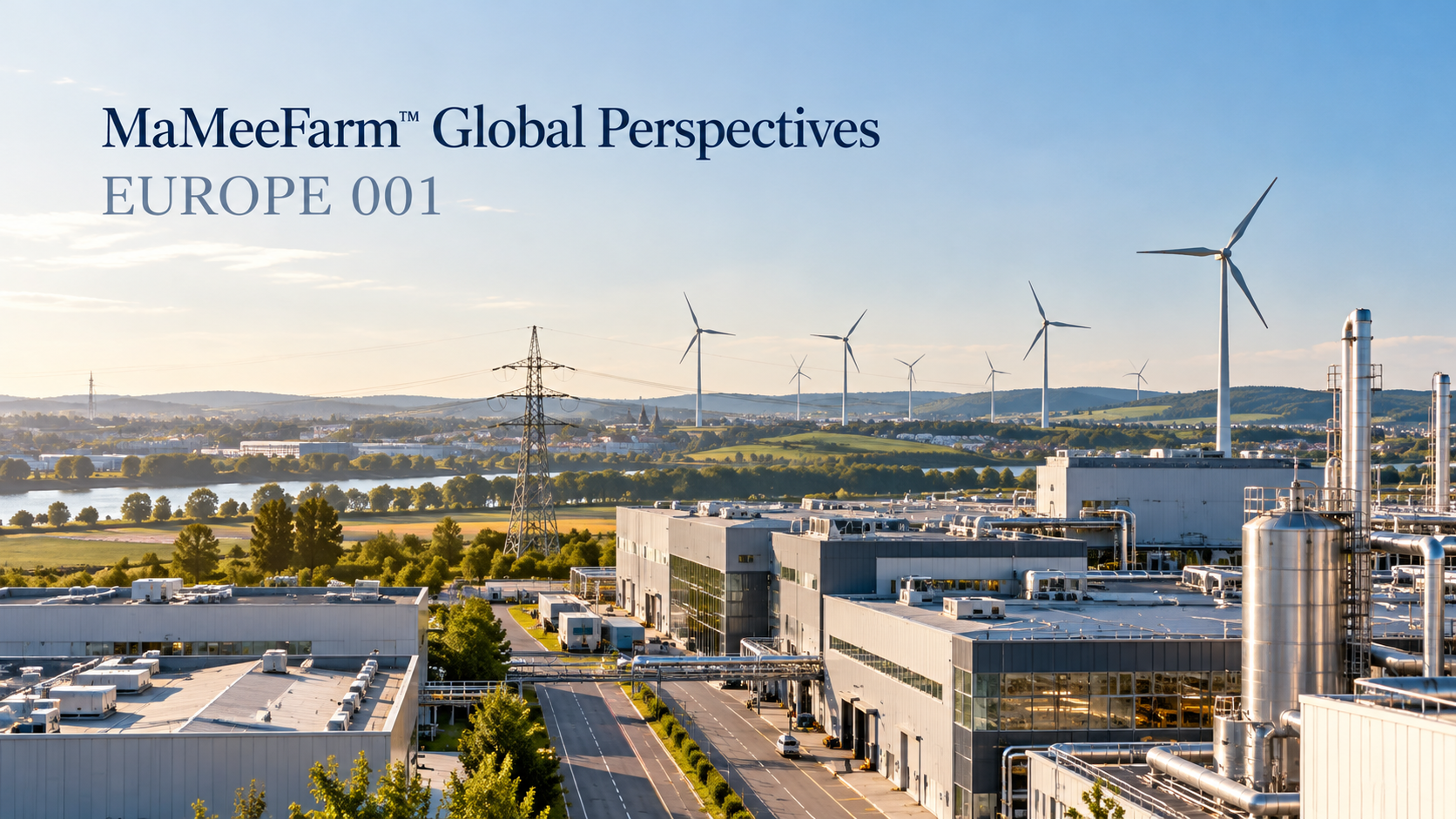
Editorial illustration of wind turbines, electricity transmission lines and manufacturing facilities representing Germany's industrial energy transition.
Editorial illustration · EUROPE 001 · Germany

MaMeeFarm™ Global Perspectives | EUROPE 001

Publication Date: 24 October 2026
Country: Germany
Geographic Classification: Europe / Germany

Energy as an Industrial Foundation

Germany's energy transition is reshaping one of Europe's most important manufacturing economies. The expansion of renewable electricity, changes in energy supply and growing requirements for industrial decarbonisation are taking place alongside persistent concerns about production costs and international competitiveness.

For Germany, energy is not simply a utility service. It is an essential input for chemical manufacturing, metals processing, automotive production, machinery and numerous intermediate industries.

The reliability, affordability and availability of energy influence the conditions under which these businesses operate.

Germany's experience therefore raises an important industrial question: how can an economy transform its energy system while maintaining the productive capabilities on which its manufacturing base depends?

The available evidence demonstrates substantial progress in renewable electricity generation. It also shows that energy affordability, infrastructure investment and industrial adaptation remain significant challenges.

These developments are connected, but they should not be treated as equivalent measures of success.

The Changing Electricity System

Germany has substantially increased the role of renewable energy in electricity generation.

According to the Federal Network Agency, electricity generated and fed into Germany's general supply network amounted to 437.6 terawatt-hours (TWh) in 2025. Renewable sources accounted for 257.5 TWh, representing 58.8% of that generation.

Wind remained the largest individual electricity source, while solar generation increased compared with the preceding year. Solar electricity fed into the general supply network reached 74.1 TWh, compared with 63.2 TWh in 2024.

These figures establish the scale of renewable electricity within Germany's general supply network.

They do not represent the entire national energy system. Electricity generation is different from total energy consumption, which also includes fuels used in industrial processes, transportation and heating.

Nor does the renewable electricity share directly establish the prices paid by industrial consumers.

Manufacturing businesses may face electricity costs influenced by procurement contracts, network charges, taxes, consumption patterns and market conditions.

The growth of renewable generation is therefore an important industrial development, but it is not sufficient evidence that manufacturing energy costs have become internationally competitive.

The Federal Statistical Office publishes a separate electricity-generation series with somewhat different results. The figures presented here consistently follow the Federal Network Agency's SMARD reporting basis.

Industrial Costs and Manufacturing Competitiveness

Germany's industrial economy includes activities that depend on continuous and substantial energy consumption.

Chemical producers require energy for industrial processes and feedstocks. Metals manufacturers depend on electricity and thermal energy. Machinery and automotive manufacturers are also affected by the energy costs embedded in components, materials and supplier operations.

Energy affordability consequently matters both directly and through the wider production network.

The International Energy Agency's 2025 review of Germany identified affordable electrification, improved electricity-system operation and stable investment conditions as important considerations for the country's energy transition.

The review also examined Germany's changing energy structure, including its withdrawal from nuclear power and efforts to reduce dependence on Russian natural gas.

These developments have increased the importance of flexible electricity systems, reliable infrastructure and alternative industrial energy inputs.

However, manufacturing competitiveness cannot be attributed to energy prices alone.

International demand, labour availability, productivity, technological capabilities, financing conditions and trade relationships also influence industrial performance.

Energy costs represent one important part of this broader environment.

The Industrial Electricity Policy Response

Germany's industrial electricity costs have become a specific subject of European policy intervention.

On 16 April 2026, the European Commission approved a German state-aid scheme providing temporary electricity-price relief for energy-intensive companies.

The approved German scheme has a budget of €3.8 billion and operates under the Clean Industrial Deal State Aid Framework adopted in June 2025.

The framework requires beneficiaries to reinvest a significant share of the assistance received in decarbonisation measures.

This connects temporary industrial cost relief with longer-term changes in energy consumption and production technology.

The policy has two distinct purposes.

The first is to reduce electricity-related financial pressure on eligible industrial businesses.

The second is to encourage investment that supports the transition towards lower-emission industrial activity.

The Commission's approval establishes that the notified scheme satisfies the applicable European state-aid requirements.

It does not demonstrate that every eligible company has received assistance or that industrial competitiveness has already improved.

The economic effects depend on implementation, investment decisions and actual operating performance.

Temporary financial assistance can address part of the cost environment. It cannot independently resolve every constraint associated with electricity networks, energy supply or industrial technology.

Resources and Infrastructure

Industrial energy transitions depend on physical infrastructure.

Electricity generation facilities require networks capable of transmitting power to consumers. Industrial facilities require suitable connections, reliable equipment and predictable supply conditions.

As renewable generation expands, the electricity system must accommodate variations in output from wind and solar resources.

Network development, electricity storage, flexible consumption, interconnection and dispatchable generation can help maintain the balance between supply and demand.

For manufacturers, the relevant issue is not merely whether electricity is produced nationally.

It is whether adequate electricity can be delivered to industrial facilities under commercially and operationally acceptable conditions.

Germany's energy transition also involves the development of hydrogen-related infrastructure.

Low-emissions hydrogen may have applications in industrial processes where direct electrification is difficult.

The International Energy Agency has identified hydrogen as an important component of Germany's energy strategy. However, its 2025 review also reported that final investment decisions were lagging because of concerns about supply, affordability and insufficient commitments from prospective buyers.

This distinction matters for industrial investment.

A hydrogen strategy establishes policy direction. It does not prove that sufficient commercially viable hydrogen production and distribution capacity is already operating.

Industrial transformation requires supporting infrastructure to move from planning and investment into dependable commercial service.

People and Industrial Capability

The energy transition also changes the technical requirements placed on Germany's industrial workforce.

Manufacturers adopting electric production technologies, energy-management systems and alternative industrial processes require employees with appropriate engineering and operational expertise.

Some existing skills remain applicable, while other activities require additional training.

Industrial electricians, maintenance specialists, process engineers, automation professionals and technical managers may encounter new equipment and operating requirements.

These changes affect both energy producers and businesses that consume energy.

The implications are not limited to employment in renewable electricity generation.

They extend into established manufacturing sectors where employees must operate, maintain and improve increasingly complex industrial systems.

The available electricity-generation statistics do not establish the number of jobs created or displaced by these changes.

Workforce outcomes require separate evidence from employment, education, training and industrial operating data.

Nevertheless, new energy technologies create practical requirements for people and institutions capable of operating them reliably.

For workers, this may mean new technical specialisations and opportunities for professional development.

For industrial employers, maintaining operational expertise while adopting new technologies remains an important consideration.

Economic Opportunities and Industrial Investment

Germany's transition creates areas of potential commercial demand across the energy and manufacturing economy.

Electricity-network expansion requires transformers, cables, control equipment, engineering and construction services.

Industrial electrification may require new machinery, power-management equipment and modifications to production facilities.

Manufacturers seeking greater energy efficiency may invest in monitoring systems, automation and process improvements.

Hydrogen-related projects may create demand for specialised equipment and infrastructure where technical feasibility and commercial conditions support implementation.

These activities can involve both German manufacturers and international suppliers.

They also create opportunities for technical partnerships between industrial companies, energy providers, equipment manufacturers and engineering organisations.

However, potential demand should not be confused with guaranteed commercial returns.

Projects must still demonstrate financial viability, operational performance and the ability to serve identifiable customers.

The scale of Germany's industrial economy makes these developments internationally relevant, but the commercial outcomes of individual investments remain dependent on their specific circumstances.

Germany's Position Within European Industry

Germany operates within interconnected European energy and industrial markets.

Its manufacturers purchase materials and components from international suppliers while serving customers across Europe and other regions.

Changes in German production costs, industrial investment and energy infrastructure can therefore affect commercial relationships beyond the country's borders.

European electricity interconnections also create relationships between national energy systems.

Cross-border electricity trading can contribute to system flexibility, although it does not remove the need for adequate domestic networks and dependable local supply.

The European Union's state-aid framework introduces another regional dimension.

National industrial-support measures operate within rules intended to preserve competition while allowing certain forms of assistance for industrial decarbonisation.

Germany's transition therefore reflects the interaction between national manufacturing priorities and European energy, industrial and competition policies.

The experience is relevant to other manufacturing economies, although differences in industrial structure, energy resources and infrastructure mean that Germany's circumstances cannot simply be reproduced elsewhere.

Measuring Industrial Outcomes

Germany's energy transition has produced measurable changes in electricity generation, while industrial outcomes remain more complex.

Renewable electricity accounted for 58.8% of generation fed into the general supply network in 2025, according to the Federal Network Agency.

European institutions have approved temporary measures intended to relieve electricity costs for energy-intensive industries.

The International Energy Agency has identified infrastructure, affordability and investment conditions as important elements of Germany's continuing transition.

These developments establish progress and policy direction.

They do not establish that Germany's industrial transformation has been completed.

Electricity-generation statistics measure energy supply. Financial-support decisions describe policy intervention. Industrial production, investment, operating costs and business performance measure different outcomes.

An increase in renewable electricity generation does not automatically demonstrate lower industrial production costs.

The availability of industrial subsidies does not establish improved productivity.

The announcement of infrastructure investment does not confirm operational delivery.

Germany's industrial transition will be better understood through evidence of how energy-system changes affect actual manufacturing operations over time.

Global Perspective

Germany's experience illustrates a broader economic reality: transforming an energy system and sustaining an industrial economy are interconnected but distinct objectives.

The expansion of renewable electricity is a measurable achievement. Its industrial significance depends on whether businesses can obtain the energy they require under reliable and economically sustainable conditions.

For people, the transition involves workforce skills, technical adaptation and the continuity of industrial expertise.

For the economy, it concerns production costs, capital investment and the competitiveness of established manufacturing sectors.

For resources, it requires electricity networks, generation facilities, industrial equipment and supporting energy infrastructure.

For business, it creates demand for new technologies and services while requiring careful assessment of investment costs and commercial viability.

Germany's transition is not solely a question of how electricity is generated.

It is also a question of how energy infrastructure supports the productive capacity of an advanced industrial economy.

The evidence demonstrates significant progress in renewable electricity generation and continuing policy efforts to address industrial costs.

Whether these developments result in sustained improvements in manufacturing competitiveness remains a matter for further observation.

The wider significance extends beyond Germany. As manufacturing economies change their energy systems, industrial performance will depend not only on how energy is produced, but also on whether businesses can use it reliably, affordably and productively.

People • Economy • Resources • Opportunities


References

  1. Bundesnetzagentur. Bundesnetzagentur Publishes 2025 Electricity Market Data. 5 January 2026.
    https://www.bundesnetzagentur.de/SharedDocs/Pressemitteilungen/EN/2026/20260104_SMARD.html
  2. Bundesnetzagentur, SMARD. The Electricity Market in 2025. 5 January 2026.
    https://www.smard.de/page/en/topic-article/217400/219038
  3. International Energy Agency. Germany 2025: Energy Policy Review. 7 April 2025.
    https://www.iea.org/reports/germany-2025
  4. European Commission. Commission Approves Bulgarian, German and Slovenian State Aid Schemes Providing Temporary Electricity Price Relief for Energy-Intensive Companies. 16 April 2026.
    https://europa.eu/newsroom/ecpc-failover/pdf/ip-26-815_en.pdf
  5. European Commission. State Aid SA.120495: Germany, Temporary Electricity Relief for Energy-Intensive Users. Decision of 16 April 2026.
    https://ec.europa.eu/competition/state_aid/cases1/202618/SA_120495_40.pdf
  6. Federal Statistical Office of Germany (Destatis). Electricity Generation from Photovoltaics and Natural Gas Reached New Highs in 2025. 6 March 2026.
    https://www.destatis.de/DE/Presse/Pressemitteilungen/2026/03/PD26_073_43312.html

Rights Holder: P’Toh
Position: System Architect
Framework: DGCP™

License

DGCP | MMFARM-POL-2025

This work is licensed under the DGCP (Data Governance & Continuous Proof) framework.

All content is part of the MaMeeFarm™ Real-Work Data & Philosophy archive.

Redistribution, citation, or derivative use must preserve attribution and license reference.

Back to Europe ↑

MaMeeFarm™ Global Perspectives · EUROPE 002

Romania's Critical Materials Transition: From Battery Waste to Industrial Resources

Editorial illustration of battery assemblies, workers and industrial recycling equipment representing Romania's transition from battery waste to industrial resources.
Editorial illustration · EUROPE 002 · Romania

MaMeeFarm™ Global Perspectives | EUROPE 002

Editorial Production Date: 27 October 2026
Country: Romania
Geographic Classification: Europe / Romania

A Different Starting Point for Industrial Development

Industrial development is frequently associated with new mines, factories and manufacturing equipment. Yet an increasingly important part of industrial supply involves recovering materials that have already passed through the economy.

Batteries, electronic equipment and industrial products contain materials that may remain economically useful after the original product reaches the end of its life.

Recovering those materials requires more than collecting waste. Businesses must identify, sort, process and refine used products into inputs that manufacturers can use again.

Romania's participation in a new European critical raw materials initiative offers an example of this wider industrial challenge.

On 9 October 2026, the European Commission selected 46 new Strategic Projects under the Critical Raw Materials Act across 16 European Union member states.

Two of the newly selected projects are located in Romania.

One concerns battery recycling in Răcari, Dâmbovița County. The other concerns magnesium processing.

Together, they illustrate two different routes towards greater industrial capability: recovering materials from existing products and processing materials for industrial use.

Their selection is a significant policy development. It does not establish that the projects have completed construction, secured all financing or achieved commercial production.

Europe's New Strategic Project Selection

The European Union adopted its Critical Raw Materials Act in 2024 to address vulnerabilities in the supply of materials important to manufacturing, energy technologies, digital systems, defence and other industries.

The legislation establishes benchmarks for European extraction, processing and recycling capacity.

By 2030, the EU aims to develop capacity equivalent to at least 10% of its annual consumption for extraction, 40% for processing and 25% for recycling of strategic raw materials.

These are capacity benchmarks rather than guarantees that the corresponding share of actual consumption will be supplied domestically.

The Act also seeks to reduce excessive dependence on individual suppliers outside the European Union.

On 9 October 2026, the European Commission selected 46 additional Strategic Projects across 16 member states.

The selection followed the designation of 47 projects within the European Union in March 2025.

The 2026 selection brought the number of EU-based Strategic Projects to 93. Together with 13 projects previously designated outside the EU, the Commission's overall portfolio reached 106.

Strategic Project status is intended to facilitate implementation through administrative coordination, permitting procedures and access to financing opportunities.

It does not automatically award a grant or guarantee that the necessary capital has been secured.

Developers remain responsible for meeting technical, commercial and environmental requirements.

The designation recognises the projects' potential contribution to European supply security. Their practical contribution depends on implementation.

Battery Recycling in Răcari

One of Romania's newly recognised projects is formally identified as Establishment of electric battery recycling capacity, Racari city, Dambovita county.

The project is promoted by ECO LIFE STYLE SRL.

According to the annex to Commission Decision (EU) 2026/2349, it is classified as a recycling project intended to contribute to supplies of cobalt, battery-grade lithium, battery-grade manganese, battery-grade graphite and battery-grade nickel.

These materials are relevant to different stages of battery manufacturing, although their requirements vary by chemistry and application.

Battery recycling involves several industrial activities.

Used batteries must be collected, transported and handled under appropriate safety conditions.

Their composition and condition influence the processes required to recover useful materials.

Dismantling, mechanical treatment and separation may produce material fractions that require further refining.

Chemical processing may then be needed before recovered materials meet specifications for industrial reuse.

Not every recycling facility performs every stage.

A facility that produces intermediate recycled material does not necessarily manufacture battery-grade products itself.

The significance of the Răcari project will depend on the technology installed, the materials processed, recovery performance and the quality of its output.

The European designation identifies the project's intended contribution to critical materials supply.

It does not independently establish future recovery volumes, completed production capacity or commercial profitability.

Recycling as an Industrial Capability

Recycling is often discussed primarily as a waste-management activity.

For critical raw materials, it can also become part of an industrial supply system.

Manufacturers need reliable inputs that meet established technical specifications.

Recycling businesses may contribute to that supply by transforming end-of-life products and industrial scrap into usable materials.

This requires processing infrastructure, laboratories, industrial equipment, technical expertise and dependable relationships with suppliers and customers.

The activity is therefore more complex than the physical collection of discarded products.

Commercial viability depends partly on the availability, composition and cost of recyclable material.

Battery technologies also differ.

The proportions of nickel, cobalt, lithium, iron, phosphate and other materials vary across battery types.

Changes in battery chemistry can influence the value of recoverable materials and the economics of recycling operations.

A recycling business designed around one expected material mix may encounter different market conditions as battery technologies evolve.

Romania's battery-recycling initiative illustrates the potential to develop industrial services connected to European materials supply chains.

Its eventual contribution will depend on usable material recovery and sustained commercial demand.

Magnesium Processing as a Separate Industrial Activity

Romania's second project selected in October 2026 is Verde Magnesium Industries.

The European Commission identifies Verde Magnesium Industries SRL as the promoter and classifies the project as a magnesium-processing activity.

This is distinct from the Răcari battery-recycling project.

It is also distinct from a magnesium-extraction project promoted by Verde Magnesium SRL that appeared in the Commission's earlier 2025 selection.

The distinction matters because extraction and processing represent different industrial activities.

Magnesium is used in metal alloys, manufacturing processes and specialised industrial components.

Processing involves transforming feedstock into products suitable for downstream industrial customers.

Such operations may require specialised equipment, energy, technical controls and reliable logistics.

Their economic contribution depends on whether they can produce material at the quality, volume and cost required by buyers.

The October 2026 designation identifies a processing project, not a newly completed mine.

It does not establish a confirmed annual production volume or prove that commercial operations have begun.

The European decision also does not provide a verified project-level investment value or detailed production timetable.

The project's eventual significance will depend on the facilities developed and their operating performance.

Industrial Investment and Financing

Critical raw materials projects can require substantial capital expenditure.

Recycling facilities may need specialised processing equipment, material-handling systems, environmental protection infrastructure and laboratory capabilities.

Magnesium processing may require different equipment, energy systems and industrial controls.

Commercial performance depends on factors including input costs, electricity prices, recovery efficiency, product quality and customer demand.

Strategic recognition may help developers engage with financing institutions and navigate administrative procedures.

However, designation does not eliminate commercial risk.

Projects still need appropriate capital, technical execution and viable operating arrangements.

Recycling businesses also depend on the availability and composition of material entering their facilities.

Processing businesses may face different risks involving feedstock supply, energy requirements and industrial prices.

Romania's two projects therefore represent different commercial propositions.

It would be misleading to assign them a combined investment value or projected revenue without verified project-specific information.

Their recognition is an important development, but future economic results remain dependent on implementation.

People, Employment and Technical Skills

Industrial recovery and processing activities require specialised capabilities.

Battery recycling can involve engineering, chemical treatment, industrial maintenance, material testing, logistics and occupational safety.

Magnesium processing has its own technical and operational requirements.

These activities can create employment opportunities and demand for technical services.

They may also support education and training related to industrial chemistry, metallurgy, equipment operation and environmental management.

However, the number and quality of jobs ultimately created cannot be determined from Strategic Project designation alone.

Employment depends on project scale, technology, operating conditions and the proportion of work carried out domestically.

Local communities may also have legitimate interests in industrial safety, environmental safeguards, transport impacts and waste handling.

The economic significance of industrial development therefore extends beyond the number of facilities recognised under a policy programme.

It also depends on the conditions experienced by workers and communities.

Environmental Responsibilities

Recycling can reduce demand for some newly extracted materials, but it is not an impact-free activity.

Battery handling and material recovery require appropriate safety controls.

Chemical processes can generate emissions, residues and wastewater that require management.

Actual environmental effects depend on the technology used, operating practices and the materials being processed.

Magnesium processing can also require significant energy and supporting infrastructure.

The environmental benefit of recycling cannot be established merely by describing an activity as circular.

Its performance depends on energy consumption, recovery efficiency, emissions, waste management and the treatment of materials that cannot be recovered.

European environmental requirements remain relevant to Strategic Projects.

Strategic recognition is intended to support secure and sustainable supplies, not to remove environmental responsibilities.

Both Romanian initiatives will need to operate within the applicable regulatory framework.

Romania Within European Supply Chains

Romania's newly recognised projects form part of a broader European effort to develop critical raw materials capacity.

Industrial supply chains frequently involve several countries.

A material may be collected in one location, processed in another and incorporated into a finished product elsewhere.

This creates opportunities for industrial specialisation.

A recycling facility does not need to manufacture finished batteries to contribute to the battery industry.

A magnesium-processing facility does not need to manufacture final machinery to supply industrial customers.

The value of each activity depends on the reliability, specifications and commercial usefulness of its output.

Romania's potential contribution therefore extends beyond its domestic market.

Successful projects could participate in wider European manufacturing supply chains.

However, that participation remains conditional on operating performance, customer relationships and the ability to deliver suitable materials consistently.

European strategic recognition identifies intended contributions rather than completed supply arrangements.

Business Opportunities Beyond the Project Developers

Industrial processing and recycling can create demand for supporting products and services.

Engineering companies may provide facility design and construction services.

Equipment suppliers may provide material-handling systems, separation equipment and industrial controls.

Laboratories may support testing and quality assurance.

Logistics companies may transport specialised materials under applicable safety requirements.

Maintenance providers and environmental service companies may support facilities during operation.

These are potential commercial opportunities rather than confirmed contracts.

Businesses considering participation must evaluate procurement requirements, technical specifications and actual project development schedules.

The existence of a recognised project does not guarantee that a supplier will receive an order.

Commercial opportunities become tangible as developers purchase equipment, build facilities and establish operating relationships.

From Strategic Recognition to Industrial Production

Romania's two new Strategic Projects illustrate the distance that can exist between policy recognition and operating industrial capacity.

The European Commission has recognised the Răcari battery-recycling project and Verde Magnesium Industries as contributors to its critical raw materials strategy.

This is a meaningful step in the development process.

However, their long-term economic significance will depend on financing, construction, regulatory compliance, technical performance and customer demand.

A successful recycling facility must recover usable materials reliably.

A successful processing facility must supply products that industrial customers can use.

Both must operate under commercially sustainable conditions.

The same distinction applies to the European Union's wider critical raw materials strategy.

The number of designated projects demonstrates the scale of the policy initiative.

The actual contribution to European supply security will depend on the capacity that becomes operational and the materials delivered to manufacturers.

Global Perspective

Romania's newly designated critical materials projects illustrate a wider shift in industrial development.

Economic value can emerge not only from extracting resources, but also from recovering materials already circulating in the economy and processing them into products that manufacturers need.

For people, these activities can create demand for technical skills and employment while requiring responsible industrial and environmental management.

For the economy, they offer potential additions to processing capabilities and European manufacturing supply chains.

For resources, battery recycling provides a route for recovering useful materials, while magnesium processing addresses a separate stage of industrial supply.

For business, both activities create potential opportunities in equipment, engineering, testing, logistics and specialised services.

The October 2026 European selection is an important step, but it does not complete the industrial transition.

The lasting contribution will depend on facilities that operate reliably, produce useful materials, meet customer requirements and sustain commercial activity.

Romania's case demonstrates a principle relevant to economies far beyond Europe.

Industrial resilience is not established by identifying valuable materials alone. It depends on the practical capacity to make those materials available to businesses when and where they are required.

People • Economy • Resources • Opportunities


References

  1. European Commission. Commission selects 46 new Strategic Projects to bolster the EU's supply of critical raw materials. 9 October 2026.
    https://luxembourg.representation.ec.europa.eu/actualites-et-evenements/actualites/commission-selects-46-new-strategic-projects-bolster-eus-supply-critical-raw-materials-2026-10-09_en
  2. European Commission. Selected Strategic Projects under the Critical Raw Materials Act. Includes Commission Decision C(2026)8051 and its annex.
    https://single-market-economy.ec.europa.eu/sectors/raw-materials/areas-specific-interest/critical-raw-materials/strategic-projects-under-crma/selected-projects_en
  3. European Commission. Commission Decision (EU) 2026/2349 of 9 October 2026 recognising certain critical raw material projects as Strategic Projects under Regulation (EU) 2024/1252.
    https://eur-lex.europa.eu/eli/dec/2026/2349/oj
  4. European Commission. European Critical Raw Materials Act.
    https://commission.europa.eu/topics/competitiveness/green-deal-industrial-plan/european-critical-raw-materials-act_en
  5. European Parliament and Council of the European Union. Regulation (EU) 2024/1252 establishing a framework for ensuring a secure and sustainable supply of critical raw materials.
    https://eur-lex.europa.eu/eli/reg/2024/1252/oj

Rights Holder: P'Toh
Position: System Architect
Framework: DGCP™
License: DGCP | MMFARM-POL-2025
Back to Europe ↑

MaMeeFarm™ Global Perspectives · EUROPE 003

The UK's Industrial Site Transition: From Investment Potential to Development Readiness

Editorial illustration of an industrial development site, warehouses, construction equipment and electricity infrastructure representing the UK's Strategic Sites Accelerator programme.
Editorial illustration · EUROPE 003 · United Kingdom

MaMeeFarm™ Global Perspectives | EUROPE 003

Editorial Production Date: 2 November 2026
Country: United Kingdom
Geographic Classification: Europe / United Kingdom

When Investment Opportunities Cannot Yet Be Built

Industrial investment requires more than available land.

A promising location may be close to transport networks, established businesses and a skilled workforce. It may attract interest from manufacturers, technology companies or commercial investors.

Yet that location can remain undeveloped when essential conditions are missing.

Electricity connections may be insufficient. Planning requirements may remain unresolved. Infrastructure costs may make a project difficult to finance. Developers may struggle to secure investment until these barriers are addressed.

These conditions create a distinction between an economically promising site and one that is ready for development.

On 2 November 2026, the United Kingdom government announced a new phase of its Strategic Sites Accelerator, a programme intended to help overcome such constraints.

The government announced approximately £700 million in financial support, alongside technical assistance, to help bring forward major industrial and commercial sites.

Its stated ambition is to support six to ten sites and attract up to £2 billion in private investment over time.

These figures describe the programme's planned capacity and objectives.

They do not establish that the targeted sites have already been selected, financed, constructed or occupied.

The initiative raises a broader economic question: how can public institutions help commercially credible investment opportunities overcome the barriers that prevent them from becoming productive assets?

A Programme Designed to Address Development Barriers

The Strategic Sites Accelerator focuses on sites with credible commercial demand but significant obstacles to development.

These obstacles may involve planning requirements, electricity grid connections, infrastructure costs, land assembly or gaps in project financing.

The programme is designed to provide both financial and non-financial assistance.

Its financial instruments may include loans, equity investment and targeted grants.

Technical support may help developers and public authorities assess infrastructure requirements, resolve planning difficulties or improve project readiness.

This combination reflects the different problems that can prevent investment.

A project may have potential customers but lack a commercially viable financing structure.

Another may require technical studies before investors can assess its feasibility.

A third may need coordination among landowners, utility providers and local authorities.

The programme seeks to address such constraints through interventions suited to individual projects.

However, the existence of public support does not mean that every proposed development will qualify.

Official investment principles require credible market demand, evidence that public intervention is necessary, delivery capability and an appropriate investment case.

Understanding the £700 Million Announcement

The programme's headline figures require careful interpretation.

The government announced around £700 million in financial support to help unlock strategic industrial and commercial sites.

This is an announced programme funding envelope, not evidence that the full amount has already been disbursed.

The programme also aims to attract up to £2 billion in private investment.

That figure is an investment ambition, not a measurement of private capital already mobilised.

The government has indicated that successful development could support tens of thousands of jobs directly and through the wider economy over time.

This is a conditional employment expectation.

Actual employment will depend on which projects receive approval, which businesses invest and what operations are eventually established.

Individual investments remain subject to commercial assessment, due diligence and approval.

These distinctions matter because industrial development progresses through several stages.

A programme may be announced before individual projects receive financing.

A site may receive financing before construction begins.

Infrastructure may be completed before businesses occupy a development.

Commercial operations may then require additional time to establish production, employment and revenue.

Each stage represents a different form of progress.

Why Infrastructure Readiness Matters

Large industrial developments depend on several interconnected systems.

Advanced manufacturing facilities may require substantial electricity capacity, reliable transport connections, water supply, wastewater services, telecommunications and specialised buildings.

Science and technology campuses may have different requirements, but they still depend on functioning infrastructure and access to suitable workers.

Some locations already possess part of this infrastructure.

Others require significant investment before construction can proceed.

Electricity grid access can be a particularly important constraint for power-intensive activities.

A developer may identify a viable commercial opportunity while remaining unable to secure the necessary network connection within an acceptable timeframe.

Planning and financing can create similar difficulties.

Delays may increase costs, while uncertainty can reduce investors' willingness to commit capital.

The Strategic Sites Accelerator is intended to help address these barriers.

It does not replace the need for businesses to demonstrate that their proposed activities are commercially sustainable.

Industrial Opportunities Across the United Kingdom

The programme has a national geographic scope.

It is intended to support investment opportunities across the United Kingdom rather than concentrating exclusively on established economic centres.

The government's November announcement identifies early technical engagement with potential sites in Glasgow, Burgess Hill and Sheffield.

It also refers to exploring opportunities in Greater Manchester, West Yorkshire, the West Midlands, South Yorkshire, the Liverpool City Region, the North East, the Glasgow City Region and the Cardiff Capital Region.

These locations represent areas of engagement or potential investment activity.

They should not be interpreted as a final list of approved funding recipients.

Different regions possess different industrial capabilities, infrastructure conditions and commercial opportunities.

A location suitable for advanced manufacturing may not meet the requirements of a digital infrastructure facility.

A science park may need specialised buildings and research connections that differ from those required by a logistics or manufacturing site.

Successful development depends on matching the characteristics of a location with credible commercial demand.

The programme's national scope creates the possibility of supporting investment across different regional economies, but actual outcomes will depend on project selection and implementation.

The Role of Local Government

Industrial developments operate within wider regional communities.

They depend on transport systems, housing markets, workers and public services beyond the boundaries of an individual site.

Local governments may influence planning, economic development coordination and supporting infrastructure.

The UK government's announcement emphasises cooperation with mayors and local leaders.

This reflects the importance of understanding the specific barriers affecting individual locations.

Local authorities may have information about infrastructure limitations, development history and the needs of surrounding communities.

They may also help coordinate developers, utility providers, transport organisations and other institutions.

However, local institutional support does not remove the requirement for commercial viability.

A programme cannot be evaluated solely by the number of public authorities participating.

Its effectiveness will depend on whether cooperation helps sites progress toward productive economic activity.

Public Finance and Private Capital

The Strategic Sites Accelerator combines public financing with private-sector development expertise.

The programme is jointly delivered through the Office for Investment and the National Wealth Fund.

CBRE has been appointed as the National Delivery Partner.

The delivery structure is intended to bring together financing, commercial assessment and technical support.

Its central proposition is that selective public intervention may help overcome barriers affecting developments that have credible market demand.

This does not mean that public finance is intended to replace private capital entirely.

The programme's investment principles require a credible route to obtaining the majority of project funding from the market.

They also emphasise additionality, meaning that public intervention should address a constraint that would otherwise prevent or delay development.

Projects must demonstrate strategic alignment, economic benefit and value for money.

Public investment decisions therefore require consideration of commercial risks, financial structures and potential wider economic outcomes.

The objective is to improve development readiness where specific barriers prevent viable projects from progressing.

People and the Conditions for Employment

Industrial development is often discussed through employment projections.

New facilities may create direct jobs in manufacturing, research, technology and business services.

Construction and infrastructure projects may also create temporary employment during development.

Additional economic activity may emerge through suppliers and supporting businesses.

However, these categories should not be combined without distinction.

A projection of future employment is not evidence that jobs have already been created.

Construction employment is different from permanent operational employment.

The number and type of jobs will depend on the industries that eventually occupy each site.

Workforce capabilities also matter.

Advanced manufacturing and technology developments may require engineers, technicians, researchers and other specialised workers.

Physical infrastructure alone cannot guarantee that these positions will be filled.

Employment outcomes also depend on education, training, transport access and the ability of businesses to sustain their operations.

The economic contribution of industrial development therefore extends beyond the construction of buildings.

Resources and Industrial Capacity

Industrial investment requires the coordination of multiple resources.

Land is only one component.

Electricity capacity, water services, transport access, construction materials, skilled labour and financing are also necessary.

A location may be geographically attractive while remaining constrained by one critical resource.

Resolving that constraint can improve its development prospects.

However, public finance and infrastructure capacity are limited.

Different projects may compete for grid connections, technical expertise, investment funding and other resources.

This makes site selection an economic and governance decision.

A credible assessment should consider whether the proposed activity can operate sustainably, whether supporting infrastructure can be delivered and whether the expected benefits justify the resources required.

Environmental and planning obligations remain part of that assessment.

Improving development readiness involves making essential resources available in a coordinated and commercially credible way.

Opportunities for Businesses and Regional Economies

If successfully implemented, the Strategic Sites Accelerator may create opportunities across several industries.

Developers may be able to advance projects that previously faced financing or infrastructure constraints.

Engineering and construction businesses may compete for future site-development work.

Utilities and technical service providers may support electricity connections, infrastructure planning and site preparation.

Manufacturers and technology companies may gain access to locations better suited to their operating requirements.

Regional suppliers may benefit if new businesses establish sustained commercial activity.

These are potential channels of economic opportunity.

They are not confirmed contracts or guaranteed revenue.

No individual company can be assumed to receive support simply because it operates within a relevant sector or region.

Commercial outcomes will depend on approved projects, procurement decisions, private investment and eventual operations.

The programme's value will need to be demonstrated through productive activity rather than announcements alone.

From Programme Announcement to Measurable Results

The November 2026 announcement establishes a basis for assessing future implementation.

Subsequent reporting should distinguish between sites considered and sites formally selected.

Financial approvals should be separated from the overall announced funding envelope.

Technical assistance should be distinguished from construction activity.

Construction starts should be distinguished from completed infrastructure.

Completed developments should be distinguished from facilities that have attracted tenants and begun commercial operations.

Private investment should be assessed through substantiated commitments and expenditure.

Employment outcomes should be evaluated using observed jobs rather than initial projections.

These distinctions are important for public accountability.

A programme designed to remove development barriers must ultimately demonstrate whether those barriers were addressed and whether commercially useful activity followed.

The relevant evidence will emerge through individual project decisions and subsequent operating outcomes.

Global Perspective

The United Kingdom's Strategic Sites Accelerator illustrates a development challenge shared by many economies.

Industrial potential does not automatically translate into investment.

Businesses need locations where infrastructure, planning conditions, financing and market demand can operate together.

For people, successful projects may create employment and skills opportunities, although their scale and timing remain uncertain.

For the economy, the objective is to make commercially credible investment locations more capable of attracting productive businesses.

For resources, the challenge concerns the allocation and coordination of land, electricity, infrastructure, capital and technical capacity.

For opportunities, the programme may support new industrial projects and related services, subject to selection, approval and commercial demand.

The initiative's economic significance cannot be measured through its announced funding envelope alone.

It will need to be assessed through sites that progress, private investment that is actually mobilised, infrastructure that becomes operational and economic activity that can be sustained.

The broader lesson extends beyond the United Kingdom.

Development readiness is an economic capability in its own right.

Turning investment potential into productive capacity requires more than identifying promising locations.

It requires resolving the practical constraints that prevent those locations from becoming functioning centres of economic activity.

People • Economy • Resources • Opportunities


References

  1. UK Government. Mayors and local leaders work with No10 North to drive search for 'top 10' biggest strategic investment sites across country. Department for Business, Innovation, Science and Trade. 2 November 2026.
    https://www.gov.uk/government/news/mayors-and-local-leaders-work-with-no10-north-to-drive-search-for-top-10-biggest-strategic-investment-sites-across-country
  2. UK Government. Strategic Sites Accelerator. Official programme information, delivery structure and investment principles.
    https://www.business.gov.uk/campaign/strategic-sites-accelerator/

Rights Holder: P'Toh
Position: System Architect
Framework: DGCP™
License: DGCP | MMFARM-POL-2025
Back to Europe ↑

Africa

Countries

MaMeeFarm™ Global Perspectives · AFRICA 001

Zambia's Copper Transition: From Mineral Extraction to Industrial Value Creation

Editorial photograph of a copper mining and processing landscape in Zambia, illustrating the transition from extraction to industrial value creation.
Editorial cover · AFRICA 001 · Zambia

Beyond the Extraction Economy

Zambia occupies an important position in the international copper economy. Its mineral resources contribute to global manufacturing supply chains, particularly those serving electrical equipment, electricity networks, transport systems and industrial infrastructure.

Yet the economic significance of copper extends beyond the extraction and export of the metal.

The ability to process minerals, manufacture intermediate products, develop local suppliers and support skilled employment influences how much industrial activity can be built around a natural resource.

This distinction is becoming increasingly important for Zambia.

On 16 October 2026, the World Bank Group announced country-led metals and minerals partnerships and compacts involving eight countries, including Zambia.

Zambia's compact seeks to connect expanded copper production with domestic value creation through stronger governance, energy and transport infrastructure, geological information, skills development and local business participation.

The announcement represents a significant development in the country's industrial policy direction.

It does not establish that the proposed investments, infrastructure or manufacturing activities have already been completed.

The broader economic question is whether Zambia can translate its established mineral position into a more diversified and productive industrial economy.

Copper and the Global Industrial System

Copper is widely used because of its electrical conductivity, thermal properties and suitability for industrial applications.

Electricity transmission and distribution networks, motors, transformers, industrial machinery and electrical systems all depend on copper-containing components.

Its importance therefore extends across established industries and emerging energy technologies.

Zambia's copper sector connects the country's domestic economy with international demand for these products.

According to Zambia's Ministry of Mines and Minerals Development, the country produced approximately 820,676 metric tonnes of copper in 2024, an increase of 12% compared with 2023.

This production demonstrates the scale of Zambia's established mining industry.

However, mineral output does not describe the full economic contribution of the sector.

The location of refining, manufacturing, technical services and product development also matters.

A country can produce substantial quantities of mineral inputs while purchasing manufactured goods containing those same resources.

For Zambia, expanding copper production presents an opportunity to strengthen its existing position in international supply chains.

Developing additional industrial activities around copper could create further opportunities for domestic enterprises, skilled workers and supporting industries.

The economic challenge is therefore not simply to extract more copper. It is to establish additional activities that can operate competitively within the domestic economy.

A New Framework for Mineral Development

Zambia's October 2026 minerals compact places domestic value creation alongside the expansion of copper production.

The framework identifies stronger governance, expanded energy and transport infrastructure, improved geological information and licensing, workforce development and local business linkages as priorities.

These areas are closely connected to the practical requirements of mineral-based industrial development.

Mining companies depend on electricity, transportation, equipment, skilled workers and reliable institutions.

Processing and manufacturing activities introduce further requirements, including quality control, machinery, technical standards and access to customers.

Zambia's national copper strategy targets annual production of three million metric tonnes by 2031.

The strategy, launched in 2024, includes measures intended to encourage exploration, expand production, improve regulation, strengthen technical capacity and support mineral processing and industrial value addition.

The International Energy Agency's policy database identifies these priorities as part of Zambia's existing national strategy.

The October 2026 compact therefore reinforces an established policy direction rather than introducing the country's copper ambitions for the first time.

Its significance lies in connecting production expansion with the wider conditions required for industrial development.

The three-million-tonne target remains a policy objective. It should not be interpreted as an achieved production level or a guaranteed future outcome.

The Difference Between Mineral Wealth and Industrial Capability

Natural resources provide economic opportunities, but they do not automatically create diversified industrial systems.

Copper extraction requires substantial capital, specialised equipment and technical expertise.

Further processing and manufacturing require additional capabilities.

Copper can be transformed into products such as rods, wires, cables, tubes, connectors and components used in electrical machinery.

These products involve different manufacturing processes, investment requirements and customer relationships.

World Bank research on Zambia's energy transition minerals has identified opportunities for developing additional copper-related processing and manufacturing activities, including products used in electrical equipment.

Zambia already possesses some relevant industrial capabilities. The opportunity is to expand commercially viable activities rather than assume that all downstream manufacturing must begin from nothing.

Manufacturing competitiveness depends on reliable inputs, energy costs, technical quality, transport access, production scale and the ability to serve identifiable markets.

The existence of copper deposits does not remove these requirements.

A domestic manufacturer must still compete on price, reliability, product specifications and delivery performance.

For Zambia, the development of additional industrial capability could support a broader range of productive businesses.

However, the economic value of such development will depend on actual production, commercial demand and sustained operating performance.

Energy as an Industrial Constraint

Electricity is essential to Zambia's mining and industrial development.

Mining operations require energy for extraction, processing, ventilation, pumping and associated infrastructure.

Further mineral processing and manufacturing can increase the importance of dependable electricity supply.

Zambia has experienced electricity constraints associated with drought and its substantial dependence on hydropower.

The country's 2024 energy crisis demonstrated the vulnerability of electricity systems exposed to changing water availability.

These conditions affect more than electricity generation.

Industrial facilities depend on reliable power to operate equipment, maintain production schedules and meet customer requirements.

On 23 July 2026, the World Bank Group announced support for the Zambia–Malawi Interconnector Project.

A US$43 million International Development Association grant will support approximately 47 kilometres of transmission infrastructure in Zambia as part of a wider 192-kilometre, 400-kilovolt cross-border electricity corridor.

The project is intended to strengthen electricity security, diversify supply sources and support regional electricity trade.

It may also improve conditions for businesses that depend on reliable electricity.

However, approved financing and planned construction are not equivalent to an operational electricity connection.

The project's contribution will depend on implementation, commissioning and integration with the wider regional power system.

For Zambia's copper industry, electricity infrastructure is not separate from industrial development.

It is one of the conditions influencing whether expanded mineral production and downstream manufacturing can operate reliably.

People and the Development of Technical Skills

Mineral-based industrial development has important implications for employment and technical education.

Mining, refining and manufacturing require different combinations of skills.

Geologists, mining engineers and equipment operators support resource extraction.

Metallurgical specialists, electrical engineers, maintenance technicians and manufacturing workers support processing and downstream production.

Additional activity in transport, industrial services and equipment supply can create demand for further occupational capabilities.

Zambia's October minerals compact explicitly includes skills development and local business linkages.

This is significant because expanding production does not necessarily translate into broad-based employment growth.

Capital-intensive mining operations may generate substantial output without creating employment in proportion to the value of production.

The potential employment benefits of mineral development therefore depend partly on the range of activities established around extraction.

Supplier development, technical services and manufacturing can provide additional channels for economic participation.

For educational institutions, these developments may create demand for technical training aligned with industrial requirements.

For workers, they may expand opportunities in specialised manufacturing, engineering, maintenance and logistics.

However, the scale of future employment cannot be established from the announcement of a minerals compact.

Actual workforce outcomes require evidence from operational businesses, training programmes and employment data.

Resources, Infrastructure and Industrial Geography

Copper is a physical resource, but its industrial value depends on the systems connecting extraction, production and markets.

Transport networks influence the cost and reliability of moving minerals, intermediate products and manufactured goods.

Electricity systems determine whether industrial facilities can operate consistently.

Water infrastructure, technical equipment and logistics services also affect production conditions.

For a landlocked country such as Zambia, access to regional transport corridors is particularly important.

Mining and manufacturing businesses must connect domestic production locations with regional and international customers.

The quality of these connections influences delivery times, operating costs and commercial reliability.

World Bank research has identified infrastructure investment and stronger conditions for private-sector participation as important to Zambia's mineral development.

These requirements demonstrate why industrial opportunities cannot be assessed solely through mineral reserves or production targets.

A resource can be commercially valuable while infrastructure constraints limit the activities that can develop around it.

Improving supporting systems may create opportunities for mining companies and businesses operating in transport, electricity, engineering, construction and industrial services.

The benefits of infrastructure investment, however, depend on projects reaching dependable operational service.

Opportunities for Domestic and International Business

Zambia's mineral development agenda creates potential areas of commercial activity across several sectors.

Mining expansion can generate demand for equipment, engineering, maintenance and technical services.

Processing and downstream manufacturing may create opportunities for industrial machinery, quality-control systems and specialised production inputs.

Energy infrastructure development can involve electricity equipment, transmission engineering and construction services.

Transport improvements can support logistics providers and businesses serving industrial supply chains.

The development of local suppliers may also enable Zambian enterprises to participate in activities previously sourced from international providers.

For international businesses, Zambia's industrial development may create opportunities for equipment supply, technical partnerships, specialised services and investment in selected manufacturing activities.

For domestic enterprises, stronger supplier relationships could create additional channels for participating in the country's mineral economy.

These opportunities are not guaranteed commercial outcomes.

The ability of businesses to participate depends on financing, technical capability, regulatory conditions, market access and customer requirements.

The October 2026 compact identifies a framework for addressing some of these constraints.

Its success will need to be assessed through actual investment, operating capacity and the performance of participating enterprises.

Zambia Within African and Global Value Chains

Zambia's copper industry operates within international production networks.

Copper produced in one economy may be refined, processed or incorporated into manufactured goods elsewhere.

This geographic separation reflects differences in infrastructure, industrial capabilities, capital availability and market relationships.

Developing additional processing and manufacturing activities within Zambia could expand the country's participation in these networks.

Regional energy and transport connections may also support greater industrial integration with neighbouring economies.

The Zambia–Malawi electricity interconnector is one example of infrastructure intended to strengthen cross-border energy connectivity.

Such connections can support economic activity by improving access to regional resources and markets.

Nevertheless, regional cooperation does not automatically create competitive industrial production.

Commercial integration requires functioning infrastructure, dependable institutions, capable businesses and sustained customer demand.

Zambia's mineral resources establish a significant starting position.

The broader economic opportunity depends on the industrial capabilities developed around those resources.

This distinction is relevant across Africa and other resource-producing regions seeking to expand participation in international manufacturing.

From Policy Commitments to Measurable Outcomes

Zambia's current development agenda includes clear ambitions.

The country aims to increase copper production, expand domestic value addition, strengthen infrastructure and improve economic opportunities.

The available evidence supports the existence of these policy commitments and identifies specific areas of planned investment.

It does not establish that all intended results have been achieved.

Production targets are different from actual output.

Infrastructure financing is different from completed construction.

Industrial policy commitments are different from operating businesses.

Employment objectives are different from verified jobs.

These distinctions are important for understanding Zambia's present stage of industrial development.

Progress will become clearer through operational capacity, completed infrastructure, functioning suppliers, commercially viable manufacturing and measurable employment outcomes.

The central issue is whether the expansion of mineral activity can support a broader and more sustainable industrial economy.

Global Perspective

Zambia's copper transition illustrates a wider economic question facing resource-rich economies.

The presence of valuable mineral resources creates economic possibilities, but the distribution of industrial value depends on the activities that can be developed around those resources.

For people, the implications concern employment, technical skills and participation in industrial activity.

For the economy, they concern diversification, investment and the development of additional productive sectors.

For resources, they concern the relationship between mineral deposits, energy systems, transport infrastructure and manufacturing inputs.

For business, they concern opportunities in processing, equipment, engineering, logistics and domestic supply chains.

Zambia's October 2026 minerals compact provides a recent policy framework connecting these priorities.

Its significance lies in recognising that expanding mineral production and building industrial capability are related but different objectives.

The country has substantial copper resources and established mining operations. The development of a broader manufacturing and services economy around those resources remains an ongoing task.

The global relevance of Zambia's transition is therefore not limited to copper supply.

It concerns the conditions under which natural resources can support lasting industrial development, wider economic participation and stronger positions within international value chains.

People • Economy • Resources • Opportunities

Rights Holder: P’Toh
Position: System Architect
Framework: DGCP™

License

DGCP | MMFARM-POL-2025

This work is licensed under the DGCP (Data Governance & Continuous Proof) framework.

All content is part of the MaMeeFarm™ Real-Work Data & Philosophy archive.

Redistribution, citation, or derivative use must preserve attribution and license reference.

Back to Africa ↑

MaMeeFarm™ Global Perspectives · AFRICA 002

Cameroon's Trade Finance Transition: Connecting Small Businesses to Industrial Production

Editorial illustration of a port, cargo handling, warehouse workers and agricultural goods representing Cameroon's trade finance and productive supply chains.
Editorial illustration · AFRICA 002 · Cameroon

MaMeeFarm™ Global Perspectives | AFRICA 002

Editorial Production Date: 28 October 2026
Country: Cameroon
Geographic Classification: Africa / Cameroon

When Industrial Growth Depends on Access to Finance

Industrial development requires more than factories, equipment and natural resources.

Businesses must also be able to purchase production inputs, obtain machinery, arrange shipments and make payments across borders.

These activities often require financing before goods are delivered or revenue is received.

For smaller enterprises, the availability and cost of trade finance can influence whether commercial opportunities become actual transactions.

Cameroon's October 2026 trade finance initiative provides an example of how development finance can support industrial activity through the banking system rather than by directly constructing new factories.

On 21 October 2026, the African Development Bank Group announced the approval of a €40 million trade finance package for AFG Bank Cameroon.

The initiative is intended to help businesses access financing for international trade, with particular emphasis on small and medium-sized enterprises.

It illustrates an important aspect of economic development: productive capacity depends not only on physical investment, but also on financial arrangements that allow businesses to obtain equipment, materials and commercial services.

The October 2026 Financing Decision

The African Development Bank Group's Board of Directors approved the financing package on 21 October 2026.

It comprises two separate instruments.

The first is a trade finance line of credit of up to €30 million, structured over three and a half years with a three-year grace period.

The second is a €10 million transaction guarantee facility extending over five years.

Together, they represent an approved financing framework of €40 million.

The instruments perform different functions.

The credit line is intended to provide financing for eligible trade transactions.

The transaction guarantee facility is designed to support trade operations by addressing specified payment risks faced by participating international confirming banks.

Under the African Development Bank's transaction guarantee mechanism, coverage may extend to 100% of the relevant risk assumed by confirming banks for eligible transactions.

This does not mean that all loans to Cameroonian businesses receive a 100% guarantee.

Nor does it mean that every enterprise automatically qualifies for financing.

Access depends on banking assessments, transaction eligibility, documentation and applicable terms.

The approval establishes a financing commitment and programme structure. It does not establish that the entire €40 million has already been disbursed or utilised.

The distinction is important when assessing the economic significance of the announcement.

Why Trade Finance Matters to Manufacturers

Manufacturing businesses often rely on imported machinery, spare parts and specialised production inputs.

A company may identify a viable commercial opportunity but face difficulty completing a purchase when suppliers require payment before goods arrive.

This challenge can be particularly significant for smaller firms with limited collateral or established international banking relationships.

Trade finance instruments help manage the timing and payment risks associated with international transactions.

A letter of credit, for example, provides a structured payment undertaking subject to specified documentary conditions.

Guarantee arrangements may help participating banks support eligible transactions that would otherwise be difficult to confirm.

These financial services can make it easier for businesses to purchase machinery, equipment and materials from international suppliers.

However, financing is only one requirement for successful industrial activity.

A manufacturer must also operate equipment effectively, maintain product quality, manage costs and secure customers.

An approved trade finance facility does not independently establish that a business has increased production or become profitable.

Its potential contribution lies in addressing a financial constraint that may otherwise prevent a viable commercial transaction from proceeding.

Connecting Agriculture with Industrial Processing

Cameroon's financing initiative identifies agribusiness and agro-industry among its intended areas of support.

Agriculture and industrial processing are connected but distinct economic activities.

Agricultural production generates raw materials.

Processing businesses transform those materials into food products, ingredients, packaged goods and other industrial outputs.

Such transformation requires equipment, energy, transportation, technical expertise and dependable access to inputs.

A smaller agro-industrial enterprise may need machinery that is not manufactured domestically.

It may also require packaging materials, production components or technical supplies from international markets.

Trade finance can help support eligible purchases of these goods.

The potential economic benefit lies in enabling businesses to undertake more production and processing activities within the domestic economy.

However, importing equipment does not automatically create a competitive processing industry.

Product quality, food safety, maintenance, market access and operating costs remain essential to commercial performance.

Cameroon's initiative provides a financial mechanism that could support these activities.

It does not demonstrate that agricultural processing output has already increased as a result of the financing decision.

Small Businesses and Economic Participation

The facility places particular emphasis on small and medium-sized enterprises.

According to the African Development Bank's October 2026 announcement, 50% of the €30 million trade finance line of credit is intended to support SMEs.

Within that SME allocation, 30% is intended for businesses owned by women or young people.

If the allocation targets are applied to the full approved credit line, they correspond to €15 million for SMEs, including €4.5 million for women- or youth-owned businesses.

These amounts describe intended allocations, not verified disbursements to beneficiaries.

The distinction matters because smaller firms often face different financial constraints from large industrial groups.

They may have fewer assets available as collateral, less extensive banking histories or limited access to international counterparties.

Improving access to trade finance can broaden opportunities for participation in international commerce.

However, the distribution of benefits depends on implementation.

A formal allocation target does not guarantee that eligible enterprises will qualify for financing or achieve sustainable growth.

The effectiveness of the initiative will depend on the suitability of financed transactions, the capabilities of participating businesses and the performance of the banking arrangements.

People and Employment

Trade finance can support economic opportunities through several commercial activities.

A manufacturing enterprise importing machinery may require technicians, operators and maintenance specialists.

An agro-industrial business expanding production may increase demand for agricultural inputs, transport and packaging services.

Export-oriented companies may also require logistics, documentation and administrative expertise.

These possibilities connect financial access with employment and technical skills.

The African Development Bank identifies job creation and preservation among the intended development benefits of the facility.

However, no specific number of jobs should be attributed to the programme without verified employment data.

Financing approval alone does not demonstrate that new positions have been created.

Some businesses may use finance to maintain existing operations rather than expand their workforce.

Others may introduce equipment that changes the skills required.

Employment outcomes will depend on the actual activities and operating performance of participating enterprises.

Resources and Productive Capacity

Cameroon's economy contains agricultural, industrial and other resources that can support commercial activity.

The value of these resources depends partly on the systems connecting production with markets.

Businesses require electricity, water, transport, machinery and working capital.

A shortage in one area can limit the benefits of investment in another.

Trade finance may help firms obtain equipment or production inputs, but it cannot replace physical infrastructure.

A manufacturer still depends on reliable electricity and transportation.

An agricultural processor requires suitable raw materials, storage and compliance with product standards.

A business importing machinery must also manage installation, operation and maintenance.

Financial access and physical infrastructure therefore serve complementary functions.

Trade finance can support the acquisition of productive assets, while the benefits of those assets depend on the wider conditions in which businesses operate.

The Role of Banks in International Trade

International trade involves relationships among buyers, suppliers and financial institutions.

A local bank may support an importer's transaction, while an international confirming bank evaluates the payment risks associated with the arrangement.

Even when businesses have agreed on commercial terms, difficulties in arranging acceptable payment instruments can delay or prevent transactions.

Development-bank guarantees are designed to address certain constraints within these banking relationships.

The African Development Bank introduced its transaction guarantee instrument in 2021 to support eligible trade finance operations through participating African financial institutions.

The arrangement with AFG Bank Cameroon extends this approach to a specific banking partner.

Its effectiveness will depend on the bank's ability to support eligible customers and on participation by international confirming banks.

Guarantees facilitate defined risk-sharing arrangements.

They do not eliminate the need for credit assessment, appropriate documentation or responsible financial management.

Business Opportunities and Commercial Limitations

Greater access to trade finance may create opportunities for equipment suppliers, logistics companies, exporters and local manufacturers.

Businesses importing machinery could acquire production technologies that were previously difficult to finance.

Suppliers may benefit when reliable payment arrangements support transactions with Cameroonian customers.

Logistics providers may participate in the movement of machinery, industrial inputs and commercial goods.

Agricultural enterprises may become suppliers to additional processing activities.

These are potential commercial relationships rather than confirmed contracts arising from the October announcement.

The existence of a financing facility does not guarantee demand for a particular product or service.

Market access, pricing, customs procedures, regulatory requirements and customer purchasing power remain important.

The programme also does not mean that €40 million has been allocated directly to factories or industrial construction.

Its purpose is to support eligible trade financing through a participating banking institution.

The economic effects will depend on how the instruments are used and whether supported transactions contribute to viable commercial activity.

From Financial Commitment to Economic Activity

The October 2026 decision establishes a defined financing framework intended to support international trade and productive businesses in Cameroon.

The €30 million credit line and €10 million transaction guarantee facility address different financing needs.

Together, they may help eligible enterprises obtain equipment, materials and goods through international trade arrangements.

However, approval is not the same as utilisation.

The announcement does not provide sufficient evidence to conclude that manufacturing output, export volumes or employment have already increased because of the programme.

Its eventual contribution will depend on actual financing activity, participating businesses and commercial outcomes.

This distinction is important for understanding development finance.

Financial commitments can create opportunities, but lasting economic benefits depend on the productive activities they enable.

Global Perspective

Cameroon's trade finance initiative illustrates how financial infrastructure can influence the development of a productive economy.

Industrial activity is often associated with factories, resources and manufactured goods.

Yet businesses also require dependable mechanisms for financing purchases, managing payment risk and engaging international suppliers.

For people, better access to commercial finance may help smaller enterprises participate in production and trade.

For the economy, it can support transactions that contribute to domestic productive activity and international exchange.

For resources, it can facilitate access to machinery and materials needed to transform agricultural and industrial inputs.

For business, it creates potential opportunities across banking, manufacturing, logistics and supply relationships.

The €40 million facility approved in October 2026 provides a concrete institutional mechanism intended to address these needs.

Its effectiveness remains to be demonstrated through actual financing and commercial outcomes.

The broader significance extends beyond Cameroon.

Economic development requires not only resources and industrial ambition, but also financial systems that enable productive businesses to obtain what they need and deliver value to customers.

People • Economy • Resources • Opportunities


References

  1. African Development Bank Group. Cameroon: African Development Bank Group grants €40 million trade finance facility to AFG Bank Cameroon. 21 October 2026.
    https://www.afdb.org/en/news-and-events/press-releases/cameroon-african-development-bank-group-grants-97726
  2. African Development Bank Group. Transaction Guarantee. Trade finance instrument information.
    https://www.afdb.org/en/topics-and-sectors/initiatives-partnerships/trade-finance-program/transaction-guarantee
  3. African Development Bank Group. Trade Finance Program. Programme information and financial instruments.
    https://www.afdb.org/en/topics-and-sectors/initiatives-partnerships/trade-finance-program

Rights Holder: P'Toh
Position: System Architect
Framework: DGCP™
License: DGCP | MMFARM-POL-2025
Back to Africa ↑

MaMeeFarm™ Global Perspectives · AFRICA 003

Uganda's Energy Transition: From National Access Targets to Deliverable Infrastructure

Editorial illustration of rural electrification in Uganda, with technicians beside a distribution transformer and solar panels near village homes.
Editorial illustration · AFRICA 003 · Uganda

MaMeeFarm™ Global Perspectives | AFRICA 003

Editorial Production Date: 3 November 2026
Country: Uganda
Geographic Classification: Africa / Uganda

When Energy Ambition Becomes an Implementation Challenge

Electricity access is an important measure of economic development, but national access targets do not automatically translate into reliable power for households and businesses.

Electricity must be generated, transmitted and distributed. Consumers need affordable connections, functioning equipment and services that can be maintained over time.

For rural communities, the challenge may involve the distance between existing networks and where people live or work. For businesses, it may involve the availability, reliability and cost of electricity. For households, it also includes access to cleaner cooking technologies and fuels.

Uganda's National Energy Compact addresses these interconnected challenges.

On 28 October 2026, the African Development Bank Group reported the outcomes of the eleventh Africa Energy Market Place, held in Kampala on 21 and 22 October.

During the meeting, the Government of Uganda formally launched its National Energy Compact on 22 October.

Government representatives, development partners, electricity-sector institutions and private investors discussed how national energy targets could be translated into projects, financing arrangements and institutional responsibilities.

The discussions established an implementation agenda.

They did not establish that the planned electricity connections, generation facilities or investments had already been delivered.

Uganda's National Energy Compact

Uganda's National Energy Compact forms part of Mission 300, a joint initiative of the African Development Bank Group and the World Bank Group.

Mission 300 aims to connect 300 million additional people across Africa to electricity by 2030.

Uganda's compact establishes two major access targets for 2030:

- 85% electricity access - 50% access to clean cooking

These targets are connected to the country's longer-term ambition of achieving universal energy access under Vision 2040.

The compact also includes objectives for generation capacity, mini-grids, financing and regional electricity trade.

According to the African Development Bank, Uganda aims to achieve approximately 2,500 megawatts of operational generation capacity by 2030.

A further 5,800 megawatts of projects are targeted to reach financial close by 2030, with commissioning expected after that date.

This distinction is important.

Financial close indicates that the financing arrangements required for a project have been secured. It does not mean that construction has been completed or that electricity is being generated.

Likewise, an electricity-access target is not equivalent to a measured access rate.

These figures describe different milestones within the development of the national energy system.

From National Plans to Specific Projects

Energy development requires national objectives to be translated into individual projects and operating systems.

A proposed generation facility must be assessed for technical feasibility, financing, environmental requirements and commercial demand.

Transmission and distribution networks may need to be extended or reinforced.

Connections must then reach the households, public facilities and businesses expected to use the electricity.

Where conventional grid expansion is difficult or uneconomic, distributed energy systems may provide alternative access.

Uganda's compact includes a target of 2,712 mini-grids by 2030.

This is a programme target, not confirmation that all 2,712 mini-grids are operational.

Each installation requires financing, equipment, construction, customer connections and arrangements for ongoing operation and maintenance.

The October 2026 discussions also distinguished two categories of priority projects.

Category A projects were identified for operation by the end of 2030.

Category B projects were identified for reaching financial close within the same period.

These categories establish different intended milestones.

They should not be combined into a single measure of completed infrastructure.

The Financing Requirement

The African Development Bank reported that Uganda's compact aims to mobilise approximately US$17.7 billion in investment.

The programme includes an objective of mobilising approximately US$9.4 billion in private capital.

These figures describe investment requirements and mobilisation ambitions.

They do not establish that the full amounts have already been committed, disbursed or invested in operational infrastructure.

Private financing depends on the viability of individual projects.

Investors may evaluate electricity demand, tariffs, payment arrangements, regulatory conditions, construction costs and the financial position of relevant counterparties.

Public institutions and development-finance organisations can support investment through project preparation, financing instruments and regulatory reforms.

However, a national investment roadmap does not eliminate commercial risk.

The difference between identified financing requirements and capital actually secured remains an important measure of implementation progress.

Why Electricity Access Matters for People

Electricity supports daily activities through lighting, communications, refrigeration, education, healthcare and household equipment.

However, the presence of electricity infrastructure does not guarantee that every household can use it.

A distribution network may reach a community while individual households remain unable to afford a connection.

Electricity tariffs, equipment costs and payment arrangements may create additional barriers.

Reliability is equally important.

A connection provides limited benefits if frequent interruptions prevent households, schools or clinics from operating essential equipment.

Access must therefore be considered alongside affordability and service quality.

For households, the relevant outcome is not simply whether infrastructure exists.

It is whether electricity can be obtained, used and maintained at an affordable cost.

Clean Cooking as a Separate Energy Priority

Uganda's energy transition includes clean cooking as a distinct objective.

The Ministry of Energy and Mineral Development identifies dependence on firewood and charcoal as a significant challenge affecting health, environmental conditions and economic development.

Traditional cooking practices can contribute to household air pollution and pressure on biomass resources.

The country's clean-cooking programmes consider several technologies and fuels, including electric cooking, biogas, liquefied petroleum gas and other alternatives.

The National Energy Compact targets 50% access to clean cooking by 2030.

Achieving this objective requires more than expanding electricity generation.

Households may need affordable appliances, suitable fuels, distribution networks, repairs and technical assistance.

Different technologies have different operating requirements.

Electric cooking depends on adequate electricity service.

Biogas systems require suitable inputs, equipment and maintenance.

Liquefied petroleum gas depends on distribution infrastructure and continuing fuel availability.

Clean-cooking access therefore involves household affordability, market development and practical adoption.

It must be assessed separately from electricity connection rates.

Agriculture and Productive Electricity Use

The relationship between electricity and Uganda's economy extends beyond household consumption.

Agricultural enterprises can use electricity for irrigation, milling, processing and refrigerated storage.

These activities are important because agricultural products often require handling or processing before reaching markets.

Dependable electricity may help machinery operate consistently and support the preservation of product quality.

Cold storage, for example, requires more than refrigeration equipment.

It also requires a reliable energy supply, maintenance and suitable operating conditions.

A business considering investment in processing equipment must evaluate both the machinery and the cost of operating it.

However, electricity access does not automatically create profitable agricultural enterprises.

Businesses also require raw materials, customers, transport, technical capabilities and working capital.

Energy infrastructure enables productive activity when these supporting conditions are present.

Industrial Development and Electricity Infrastructure

Manufacturers depend on electricity for machinery, production lines, lighting and supporting services.

Electricity requirements differ substantially among industries.

Some businesses operate with relatively modest demand.

Others require large amounts of dependable power.

A national electricity system must therefore accommodate both the number of consumers and the amount of electricity required by productive activities.

Generation capacity alone does not determine the quality of service received by businesses.

Electricity must pass through transmission networks and distribution systems before reaching consumers.

Network constraints, equipment failures and inadequate connections may limit the benefits of additional generation.

Uganda's compact includes infrastructure development intended to support greater access and economic activity.

Its effectiveness will depend on the ability of the wider electricity system to deliver reliable and affordable power.

Regional Electricity Trade

Uganda participates in electricity trade with neighbouring countries.

The African Development Bank identifies regional integration as an important element of the National Energy Compact.

The programme includes a target of approximately 500 to 650 megawatts of regional electricity exports by 2030.

This is a future objective, not confirmation that the same amount is currently being exported.

Cross-border electricity trade depends on interconnected transmission systems, available generation, commercial agreements and coordination among participating institutions.

Regional electricity markets may support the exchange of electricity between countries with different generation resources and demand patterns.

However, export ambitions must also be considered alongside domestic electricity requirements.

The practical contribution of regional trade depends on network capacity, reliability and commercial arrangements.

Domestic access and regional electricity exports are connected objectives, but they represent different outcomes.

Institutional Coordination and Delivery

The October 2026 Africa Energy Market Place brought together government ministries, electricity utilities, regulators, development partners and private investors.

Participants considered project priorities, regulatory reforms, financing requirements and implementation arrangements.

The African Development Bank reported agreement to establish a Compact Delivery and Monitoring Unit within Uganda's Ministry of Energy and Mineral Development.

The unit is intended to support implementation and accountability.

A first semi-annual progress report was scheduled for December 2026.

As of the editorial production date, that reporting milestone remained in the future.

The agreement to establish a monitoring unit is an institutional development.

It is not evidence that the planned energy infrastructure has already been completed.

Future implementation assessments will need to distinguish projects under preparation, projects reaching financial close, projects under construction and facilities that have entered operation.

The Role of Private Enterprise

Energy development can create opportunities for businesses through several activities.

Generation projects require engineering, equipment and construction services.

Transmission and distribution networks need transformers, cables, substations, installation teams and maintenance.

Distributed energy systems may create demand for smaller-scale electrical equipment and customer services.

Clean-cooking programmes can involve appliance suppliers, fuel distribution, technical training and repair services.

Agricultural and industrial businesses may invest in productive equipment when electricity becomes sufficiently reliable and affordable.

These are potential forms of economic activity.

They do not represent confirmed contracts or guaranteed revenue.

Participation depends on procurement requirements, financing, market demand and the actual implementation of individual projects.

Reliability and Affordability as Measures of Progress

A country can increase generation capacity while some consumers continue to experience difficulty obtaining dependable electricity.

Transmission constraints, distribution losses, equipment failures and high costs may limit the benefits of new infrastructure.

For consumers, the relevant outcome is the electricity service they can actually use.

That includes availability, reliability, affordability and sufficient capacity.

For businesses, these characteristics influence operating costs and investment decisions.

For households, they influence whether energy services can be adopted and sustained.

Connection numbers and megawatt targets remain useful indicators.

However, they are not complete measures of energy-sector performance.

The quality and affordability of delivered electricity must also be considered.

What Should Be Observed Next

The African Development Bank's October 2026 announcement establishes several milestones for monitoring Uganda's National Energy Compact.

Future evidence will need to distinguish between project identification and formal approval.

Financing agreements should be separated from investment requirements and mobilisation targets.

Construction activity should be distinguished from commissioned generation and operating networks.

Electricity connections should be evaluated alongside actual service availability, reliability and affordability.

Clean-cooking progress should be assessed through access to and adoption of suitable technologies and fuels.

Regional electricity exports should be measured through actual trading activity rather than planned capacity alone.

The first semi-annual progress report, scheduled for December 2026, may provide further implementation information if published.

Until documented outcomes are available, the compact's 2030 objectives remain targets rather than completed achievements.

Global Perspective

Uganda's National Energy Compact illustrates how electricity access involves more than constructing power stations.

It requires coordination across generation, transmission, distribution, financing, regulation and consumer services.

For people, the central objectives concern usable electricity connections and greater access to clean cooking.

For the economy, the opportunity lies in improving the conditions under which agricultural enterprises, manufacturers and service providers can operate.

For resources, the transition concerns generation infrastructure, renewable energy potential, network capacity and alternatives to traditional household fuels.

For businesses, the programme identifies potential opportunities in energy infrastructure, equipment, maintenance and productive electricity use, subject to financing and implementation.

The October 2026 Africa Energy Market Place established priorities and an implementation agenda for Uganda's energy ambitions.

It did not establish that the country's 2030 targets had already been achieved.

The broader lesson extends beyond Uganda.

National energy ambitions become economically meaningful when planned investments are converted into operational infrastructure and dependable services that households and businesses can actually use.

People • Economy • Resources • Opportunities


References

  1. African Development Bank Group. At 11th Africa Energy Market Place, Uganda launches National Energy Compact targeting 85 percent electricity access by 2030. 28 October 2026.
    https://www.afdb.org/en/news-and-events/press-releases/11th-africa-energy-market-place-uganda-launches-98035
  2. African Development Bank Group. The 11th Africa Energy Market Place: Stakeholder Consultation on the National Energy Compact to Deliver on Mission 300 Targets. October 2026.
    https://www.afdb.org/en/news-and-events/events/11th-africa-energy-market-place-stakeholder-97357
  3. Ministry of Energy and Mineral Development, Uganda. Clean Cooking. Official programme information.
    https://memd.go.ug/programmes/view/5
  4. International Energy Agency. Uganda Energy Transition Plan. 2023.
    https://www.iea.org/reports/uganda-energy-transition-plan

Rights Holder: P'Toh
Position: System Architect
Framework: DGCP™
License: DGCP | MMFARM-POL-2025

Back to Africa ↑

North America

Countries

MaMeeFarm™ Global Perspectives · NORTH AMERICA 001

Mexico's Infrastructure Investment: Building the Foundations for Industrial Growth

Editorial illustration of freight trains, roads, electricity transmission lines and industrial facilities representing Mexico's infrastructure investment.
Editorial illustration · NORTH AMERICA 001 · Mexico

MaMeeFarm™ Global Perspectives | NORTH AMERICA 001

Editorial Date: 25 October 2026
Country: Mexico
Geographic Classification: North America / Mexico

Infrastructure and the Capacity to Produce

Mexico's industrial economy is closely connected to international manufacturing and trade. Automotive production, electronics, machinery, logistics and a wide range of intermediate industries depend on the country's ability to move materials, maintain reliable energy supplies and connect production facilities with customers.

These capabilities are not determined by factory investment alone.

Industrial activity also depends on electricity networks, transport corridors, water systems, ports, roads and public infrastructure supporting communities and businesses.

Mexico's infrastructure investment agenda therefore represents more than a programme of public construction. It concerns the conditions under which existing industries can operate and additional productive activities can develop.

On 3 February 2026, the Mexican government announced its Infrastructure Investment Plan for Development with Wellbeing, covering the period from 2026 to 2030.

The plan envisaged MXN 5.6 trillion in public and mixed investment across eight strategic sectors: energy, railways, roads, ports, healthcare, water, education and airports.

The government also announced MXN 722 billion in additional planned infrastructure investment for 2026, beyond amounts already included in the federal budget.

These figures describe announced investment intentions. They do not establish that the full amounts have been disbursed, that every project has commenced construction or that the intended economic benefits have been achieved.

The significance of the programme lies in its potential to strengthen multiple foundations of economic activity through a national investment agenda.

Mexico's Position in North American Manufacturing

Mexico occupies an established position in North American manufacturing networks.

Industrial production frequently involves components, materials and finished products moving between Mexico, the United States and Canada.

Manufacturers operating in these networks depend on production schedules, reliable logistics and the ability to coordinate activities across different locations.

A factory's competitiveness therefore reflects more than the efficiency of its internal operations.

Transport delays, electricity interruptions, insufficient water availability and infrastructure bottlenecks can influence production costs and delivery performance.

For Mexico, infrastructure development is closely related to the practical conditions required to sustain its manufacturing role.

Improving these conditions can support established industrial activity while creating opportunities for additional suppliers and service providers.

However, infrastructure investment does not automatically produce new manufacturing capacity.

Companies also consider labour availability, market demand, financing, regulatory requirements, security and the commercial viability of individual locations.

Infrastructure is an important enabling condition, not a guarantee of industrial expansion.

Electricity as an Industrial Requirement

Electricity is one of the most important resources supporting industrial production.

Manufacturing facilities require dependable power for machinery, automation, refrigeration, digital systems and other operating processes.

Electricity demand can also increase as businesses introduce new production technologies and expand existing facilities.

Mexico's infrastructure agenda places substantial emphasis on energy investment.

At the February 2026 presentation, government officials identified energy as the largest planned investment category, accounting for approximately 54% of the announced programme.

This allocation reflects the importance assigned to energy infrastructure within the government's investment priorities.

However, a planned allocation does not establish completed electricity-generation or network capacity.

Additional manufacturing activity can place new requirements on generation, transmission and distribution systems.

An increase in national generation capacity does not necessarily establish that every industrial location can obtain the electricity it requires.

Power must also be transmitted through networks with adequate capacity and delivered through functioning distribution infrastructure.

For industrial investors, the reliability and availability of electricity at a specific location may be more important than national capacity figures considered in isolation.

The commercial value of new energy infrastructure will depend on project completion, operational performance and whether investments address actual supply constraints.

Transport Networks and Industrial Connectivity

Mexico's manufacturing economy relies on the movement of goods across extensive geographic distances.

Roads, railways, ports and border infrastructure connect factories with domestic suppliers and international markets.

The government's 2026–2030 investment plan includes railways, highways, ports and airports among its strategic sectors.

These systems perform different economic functions.

Railways can support the movement of large quantities of goods over long distances.

Road networks provide access between industrial facilities, suppliers, distribution centres and consumers.

Ports connect domestic production with international maritime trade.

Airports support passenger movement and certain categories of time-sensitive cargo.

The importance of infrastructure development is therefore not limited to increasing the number of transport assets.

It also concerns the reliability, capacity and coordination of the wider logistics system.

New infrastructure can have limited economic value if connections between transport modes remain inefficient or if facilities do not serve commercially relevant routes.

For manufacturers, improvements in freight movement and delivery reliability may support more dependable production schedules and supplier relationships.

However, the benefits of individual projects must be established through operational evidence, including completed capacity, service reliability and actual use.

Water and the Physical Requirements of Industry

Industrial development also depends on water availability and supporting infrastructure.

Water is required for certain manufacturing processes, cooling systems, sanitation and the communities in which workers live.

The requirements differ considerably between industries and locations.

Some manufacturing activities are relatively less water-intensive, while others depend on substantial quantities of water meeting particular quality standards.

Mexico's infrastructure plan includes water as one of its strategic investment sectors.

This reflects the importance of essential resources within the country's broader development agenda.

Water infrastructure can support industrial operations, agricultural activity and household access.

However, the presence of a national investment programme does not demonstrate that local water constraints have been resolved.

Industrial expansion must be considered alongside actual resource availability, management requirements and infrastructure reliability.

For businesses, the quality and dependability of local water services may influence site selection, operating conditions and the feasibility of future expansion.

For communities, improvements in water infrastructure can support essential living conditions, provided services become accessible and reliable.

The relationship between water infrastructure and manufacturing demonstrates that industrial capacity depends on supporting systems beyond production facilities themselves.

People and the Foundations of Economic Participation

Infrastructure affects people as well as industrial enterprises.

Transport networks influence access to employment, education and public services.

Electricity availability supports businesses, households and institutions.

Water systems contribute to essential living conditions and the functioning of communities.

The inclusion of healthcare and education within Mexico's infrastructure agenda extends the programme beyond the physical requirements of factories.

These sectors are connected to wider conditions supporting economic participation.

A productive industrial economy requires people who can obtain appropriate skills, travel to workplaces and access functioning public services.

Infrastructure investment can support these conditions, but its social effects depend on implementation, affordability and accessibility.

A new transport facility does not automatically establish that workers can use it conveniently or affordably.

An education investment does not independently demonstrate improved skills or employment outcomes.

Similarly, the construction of healthcare infrastructure does not by itself establish the quality or accessibility of medical services.

The practical significance of public infrastructure depends on the services delivered and the people who can use them.

For Mexico, these connections make the social dimensions of infrastructure investment relevant to its long-term industrial development.

Public Investment and Private-Sector Participation

Mexico's infrastructure plan combines public investment with arrangements involving participation from public and non-governmental partners.

The February 2026 announcement described MXN 5.6 trillion in planned investment through 2030, with most of the programme expected to involve public investment instruments and another portion involving mixed arrangements.

These structures may differ according to the characteristics of individual projects.

Public investment can provide infrastructure supporting broad economic activity.

Mixed investment arrangements can involve private enterprises or other participating organisations alongside public institutions.

The Mexican government has indicated that public ownership and oversight are central considerations in its proposed investment structures.

However, the precise financing, procurement, ownership and risk-sharing conditions must be assessed at the individual project level.

Electricity infrastructure, transport facilities and public services have different revenue models, regulatory conditions and operating requirements.

The announced national investment total should therefore not be interpreted as a single committed private-sector investment programme.

Nor should the full planned amount be treated as realised construction expenditure.

For businesses, relevant considerations include project financing, procurement conditions, implementation schedules and long-term operation of infrastructure assets.

These factors influence whether announced investment opportunities become commercially accessible projects.

Business Opportunities Across the Infrastructure Economy

Infrastructure development can create demand across several industries.

Electricity projects may require transformers, cables, control systems, construction equipment and engineering services.

Transport projects can involve civil engineering, machinery, logistics technology and maintenance.

Water infrastructure may require treatment systems, pumps, monitoring equipment and specialised technical services.

Public-service construction can create additional demand for materials, equipment and operational support.

These activities may involve domestic enterprises and international suppliers.

The development of infrastructure can also create opportunities beyond construction.

Reliable transport and utility services may improve operating conditions for manufacturers, distributors and other businesses that depend on those systems.

For suppliers, the investment agenda identifies potential areas of future demand.

For manufacturers, completed infrastructure may improve the conditions under which production and distribution take place.

For communities, functioning infrastructure can support access to services and economic activity.

However, potential commercial demand should not be confused with confirmed contracts.

Business opportunities depend on procurement rules, project approvals, financing, technical qualifications and actual implementation.

The announcement of a major investment programme establishes policy direction and potential areas of activity. It does not guarantee revenue for individual firms.

Regional Implications for North America

Mexico's infrastructure development is relevant to the wider North American economy.

Manufacturing supply chains frequently connect production facilities and suppliers across Mexico, the United States and Canada.

Infrastructure conditions in one country can influence delivery schedules and operating decisions elsewhere in the network.

Improved domestic transport and utility systems may strengthen Mexico's ability to support these relationships.

The potential benefits extend beyond individual factories.

Suppliers, logistics providers, equipment manufacturers and service businesses may also be affected by changes in infrastructure capacity and reliability.

At the same time, infrastructure expansion cannot eliminate every source of commercial uncertainty.

Trade rules, market demand, regulatory decisions, security conditions and production costs continue to influence international manufacturing.

The economic significance of Mexico's investment agenda will therefore depend on how completed infrastructure interacts with these wider conditions.

Mexico's established position within North American production networks makes its infrastructure development internationally relevant.

Its actual contribution to industrial competitiveness, however, must be established through measurable operating and economic outcomes.

From Investment Plans to Operating Capacity

Large infrastructure programmes involve several distinct stages, from public announcements and financing decisions to construction, commissioning and the delivery of services.

These stages are not interchangeable.

An announced investment programme does not establish that financing has been secured for every project.

Approved financing does not necessarily mean construction has been completed.

Completed construction does not independently demonstrate that an asset is operating effectively.

And operational infrastructure does not automatically guarantee wider economic benefits.

Mexico's announced 2026–2030 programme establishes the government's priorities and intended investment scale.

It does not provide sufficient evidence to conclude that the entire programme has been completed or that industrial competitiveness has already improved.

The economic contribution of infrastructure becomes clearer when physical assets are completed, services are delivered and businesses and communities can use them effectively.

For industrial development, the relevant outcome is not simply the amount of investment announced.

It is the additional capacity, reliability and access that functioning infrastructure can provide.

Global Perspective

Mexico's infrastructure investment agenda illustrates the relationship between public systems and industrial capability.

Manufacturing development requires more than factories, machinery and capital.

It also requires electricity, transport, water, public services and institutional conditions supporting their operation.

For people, infrastructure affects access to employment, education, essential services and economic participation.

For the economy, it influences production conditions, investment requirements and the capacity to support industrial activity.

For resources, it concerns the availability and management of electricity, water, transport assets and other physical systems.

For business, it creates potential opportunities in construction, engineering, equipment supply, logistics and manufacturing support.

Mexico's 2026–2030 programme represents an announced commitment to expanding these foundations.

Its ultimate significance will depend on the transition from planned investment to completed infrastructure and dependable services.

The broader relevance extends beyond Mexico.

Industrial competitiveness is not determined solely within the boundaries of individual enterprises. It also depends on the quality and capacity of the systems connecting businesses, resources and people.

People • Economy • Resources • Opportunities


References

  1. Government of Mexico, Presidency of the Republic. President Claudia Sheinbaum Presents the Infrastructure Investment Plan for Development with Wellbeing. 3 February 2026.
    https://www.gob.mx/presidencia/prensa/el-plan-de-inversion-en-infraestructura-para-el-desarrollo-con-bienestar-contempla-en-2026-2-adicional-del-pib-y-5-6-bdp-al-2030
  2. Government of Mexico, Presidency of the Republic. Official Transcript of the Presidential Press Conference. 3 February 2026.
    https://www.gob.mx/presidencia/es/articulos/version-estenografica-conferencia-de-prensa-de-la-presidenta-claudia-sheinbaum-pardo-del-03-de-febrero-de-2026
  3. Proyectos México. Infrastructure Investment Plan for Development with Wellbeing. 3 February 2026.
    https://www.proyectosmexico.gob.mx/plan-de-inversion-en-infraestructura-para-el-desarrollo-con-bienestar/
  4. Reuters. Mexico Presents $323 Billion Public-Private Investment Plan. 3 February 2026.
    https://www.reuters.com/world/americas/mexico-presents-323-billion-public-private-investment-plan-2026-02-03/

Rights Holder: P’Toh
Position: System Architect
Framework: DGCP™

License

DGCP | MMFARM-POL-2025

This work is licensed under the DGCP (Data Governance & Continuous Proof) framework.

All content is part of the MaMeeFarm™ Real-Work Data & Philosophy archive.

Redistribution, citation, or derivative use must preserve attribution and license reference.

Back to North America ↑

MaMeeFarm™ Global Perspectives · NORTH AMERICA 002

Canada's Transformer Supply Chain: Turning Forest Products into Electrical Infrastructure

Industrial pressboard production line with transformer equipment illustrating Canada's specialised electrical insulation manufacturing supply chain.
Editorial illustration · NORTH AMERICA 002 · Canada

MaMeeFarm™ Global Perspectives | NORTH AMERICA 002

Editorial Production Date: 28 October 2026
Country: Canada
Geographic Classification: North America / Canada

A Material Connection Between Forests and Electricity

Electricity infrastructure is often associated with power plants, transmission lines and large industrial equipment.

Yet the reliability of an electricity network also depends on specialised materials used inside individual components.

Power transformers illustrate this relationship.

Transformers change voltage levels so electricity can be transmitted and distributed across networks. Their construction depends on electrical conductors, magnetic materials, insulation and carefully engineered manufacturing processes.

Some insulating materials used in transformers are made from processed cellulose fibres.

This creates a connection between forest products and electricity infrastructure that may not be immediately visible.

In October 2026, Canada announced a major investment intended to strengthen this connection through domestic manufacturing.

The project illustrates how an established natural-resource industry can become a supplier of specialised materials for advanced electrical infrastructure.

The October 2026 Manufacturing Announcement

On 16 October 2026, the Government of Canada announced C$30 million in federal support for a C$478.8 million project by Hitachi Energy Canada in London, Ontario.

The project is intended to establish Canada's first manufacturing facility for electrical-grade pressboard, including laminated insulation materials used in high-voltage transformers.

The federal contribution comprises C$20 million through the Strategic Response Fund and C$10 million through the Investments in Forest Industry Transformation programme.

The Government of Ontario separately announced support of up to C$20 million through the Invest Ontario Fund.

These public contributions form part of the financing arrangements associated with the announced project. They should not be added to the C$478.8 million project value as though they represented separate industrial projects.

The planned Transformer Insulation Centre will be located in London's Huron Industrial Park.

According to the Ontario government, the facility will cover approximately 21,000 square metres and is expected to be completed by 2028.

The federal announcement states that the facility is designed to produce up to 20,000 tonnes annually of electrical-grade pressboard and laminated insulation materials.

This represents intended production capacity, not output already achieved.

The project is also expected to create more than 100 jobs at the London facility.

These figures describe the scale and objectives of an announced manufacturing investment.

They do not establish that construction has been completed, that the facility has reached its planned capacity or that all anticipated positions have been filled.

Why Transformers Require Specialised Materials

Transformers help electricity networks operate across different voltage levels.

High-voltage transmission can reduce electrical losses associated with moving electricity over long distances, while lower voltage levels are required for distribution and many end uses.

Transformer design must manage electrical, thermal and mechanical demands.

Insulating components help separate electrically active parts and withstand operating stresses.

Electrical-grade pressboard is produced to meet specialised requirements for transformer insulation systems.

It is not interchangeable with ordinary packaging cardboard.

Its manufacturing process must achieve appropriate material consistency and performance for the intended electrical application.

This illustrates how industrial value can emerge from additional processing and technical specialisation.

A natural resource does not become a high-performance industrial component merely through harvesting or basic processing.

Manufacturing requires suitable machinery, engineering expertise, material testing and dependable quality.

Transforming wood fibre into electrical insulation is therefore a distinct industrial activity from conventional forest-product manufacturing.

Forest Resources and Industrial Diversification

Canada's forest sector has long supplied timber, pulp, paper and a range of manufactured products.

The market conditions facing these products differ according to demand, trade arrangements, production costs and competition.

Specialised industrial applications can create opportunities for diversification.

Electrical-grade insulation uses forest-derived cellulose in a product serving electricity infrastructure manufacturers.

The economic opportunity does not arise from access to wood fibre alone.

It depends on producing material that meets the technical requirements of industrial customers.

For forest-product suppliers, participation in higher-specification manufacturing can create different commercial relationships from those associated with traditional products.

The October 2026 project provides a potential new market for Canadian forest-based inputs.

The federal government also identified local sourcing of key materials as part of the project's intended contribution.

However, one manufacturing investment does not establish that Canada's entire forest industry has undergone a structural transformation.

The project's contribution will depend on production performance, procurement relationships and sustained customer demand.

Electricity Demand and Supply-Chain Capacity

Electricity systems face changing requirements as industries and households adopt additional electrical technologies.

Grid modernisation, renewable-energy connections, electrification and data-centre development can increase demand for electrical infrastructure components.

Transformers form part of the equipment required to support these systems.

Their availability can influence the timing of electricity-network investments.

A transformer supply chain depends not only on final assembly facilities, but also on specialised materials and components.

A shortage of an essential input can constrain manufacturing even when demand for finished equipment is strong.

Establishing domestic pressboard production may help address one such dependency.

The federal government states that the planned London facility is intended to supply Hitachi Energy's transformer manufacturing operations in Varennes, Quebec, as well as other manufacturers in North American and international markets.

This establishes the intended commercial role of the facility.

It does not guarantee that all future production will be sold or that every transformer supply constraint will be resolved.

Other requirements include electrical steel, conductors, manufacturing equipment, skilled personnel and adequate transformer assembly capacity.

The Canadian project addresses a specialised materials segment within this wider industrial system.

Manufacturing Capability Beyond Raw Materials

Producing electrical-grade pressboard requires manufacturing capability beyond access to forest fibre.

Materials must meet demanding specifications for industrial use.

Production equipment must deliver consistent outputs.

Testing and quality-control activities are needed to support customer requirements.

Manufacturers must also manage operating costs, maintenance, production reliability and delivery schedules.

The Government of Canada indicates that the planned facility will use advanced manufacturing technologies and automation.

Ontario describes the project as incorporating four formers, machines used to shape wet pulp into sheets.

These technologies are intended to support production of specialised electrical insulation materials.

Their commercial significance will depend on how the facility performs once operational.

A planned production line represents an investment in manufacturing capability.

Its lasting contribution will be demonstrated through reliable output, customer acceptance and sustained commercial activity.

People, Employment and Technical Skills

The project also has a workforce dimension.

The federal announcement states that Hitachi Energy intends to maintain its existing Canadian workforce of approximately 1,250 employees and increase that workforce to 1,765.

This is a company-wide employment objective, not a count of positions created solely at the London facility.

The federal and Ontario announcements separately identify more than 100 jobs expected at the new manufacturing centre.

These employment figures should not be added together as though they were independent commitments.

Additional production may require operators, technicians, engineers, maintenance personnel and quality specialists.

The technical requirements of electrical insulation manufacturing differ from those associated with harvesting or basic processing of forest products.

Workers may require experience with automated production equipment, material testing and industrial safety.

These capabilities can contribute to the development of an advanced-manufacturing workforce.

Nevertheless, projected employment must be distinguished from verified hiring.

The number and type of positions ultimately created will depend on the project schedule and operating requirements.

The Economy of Intermediate Products

Much of international manufacturing depends on intermediate goods rather than finished consumer products.

These materials may be relatively unfamiliar to the public but essential to equipment used throughout the economy.

Electrical-grade pressboard is one example.

Its commercial value comes from its function within a larger manufactured system.

The immediate customer is generally a manufacturer of transformers or related electrical equipment, rather than the household using electricity.

This distinction matters when assessing industrial opportunities.

Intermediate-product manufacturers must understand the requirements of downstream producers.

They may need long-term commercial relationships and the ability to meet precise technical standards.

Establishing domestic production can provide another supply option and may reduce exposure to certain international disruptions.

However, domestic location alone does not guarantee competitive pricing, reliable delivery or customer acceptance.

The success of specialised materials manufacturing depends on its role in functioning commercial supply chains.

Public Funding and Industrial Investment

The Canadian project combines substantial industrial investment with public support from two levels of government.

The announced project value is C$478.8 million, rounded to approximately C$479 million in Ontario's announcement.

The federal government has committed C$30 million through two programmes.

Ontario has separately announced up to C$20 million through the Invest Ontario Fund.

The Strategic Response Fund supports industrial competitiveness and economic resilience.

The Investments in Forest Industry Transformation programme supports innovation and diversification in forest-based manufacturing.

Ontario's contribution reflects its interest in advanced manufacturing, employment and industrial supply chains.

Together, the announced support measures illustrate the intersection of industrial policy, forest-sector development and electricity infrastructure.

However, public funding commitments should not be confused with completed expenditure.

Nor should the project value be described as an amount already spent.

The practical economic contribution will depend on the construction and operation of the planned facility.

Business Opportunities Across Connected Industries

The new manufacturing facility may create opportunities for several types of businesses.

Forest-product suppliers may participate in providing suitable fibre inputs.

Engineering and construction companies may support facility development.

Equipment suppliers may provide machinery and automation technologies.

Laboratories and manufacturing specialists may support testing and quality assurance.

Logistics providers may transport raw materials and finished insulation products.

Transformer manufacturers may benefit from access to another regional source of specialised materials.

These opportunities remain conditional.

The announced project does not establish that a particular supplier has received a contract.

Businesses must still meet procurement requirements, technical specifications and delivery expectations.

The commercial significance of the development will depend on the supply relationships that emerge as the facility is developed and operated.

North American and International Implications

Canada's manufacturing economy is closely connected to wider North American supply chains.

Industrial materials and components move across borders to support production in Canada, the United States and other markets.

Electricity-equipment manufacturing is also international.

Specialised insulation materials may be produced in one country and incorporated into transformers assembled elsewhere.

A Canadian source of electrical-grade pressboard could provide an additional supply option within these networks.

The planned relationship with Hitachi Energy's Varennes transformer operations offers a specific example of how the London facility is intended to connect with existing Canadian manufacturing.

The company also anticipates serving other transformer and insulation manufacturers in North American and international markets.

These are intended market relationships rather than evidence of completed deliveries.

The facility's eventual contribution to supply-chain diversification will depend on production quality, commercial demand, pricing and delivery performance.

The Importance of Operating Capacity

The October 2026 announcement establishes a substantial planned investment in Canadian electrical insulation manufacturing.

It identifies a facility location, intended production capacity, government support, employment expectations and a target completion year.

These commitments provide evidence of industrial development plans.

They are not equivalent to completed manufacturing output.

The project's economic significance will become clearer as the facility is constructed, commissioned and begins supplying materials to customers.

Reliable production and sustained commercial deliveries will determine how effectively the new capacity contributes to transformer supply chains.

The investment therefore represents an important opportunity for Canadian advanced manufacturing, while its eventual results remain dependent on implementation.

Global Perspective

Canada's October 2026 transformer-insulation investment illustrates how established natural resources can support new forms of industrial value.

Forest fibre is not normally associated with the public image of electricity infrastructure.

Yet specialised processing can transform it into a material used in critical electrical equipment.

For people, the project creates potential opportunities for technical employment and advanced-manufacturing skills.

For the economy, it connects a traditional resource sector with electricity-equipment supply chains and industrial investment.

For resources, it demonstrates how wood-based materials can serve applications beyond conventional forest products.

For business, it creates potential opportunities in specialised manufacturing, engineering, equipment supply and logistics.

The investment also shows why the economic value of a resource depends on the technologies and productive capabilities used to transform it.

Canada's planned facility may strengthen regional production of transformer insulation materials.

The extent of that contribution will become clear through construction, actual output and commercial deliveries.

The broader significance extends beyond Canada.

Industrial competitiveness can emerge from connections between sectors that appear unrelated, when businesses develop the technical capability to turn familiar resources into products essential to modern infrastructure.

People • Economy • Resources • Opportunities


References

  1. Government of Canada, Innovation, Science and Economic Development Canada. The Government of Canada announces significant investment to strengthen Canada's electricity and forest products supply chains. 16 October 2026.
    https://www.canada.ca/en/innovation-science-economic-development/news/2026/10/the-government-of-canada-announces-significant-investment-to-strengthen-canadas-electricity-and-forest-products-supply-chains.html
  2. Government of Ontario, Ministry of Economic Development, Job Creation and Trade. Ontario Welcomes $479 Million Advanced Manufacturing Investment in London. 16 October 2026.
    https://news.ontario.ca/en/release/1008149/ontario-welcomes-479-million-advanced-manufacturing-investment-in-london

Rights Holder: P'Toh
Position: System Architect
Framework: DGCP™
License: DGCP | MMFARM-POL-2025

Back to North America ↑

MaMeeFarm™ Global Perspectives · NORTH AMERICA 003

Mexico's Disaster Resilience Transition: From Emergency Spending to Prepared Financial Capacity

Emergency preparedness personnel reviewing a map beside an urban drainage channel and monitoring equipment in a conceptual illustration of disaster resilience in Mexico.
Editorial illustration · NORTH AMERICA 003 · Mexico

MaMeeFarm™ Global Perspectives | NORTH AMERICA 003

Editorial Production Date: 4 November 2026
Country: Mexico
Geographic Classification: North America / Mexico

When a Disaster Creates a Financial Emergency

A natural disaster can disrupt economic activity long after the immediate physical danger has passed.

Flooding can damage roads and interrupt freight movements. Hurricanes can affect electricity networks, housing and public services. Drought can constrain agricultural production and water availability. Earthquakes can damage buildings, communications systems and transport infrastructure.

These disruptions create urgent expenditure requirements at a time when households, businesses and governments may already be experiencing financial pressure.

Emergency response requires resources. Essential infrastructure may need repairs. Public services must continue, and vulnerable households may require immediate assistance.

Governments can respond through existing budgets, emergency appropriations, borrowing and external assistance.

However, arranging additional financing after a disaster can take time.

On 21 October 2026, the World Bank approved US$500 million in financing to strengthen Mexico's ability to prepare for and respond to disasters, climate-related events and public health emergencies.

The financing uses a Catastrophe Deferred Drawdown Option, commonly known as a Cat DDO.

Rather than requiring the full amount to be disbursed immediately, this instrument establishes access to contingent financing that can be drawn when applicable conditions are satisfied.

The operation illustrates a shift in financial preparedness: arranging potential emergency liquidity before the next crisis occurs.

What the World Bank Approved

The operation is formally titled Mexico Disaster and Climate Resilience Development Policy Loan with a Catastrophe Deferred Drawdown Option.

Its World Bank project identifier is P512359.

The World Bank approved the operation on 21 October 2026. The corresponding Board approval record was publicly disclosed on 2 November 2026.

The approved financing amount is US$500 million.

According to the World Bank, this is Mexico's first Cat DDO.

The facility has an initial three-year duration, with the possibility of extension.

These details establish the financing decision and its intended purpose.

They do not establish that Mexico has withdrawn the full amount, that an emergency drawdown has occurred or that specific reconstruction projects have received expenditure from the facility.

Approval, legal effectiveness, availability, withdrawal and expenditure are different stages.

Maintaining these distinctions is essential when assessing the operation.

How a Cat DDO Works

A Catastrophe Deferred Drawdown Option is a form of contingent development-policy financing.

It allows an eligible government to arrange access to credit before a disaster and request disbursement when the applicable conditions are met.

The precise requirements are determined by the financing and legal agreements.

The World Bank's general Cat DDO framework provides for rapid access to financing following eligible natural disasters or health-related emergencies, subject to the relevant drawdown trigger and continuing policy requirements.

An emergency does not automatically mean that financing has been withdrawn.

Nor does the existence of the facility mean that funds can be used without regard to its agreed conditions.

A Cat DDO establishes financial capacity that may be activated when the relevant requirements are satisfied.

Its potential value lies in reducing the time needed to arrange financing during an emergency.

It does not prevent hurricanes, earthquakes, floods or public health emergencies.

Instead, it provides an additional financial instrument for managing their consequences.

Mexico's Exposure to Multiple Hazards

Mexico faces a range of natural and climate-related hazards.

Coastal regions are exposed to hurricanes and flooding.

Other areas face drought and water stress.

Earthquakes create risks for buildings, infrastructure and essential services in parts of the country.

Public health emergencies can also place substantial demands on government resources.

The severity of these risks varies geographically.

A community exposed to repeated flooding may require different infrastructure and preparedness measures from one facing prolonged water scarcity.

The consequences of an event also depend on the condition of infrastructure, the availability of public services and the resources households possess.

The World Bank presents the new financing as support for Mexico's existing disaster-risk management and resilience policies.

Financial preparedness is one component of that wider system.

Effective resilience also requires prevention, infrastructure planning, institutional coordination and appropriate responses to local conditions.

From Reactive Spending to Prepared Financing

Disasters can create urgent public expenditure requirements.

Governments may need to repair infrastructure, restore essential services and support affected populations.

When financing has not been arranged in advance, emergency spending may require reallocations from existing public programmes.

Such reallocations can interrupt planned investments or services.

Governments may also need to seek additional borrowing during a period of uncertainty.

Contingent credit offers a different approach.

The government arranges a financing mechanism before an emergency and establishes the conditions under which it may be used.

When the relevant conditions are satisfied, financing may become available more quickly than a new operation negotiated from the beginning.

However, this arrangement does not eliminate fiscal costs.

A Cat DDO is a credit instrument, not a grant.

Amounts withdrawn create repayment obligations under the applicable loan terms.

The instrument therefore needs to be considered alongside public debt management, borrowing costs and other disaster-risk financing mechanisms.

Its potential advantage comes from having a suitable source of liquidity arranged before an emergency occurs.

A Layered Approach to Disaster Risk Financing

No single financial instrument is appropriate for every disaster.

Governments may use budget reserves, contingent loans, insurance, catastrophe bonds and other financing arrangements.

These mechanisms serve different purposes.

Budget reserves can support immediate spending needs.

Contingent credit may provide liquidity after eligible events.

Insurance and catastrophe bonds can transfer specified risks to other parties, subject to their contractual conditions.

Longer-term borrowing may help finance reconstruction and recovery.

The World Bank describes Mexico's Cat DDO as complementary to existing disaster-risk financing instruments, including catastrophe bonds and parametric insurance.

Complementary does not mean interchangeable.

Insurance payouts depend on the relevant coverage and trigger conditions.

A contingent loan instead provides access to borrowed funds under agreed terms.

Each instrument has different financial costs, coverage characteristics and conditions.

A broader disaster-risk financing strategy must consider how these mechanisms work together.

People and the Cost of Delayed Response

Disasters can affect households through several channels.

Workers may lose income when workplaces close.

Families may require temporary shelter, healthcare, food or safe drinking water.

Transport disruptions may prevent people from reaching employment or essential services.

The financial consequences can be particularly severe for households with limited savings.

Prepared emergency financing may help governments maintain response capacity.

However, the availability of credit does not guarantee that assistance reaches affected people.

Public institutions must identify needs, allocate resources and deliver services.

Transport networks and supply chains must remain functional or be restored.

Local responders require equipment, coordination and safe operating conditions.

Financial preparedness is therefore valuable when connected to effective emergency management.

The relevant outcome is not simply the existence of financing.

It is whether institutions can translate available resources into timely and appropriate assistance.

Economic Continuity During Disasters

Natural hazards can interrupt economic activity across multiple sectors.

Agricultural producers may experience crop losses or transport delays.

Manufacturers may face power outages and disruptions to materials supply.

Retailers and service providers may lose access to premises, equipment or customers.

Ports, roads and logistics networks may experience restrictions affecting trade beyond the directly damaged area.

These effects can create immediate losses and wider economic disruption.

Prepared financial resources may help governments maintain essential functions and respond to infrastructure damage.

However, contingent financing cannot guarantee that economic losses will be avoided.

The eventual consequences depend on the event's severity, infrastructure conditions, response capacity and recovery time.

Financial preparedness is one part of broader economic resilience.

Infrastructure and Disaster Resilience

The World Bank's Mexico operation supports policy and institutional measures intended to strengthen resilience.

Its programme documentation addresses several sectors, including transport, energy, housing, water, agriculture and public administration.

These sectors matter because infrastructure conditions influence how hazards affect communities and economic activity.

Drainage systems can affect flood exposure.

Electricity networks support hospitals, communications and commercial operations.

Roads and bridges enable emergency access.

Water infrastructure supports public health and essential services.

However, the US$500 million Cat DDO should not be described as a dedicated construction budget for these sectors.

The operation is development-policy financing with a contingent drawdown feature.

Its policy objectives and potential future withdrawals must be distinguished from separately identified infrastructure investment projects.

Approval of the facility is not evidence that a particular road, hospital or flood-control structure has been constructed.

Agriculture, Water and Natural Resources

Disaster resilience also concerns activities that depend directly on natural resources.

Drought may reduce water availability for agriculture and communities.

Flooding can damage crops, storage facilities and rural transport links.

Severe storms may affect fisheries, coastal infrastructure and distribution networks.

These impacts can reduce production and disrupt access to markets.

Agricultural resilience may require water management, infrastructure maintenance, weather information and suitable production practices.

Coastal resilience may involve land-use decisions and the condition of natural protective environments.

Public institutions must also consider the longer-term costs of environmental degradation.

Contingent financing can help address government liquidity needs after an eligible emergency.

It cannot substitute for policies and investments that reduce exposure and vulnerability before disasters occur.

Prevention and emergency financing therefore serve complementary purposes.

Public Health and Emergency Financial Capacity

Mexico's Cat DDO also covers qualifying public health emergencies.

This extends the operation beyond conventional natural hazards.

A public health emergency may require urgent expenditure while disrupting employment, business activity and essential services.

Prearranged financing can provide additional flexibility when the applicable conditions are met.

However, coverage of public health emergencies does not mean that financing is automatically available for every health-related expenditure.

Actual access depends on the operation's legal requirements, applicable triggers and government decisions.

The broader significance is that financial preparedness can address different forms of crisis.

Institutional Capacity and Financial Preparedness

The World Bank identifies stronger institutional and financial capacity as a central objective of the Mexico operation.

Its development-policy programme supports measures related to disaster preparedness, financial resilience and selected sectors.

Institutional capacity matters because financing arrangements must operate within functioning public systems.

Authorities need reliable information about emergencies.

Responsibilities for decisions and implementation must be clear.

Financial resources must be managed under applicable public procedures.

A contingent credit facility has limited practical value if the institutions responsible for using it cannot coordinate an effective response.

The operation's long-term significance should therefore be assessed through more than the amount of approved financing.

It should also be considered in relation to the functioning of the systems that support preparedness and response.

Opportunities for Technical Services and Local Economies

Disaster resilience can create demand for technical and operational capabilities.

Engineering companies may contribute to infrastructure rehabilitation and resilient design.

Water-management specialists may support flood and drought preparedness.

Technology providers may develop monitoring, communications and early-warning systems.

Logistics operators may support the movement of emergency supplies.

Financial institutions and technical advisers may contribute to risk assessment and financial planning.

These are potential areas of economic activity.

They are not contracts awarded through the Cat DDO.

The World Bank's financing approval does not establish that particular businesses have received procurement awards or that specific projects have been commissioned.

Commercial opportunities depend on separate expenditure decisions, procurement procedures and actual market demand.

What Should Be Verified Next

The World Bank's October 2026 approval establishes a starting point for observing the operation.

Future developments should be assessed through distinct milestones.

The first concerns legal effectiveness and the applicable operational arrangements.

The second concerns the continuing availability of the financing facility under its agreed conditions.

The third concerns whether an eligible emergency occurs and satisfies the relevant drawdown requirements.

The fourth concerns any actual withdrawal of funds.

The fifth concerns subsequent government expenditure and the delivery of emergency services.

Finally, the effectiveness of related disaster-risk policies should be evaluated through documented outcomes.

These stages should not be treated as interchangeable.

US$500 million in approved contingent financing is not equivalent to US$500 million in completed resilience investments.

Similarly, the ability to access emergency credit is not proof that disaster losses have been prevented.

Global Perspective

Mexico's first Cat DDO illustrates an important dimension of disaster-risk management.

Governments can prepare financing arrangements before an emergency rather than relying entirely on resources assembled afterward.

For people, the objective is to support timely response and the continuity of essential services.

For the economy, prepared liquidity may reduce the disruption associated with arranging emergency financing at short notice.

For resources, resilience depends on protecting infrastructure, water systems, agricultural activity and environmental conditions.

For opportunities, stronger preparedness may support demand for technical services, monitoring systems and resilient infrastructure, subject to actual investment decisions.

The World Bank's October 2026 approval marks a development in Mexico's institutional and financial preparedness.

It does not establish that the next disaster has been prevented, that the approved financing has been withdrawn or that resilience outcomes have already improved.

The broader lesson extends beyond Mexico.

Financial preparedness does not remove physical risk.

It creates an additional capacity to respond when an eligible emergency occurs.

People • Economy • Resources • Opportunities


References

  1. World Bank Group. World Bank Approves US$500 Million to Strengthen Mexico's Resilience to Disasters and Climate Change. 21 October 2026.
    https://www.worldbank.org/en/news/press-release/2026/10/21/world-bank-approves-us-500-million-to-strengthen-mexico-resilience-to-disasters
  2. World Bank Group. Mexico - Disaster and Climate Resilience Development Policy Loan with a Catastrophe Deferred Drawdown Option Program. Program Document PD000241, dated 23 September 2026, disclosed 21 October 2026.
    https://documents.worldbank.org/en/publication/documents-reports/documentdetail/099092926150562705
  3. World Bank Group. Record of Approval on an Absence of Objection Basis on October 21, 2026. Report No. 216439, disclosed 2 November 2026.
    https://documents.worldbank.org/en/publication/documents-reports/documentdetail/099102326050033887
  4. World Bank Treasury. Contingent Financing. Official explanation of Development Policy Financing with a Catastrophe Deferred Drawdown Option.
    https://treasury.worldbank.org/en/about/unit/treasury/ibrd-financial-products/contingent-financing
  5. World Bank Treasury. Disaster Risk Management. Official overview of contingent financing and disaster-risk financing instruments.
    https://treasury.worldbank.org/en/about/unit/treasury/ibrd-financial-products/disaster-risk-management

Rights Holder: P'Toh
Position: System Architect
Framework: DGCP™
License: DGCP | MMFARM-POL-2025

Back to North America ↑

South America

Countries

MaMeeFarm™ Global Perspectives · SOUTH AMERICA 001

Brazil's Industrial Transition: Turning Renewable Energy into Manufacturing Capability

Editorial illustration of renewable power, electricity transmission, water, forest and manufacturing facilities representing Brazil's industrial transition.
Editorial illustration · SOUTH AMERICA 001 · Brazil

MaMeeFarm™ Global Perspectives | SOUTH AMERICA 001

Editorial Date: 26 October 2026
Country: Brazil
Geographic Classification: South America / Brazil

Beyond Renewable Energy Supply

Brazil possesses substantial renewable energy resources and an established manufacturing economy. The relationship between these two strengths is becoming increasingly important as industries seek to reduce emissions while maintaining their ability to compete in international markets.

The country manufactures steel, cement, chemicals, aluminium, machinery and other industrial products. These activities require reliable energy, specialised equipment, skilled workers and supporting infrastructure.

However, the availability of renewable electricity does not automatically make industrial production low-carbon or commercially competitive.

Many manufacturing processes require high-temperature heat, chemical feedstocks and technologies that cannot be replaced simply by purchasing cleaner electricity.

The opportunity for Brazil is therefore broader than expanding renewable energy supply. It involves developing industrial capabilities that allow manufacturers to produce competitively while reducing the environmental impact of their operations.

A World Bank-supported financing operation approved in September 2026 represents an important development in this direction.

A New Industrial Financing Initiative

On 15 September 2026, the World Bank Group announced its support for the transformation of Brazil's energy-intensive industries through a financing operation implemented in partnership with the Brazilian Development Bank, BNDES.

The operation includes a US$1 billion loan from the International Bank for Reconstruction and Development and a US$60 million loan from the Clean Technology Fund, part of the Climate Investment Funds.

It is expected to mobilise an additional US$1.8 billion in development and commercial financing.

The initiative targets industrial activities including steel, cement, glass, chemicals, aluminium and low-carbon fuels.

These industries are important because their emissions can arise from both energy consumption and the physical or chemical processes used in manufacturing.

The programme is designed to support lower-carbon industrial technologies, shared infrastructure and investment in emerging production methods.

It also seeks to attract additional commercial financing as industrial technologies and markets develop.

The approved loans establish a financing framework. They do not mean that all funds have already been disbursed or invested in operating facilities.

Likewise, the expected US$1.8 billion in additional financing is a mobilisation objective, not verified completed investment.

The significance of the operation lies in the financial support available for industrial transformation and its potential to encourage projects that might otherwise face substantial financing barriers.

Source: World Bank Group, 15 September 2026.

The Relationship Between Energy and Manufacturing

Renewable electricity can provide an important foundation for reducing industrial emissions.

Where manufacturing equipment can operate electrically, access to lower-emission electricity may reduce emissions associated with energy consumption.

However, industrial processes differ considerably.

Steel production can involve emissions from the chemical reduction of iron ore, depending on the manufacturing route.

Cement manufacturing generates process emissions when limestone is transformed during clinker production.

Chemical manufacturing may depend on fossil-derived feedstocks as well as energy inputs.

Aluminium production requires substantial electricity and involves specialised industrial processes.

Consequently, a cleaner electricity system does not independently eliminate industrial emissions.

Reducing emissions across these sectors may require changes in fuels, raw materials, machinery, production methods and operating practices.

The commercial viability of such changes depends on technology maturity, capital costs, energy prices, product markets and regulatory conditions.

Brazil's industrial financing initiative addresses this wider challenge by supporting multiple industrial value chains rather than treating renewable electricity generation as the sole measure of progress.

Economic Competitiveness and Investment

Industrial transformation requires capital.

Manufacturers may need to replace equipment, modify production lines, introduce alternative fuels or establish new supply arrangements.

These investments can be substantial, particularly in sectors where industrial assets remain in operation for decades.

Businesses must consider whether new production methods can satisfy technical specifications, maintain product quality and operate at commercially acceptable costs.

Financing institutions can influence these decisions by providing capital and supporting investment in technologies that have not yet achieved widespread commercial deployment.

The World Bank and BNDES operation is designed to address some of these financing constraints.

Its significance extends beyond the initial loans.

By connecting development finance with industrial projects, the programme seeks to encourage additional participation from commercial lenders and investors.

However, financing availability does not guarantee industrial competitiveness.

Projects must still demonstrate technical feasibility, customer demand and the ability to sustain operations.

The programme's economic contribution will become clearer through financing actually deployed, projects implemented and measurable improvements in industrial performance.

People and Industrial Skills

Industrial transformation also affects the people who operate manufacturing facilities.

Changes in production processes can create demand for engineers, technicians, maintenance specialists and workers trained in new technologies.

The requirements vary by industry.

Steel producers, chemical manufacturers, cement facilities and aluminium producers operate different systems and face different technical constraints.

Employees may require additional training as companies adopt new equipment, monitoring systems and operating methods.

Technical education and workforce development therefore remain important to industrial transition.

The World Bank's financing initiative identifies employment opportunities as part of its development objectives.

However, the announcement does not establish how many additional jobs will ultimately be created.

Employment outcomes depend on the technologies adopted, the scale of investment, business performance and the relationship between new activities and existing operations.

For workers, industrial investment may create opportunities to develop specialised technical capabilities.

For employers, the availability of appropriately trained personnel will influence how successfully new technologies can be introduced and maintained.

Brazil's industrial development will therefore depend not only on financing volumes, but also on the people capable of supporting productive manufacturing operations.

Resources and Industrial Infrastructure

Manufacturing depends on the coordinated availability of resources.

Energy supply is one component. Industrial facilities also require raw materials, water, transport systems, machinery and supporting services.

Lower-carbon production can introduce additional infrastructure requirements.

Alternative fuels require production, storage and distribution arrangements.

Electrified industrial processes may require upgraded electricity connections and equipment.

New production technologies may depend on specialised materials or suppliers.

The World Bank programme includes support for low-carbon fuels such as sustainable aviation fuel, e-methanol and biomethane.

It also covers shared infrastructure, including facilities associated with hydrogen and ammonia storage and distribution.

These systems may help support industrial and transport activities where direct electrification is difficult or commercially constrained.

However, their potential environmental contribution depends on production methods, lifecycle emissions, feedstock availability and actual market adoption.

The inclusion of these technologies in a financing programme does not establish that they are already available at sufficient scale or competitive cost.

Industrial transformation requires supporting infrastructure to develop alongside the technologies it is intended to serve.

Brazil's Broader Industrial Policy

The September 2026 financing operation forms part of a wider industrial-policy environment.

Brazil introduced the New Industry Brazil programme, known domestically as Nova Indústria Brasil, in January 2024.

The programme sets out industrial development objectives extending to 2033, including technological innovation, productive capacity and sustainability.

On 22 June 2026, BNDES announced that R$140 billion would be available for investment under the programme by December 2026.

The announced amount included R$102.5 billion from BNDES and R$37.5 billion from Finep, Brazil's federal innovation financing agency.

These figures describe resources made available or planned for investment support.

They should not be interpreted as evidence that the entire amount has already been disbursed or converted into completed industrial projects.

Nor should the June financing announcement and the September World Bank operation be added together as though they necessarily represent separate, completed investments.

Different programmes may have overlapping objectives, beneficiaries and financing arrangements.

Brazil's wider industrial-policy framework provides an institutional context for the September initiative.

Its ultimate economic contribution will depend on how financing translates into productive industrial capabilities.

Source: BNDES, 22 June 2026.

Opportunities Across Industrial Supply Chains

Industrial transformation can create demand for a wide range of products and services.

Equipment manufacturers may supply machinery designed for lower-energy or lower-emission processes.

Engineering companies may provide plant modifications, process design and technical services.

Digital systems may support energy monitoring, operational control and production efficiency.

Fuel producers and infrastructure providers may participate in emerging lower-carbon supply chains.

Financial institutions may develop additional capabilities in evaluating industrial technology and project risks.

These activities can involve Brazilian enterprises and international partners.

For established manufacturers, new industrial technologies may create opportunities to modernise production.

For specialised suppliers, industrial investment may create demand for equipment, engineering, maintenance and technical services.

For international businesses, Brazil's programme may provide opportunities for partnerships and participation in selected industrial projects.

However, the announcement of financing does not establish that specific contracts have been awarded.

Commercial opportunities depend on procurement conditions, project approval, customer requirements and successful implementation.

The potential value of Brazil's transition will depend on which productive activities become technically and commercially viable.

International Implications

Brazil's industrial transition has implications beyond South America.

Steel, aluminium, chemicals and other industrial materials participate in international supply chains.

Changes in their production methods can influence the environmental characteristics of goods supplied to manufacturers in other countries.

International customers may consider product quality, cost, delivery reliability and emissions-related information when evaluating suppliers.

Brazil's renewable energy resources may provide advantages for certain production processes, but these advantages must be demonstrated through actual industrial operations.

A renewable electricity system does not automatically make every exported product low-carbon.

Production technology, fuel use, material inputs and lifecycle emissions all influence the environmental performance of manufactured goods.

As industrial markets evolve, credible product-level information may become increasingly important to commercial relationships.

Brazil's potential international position will therefore depend on its ability to translate energy resources into verifiable manufacturing performance.

From Financing Commitments to Industrial Outcomes

The September 2026 operation establishes an approved financing framework for industrial decarbonisation.

It identifies targeted sectors, financing sources and the intention to mobilise additional capital.

These are substantive institutional and financial developments.

They are not equivalent to completed industrial transformation.

The commercial and environmental significance of the programme will become clearer as financing reaches projects, technologies are installed and manufacturing facilities begin operating under changed production conditions.

Completed investments may support new productive capabilities, but their performance must be established through actual operating results.

For Brazil, the longer-term economic opportunity lies in developing manufacturing activities that can meet technical requirements, maintain commercial competitiveness and demonstrate improvements in environmental performance.

Global Perspective

Brazil's industrial transition illustrates how renewable energy resources can become part of a wider strategy for manufacturing development.

The availability of cleaner energy creates possibilities, but productive capability depends on technology, infrastructure, financing and skilled people.

For people, the transition concerns technical expertise, employment opportunities and workforce adaptation.

For the economy, it concerns industrial investment, productive capacity and international competitiveness.

For resources, it concerns the relationship between electricity, fuels, raw materials and the infrastructure required for manufacturing.

For business, it creates potential opportunities in equipment, engineering, finance and industrial supply chains.

The September 2026 World Bank and BNDES initiative represents a concrete effort to support these developments through industrial financing.

Its economic and environmental outcomes remain to be demonstrated through implementation.

The broader significance extends beyond Brazil.

Renewable energy resources do not become industrial advantages automatically. Their value grows when businesses can use them to manufacture goods reliably, competitively and with measurable improvements in environmental performance.

People • Economy • Resources • Opportunities


References

  1. World Bank Group. World Bank Group Backs Transformation of Energy-Intensive Industries in Brazil. 15 September 2026.
    https://www.worldbank.org/en/news/press-release/2026/09/15/world-bank-group-backs-transformation-of-energy-intensive-industries-in-brazil
  2. World Bank. Record of Approval on an Absence of Objection Basis. 15 September 2026.
    https://documents.worldbank.org/en/publication/documents-reports/documentdetail/099091626144513151
  3. World Bank. Brazil: Decarbonization of Energy-Intensive Value Chains Project. Project Appraisal Document, 2026.
    https://documents.worldbank.org/en/publication/documents-reports/documentdetail/099082626172516220
  4. BNDES. Nova Indústria Brasil terá R$ 140 bilhões até dezembro de 2026. 22 June 2026.
    https://agenciadenoticias.bndes.gov.br/bndes/Nova-Industria-Brasil-tera-R%24-140-bilhoes-ate-dezembro-de-2026/

Rights Holder: P’Toh
Position: System Architect
Framework: DGCP™
License: DGCP | MMFARM-POL-2025

Back to South America ↑

MaMeeFarm™ Global Perspectives · SOUTH AMERICA 002

Chile's Critical Minerals Transition: From Geological Resources to Industrial Investment

Editorial illustration of mineral processing equipment, salt-flat ponds, mountains and workers representing Chile's critical minerals and industrial investment.
Editorial illustration · SOUTH AMERICA 002 · Chile

MaMeeFarm™ Global Perspectives | SOUTH AMERICA 002

Editorial Production Date: 29 October 2026
Country: Chile
Geographic Classification: South America / Chile

From Geological Resources to Industrial Capability

Chile occupies an important position in the global mining economy.

The country is a major copper producer and an established participant in lithium production. These minerals are important to electricity networks, industrial machinery, electronics, batteries and other technologies.

Yet geological resources and industrial capability are not the same.

A mineral deposit may offer substantial economic potential, but turning that resource into a commercially productive operation requires financing, engineering, infrastructure, environmental assessment, regulatory approvals and market access.

Further industrial development may require additional processing, technical expertise and manufacturing capabilities.

Chile's mining agenda in 2026 illustrates this distinction.

The government is promoting investment in copper, lithium and other critical minerals while seeking to improve the conditions under which proposed mining projects can proceed.

The central economic question is not simply how much mineral wealth Chile possesses.

It is how effectively that resource base can support productive investment, industrial capabilities and long-term commercial activity.

Chile's October 2026 Investment Promotion

During October 2026, Chile's Ministry of Mining presented the country as a destination for international mining investment.

At London Metal Exchange Week, the government highlighted its intention to facilitate private investment and strengthen Chile's position in global mining supply chains.

On 20 October, the ministry referred to a projected mining investment portfolio of approximately US$105 billion toward 2034.

A subsequent ministry announcement on 21 October again highlighted the portfolio during meetings with international mining and financial-sector representatives.

On 27 October, at the International Mining and Resources Conference (IMARC) in Sydney, Chile promoted opportunities in copper, lithium and rare earths.

Government representatives emphasised regulatory predictability, investment incentives and measures intended to improve project permitting.

These activities demonstrate an active policy of international investment promotion.

However, the US$105 billion figure represents a projected portfolio of mining investments.

It is not a statement that this amount has already been spent.

Nor does it establish that every project will obtain financing, complete environmental assessment or enter commercial production.

The portfolio indicates the scale of potential industrial development under consideration.

Its eventual economic contribution will depend on the projects that proceed.

Copper and Chile's International Industrial Position

Copper remains central to Chile's mining economy.

In its 20 October announcement, the Ministry of Mining described Chile as accounting for approximately 23% of the global copper market.

This was the government's stated measure of Chile's international market position, rather than a newly calculated production statistic in this article.

Copper is essential to many industrial applications.

Electrical networks use copper in conductors and equipment. Motors, transformers, electronics, construction systems and transport technologies also depend on the metal.

Demand for these applications creates an important international market for copper producers.

However, producing copper concentrate or refined copper is different from manufacturing the finished equipment that uses it.

The industrial value chain includes mining, concentration, smelting, refining, fabrication and the production of electrical or mechanical components.

These activities require different technologies, investment structures and commercial capabilities.

Chile's established position in copper production gives the country an important role in global supply chains.

It does not automatically mean that every downstream manufacturing activity will be economically competitive within Chile.

The opportunity for industrial development lies in building commercially viable capabilities around the resource sector, including processing, technical services, equipment supply and specialised manufacturing.

Lithium and the Development of a Strategic Industry

Lithium represents another major component of Chile's mineral economy.

The National Lithium Strategy, introduced in 2023, established a policy framework involving state participation, public-private collaboration, environmental sustainability, technological development and opportunities for greater value addition.

Lithium is important to many rechargeable battery technologies, including batteries used in electric vehicles and energy storage.

However, lithium production is only one part of a larger industrial chain.

Depending on the resource and technology, production may involve extraction, concentration, chemical processing and conversion into battery-grade materials.

Further stages can include cathode production, battery-cell manufacturing and integration into finished products.

Each stage has different capital, energy, technical and commercial requirements.

Possessing lithium resources does not guarantee the ability to manufacture batteries competitively.

Chile's policy framework recognises the importance of moving beyond the existence of mineral deposits toward viable projects, processing capabilities and industrial partnerships.

Whether additional value is created domestically will depend on actual investment, technological performance and market conditions.

Salares Altoandinos: A Project Advances Through Its Legal Framework

The Salares Altoandinos project in the Atacama Region provides a specific example of Chile's lithium-development process.

On 6 February 2026, the Ministry of Mining announced that Chile's Comptroller General had given final administrative approval to the first Special Lithium Operation Contract under the National Lithium Strategy.

The contract concerns a project led by the state-owned Empresa Nacional de Minería (ENAMI), in partnership with Rio Tinto.

The ministry identified an estimated investment of approximately US$3 billion.

The contract authorises activities within the applicable lithium-operation framework and represents a significant legal and institutional step for the project.

It does not establish that the estimated investment has already been fully deployed.

Nor does it demonstrate that commercial production has begun.

The development of a lithium operation requires further technical, environmental, financial and construction activities.

The project illustrates how public policy can move into a more concrete contractual arrangement.

Its eventual economic contribution will depend on implementation and operating performance.

A Broader Range of Lithium Development Models

Chile's lithium agenda is not limited to conventional salt-flat extraction.

On 25 August 2026, the Ministry of Mining announced a Special Lithium Operation Contract with Quiborax in the Arica and Parinacota Region.

The initiative concerns the potential recovery of lithium from historical industrial residues rather than the development of a new salt-flat extraction operation.

The ministry reported an estimated investment of US$70 million.

It also described a contractual limit linked to approximately 20,000 tonnes of lithium carbonate equivalent, or an end date of 31 December 2046, whichever occurs first.

This is a contractual framework, not evidence that the stated volume has already been recovered or produced.

The project remains subject to technical feasibility, environmental requirements and subsequent development.

Its significance lies in the possibility of recovering useful mineral materials from existing industrial residues.

Such approaches may broaden the range of resources available to lithium producers.

However, technical recovery potential must still be converted into economically viable production.

Investment Portfolios and Project Development

Mining investment portfolios contain projects at different stages of development.

Some projects may be undergoing early exploration or technical studies.

Others may be seeking environmental approval, arranging financing or preparing for construction.

More advanced projects may already have established infrastructure and operating plans.

InvestChile provides a mining project portfolio intended to present investment opportunities and information about individual developments.

Such information can help businesses and investors understand the range of projects under consideration.

However, a portfolio is not equivalent to a collection of operating mines.

An announced project may be delayed, redesigned or discontinued because of financial, technical, environmental or commercial conditions.

A large projected investment figure therefore indicates potential activity rather than guaranteed industrial output.

Chile's challenge is to translate commercially viable projects into functioning productive capacity while meeting applicable environmental and social requirements.

Infrastructure, Energy and Water

Mining depends on more than mineral deposits.

Copper and lithium projects require access to electricity, water, transportation, equipment and specialised services.

These requirements are particularly important in arid regions, where water availability and environmental conditions can constrain project development.

Electricity costs and reliability influence the economics of extraction and processing.

Transport infrastructure affects the movement of machinery, materials and mineral products.

Water management can determine the technical and environmental feasibility of an operation.

Some mining developments are considering technologies such as direct lithium extraction, alternative water supplies and more efficient processing systems.

These approaches may offer advantages in particular circumstances.

However, no single technology automatically resolves every environmental or operating constraint.

Its effectiveness depends on local geology, chemistry, energy requirements, water conditions and demonstrated industrial performance.

Regulatory modernisation may improve the predictability of project development, but it does not eliminate the need to address these physical requirements.

People, Skills and Communities

Mining investment can influence employment, technical training and local economic activity.

Operations require geologists, engineers, equipment operators, environmental specialists, maintenance personnel and logistics workers.

They also purchase services from contractors and suppliers.

These commercial relationships can extend economic activity beyond the mine itself.

However, employment and community benefits are not automatic consequences of an investment announcement.

The distribution of opportunities depends on procurement practices, workforce requirements, training and the ability of local enterprises to participate.

Mining development can also place pressure on water resources, land use and community infrastructure.

Chile's National Lithium Strategy includes commitments relating to community participation, sustainability and the involvement of the state.

The development of lithium projects therefore involves social and institutional considerations alongside engineering and finance.

The long-term economic contribution of mining depends partly on whether productive activity can coexist with environmental responsibilities and meaningful local participation.

Business Opportunities Beyond Extraction

Chile's critical-minerals sector creates potential opportunities across multiple industries.

Mining projects require engineering, drilling, construction, equipment maintenance, industrial automation and laboratory services.

Lithium developments may also require specialised chemical-processing technologies and water-management systems.

Transportation, energy infrastructure and technical consulting can support project development and operations.

Businesses providing these services may benefit from new investment activity.

However, an investment portfolio does not guarantee contracts for suppliers.

Commercial participation depends on procurement decisions, technical qualifications, pricing and the timing of individual projects.

An announced mine may create potential demand for machinery or services, but that demand becomes commercially meaningful only when purchasing decisions are made.

For international companies, Chile offers access to an established mining economy with potential opportunities in new projects and industrial services.

For domestic businesses, supplier development and technical specialisation may create opportunities to participate more deeply in mining value chains.

Both depend on actual market relationships rather than promotional announcements alone.

Chile in the Global Critical-Minerals Economy

Chile's position in global mineral supply chains reflects its established copper industry and its significant role in lithium development.

Copper is essential to electrical infrastructure and many manufacturing processes.

Lithium is important to numerous battery technologies.

These materials connect Chile's resource economy with industrial activity in other countries.

Mineral production, chemical processing and equipment manufacturing are often distributed across different markets.

A country may supply an essential mineral while relying on international partners for specialised technologies or downstream products.

Chile's investment-promotion agenda seeks to strengthen its role within these international relationships.

The government has emphasised opportunities in copper, lithium and rare earths, together with regulatory conditions intended to attract investment.

However, the development of additional industrial capabilities will depend on the competitiveness of individual projects and businesses.

International relevance as a mineral supplier does not automatically produce a diversified manufacturing economy.

From Mineral Potential to Productive Investment

Chile's mining agenda in 2026 reflects an effort to convert established resource advantages into further industrial development.

The country has promoted a substantial projected mining investment portfolio.

Its National Lithium Strategy provides a framework for state participation and public-private collaboration.

The Salares Altoandinos project has advanced through an important administrative approval.

Other initiatives, including lithium recovery from industrial residues, illustrate the range of development approaches under consideration.

These developments represent meaningful policy and project activity.

They should not be interpreted as evidence that all proposed investments have been completed or that new production capacity is already operating.

The eventual contribution to Chile's economy will depend on viable projects reaching production, meeting customer requirements and sustaining commercial operations.

Global Perspective

Chile's critical-minerals transition illustrates a wider challenge facing resource-rich economies.

Geological resources create economic possibilities.

Industrial development depends on the infrastructure, institutions, technologies and businesses capable of transforming those resources into useful products.

For people, the issue concerns employment, technical skills and the relationship between mining operations and surrounding communities.

For the economy, it concerns whether proposed investments become commercially productive assets.

For resources, it concerns the responsible development of copper, lithium and other minerals within environmental and infrastructure constraints.

For business, it concerns opportunities in mining, processing, equipment, engineering, technology and international supply chains.

Chile's projected US$105 billion mining portfolio demonstrates the scale of the country's investment ambitions toward 2034.

Its significance should be understood as a pipeline of potential projects, not completed expenditure.

The broader lesson extends beyond Chile.

Natural-resource strength can support industrial development, but durable economic value emerges when resources are connected to viable investment, technical capability and sustained productive activity.

People • Economy • Resources • Opportunities


References

  1. Ministry of Mining, Chile. Gobierno despliega en Londres estrategia internacional para convertir a Chile en plataforma minera sudamericana. 20 October 2026.
    https://www.minmineria.gob.cl/?noticia=gobierno-despliega-en-londres-estrategia-internacional-para-convertir-a-chile-en-plataforma-minera-sudamericana
  2. Ministry of Mining, Chile. Chile consolida su liderazgo en la minería del futuro. 21 October 2026.
    https://www.minmineria.gob.cl/?noticia=chile-consolida-su-liderazgo-en-la-mineria-del-futuro-biministro-daniel-mas-concluye-exitosa-gira-en-londres-con-foco-en-inversiones-y-minerales-criticos
  3. Ministry of Mining, Chile. Gobierno promueve oportunidades en cobre, litio y tierras raras en mayor feria minera de Australia. 27 October 2026.
    https://www.minmineria.gob.cl/?noticia=gobierno-promueve-oportunidades-en-cobre-litio-y-tierras-raras-en-mayor-feria-minera-de-australia
  4. Government of Chile. National Lithium Strategy.
    https://www.gob.cl/litioporchile/en/
  5. Ministry of Mining, Chile. Primer Contrato de la Estrategia Nacional del Litio recibe aprobación definitiva de Contraloría para su operación en Atacama. 6 February 2026.
    https://www.minmineria.gob.cl/?noticia=primer-contrato-de-la-estrategia-nacional-del-litio-recibe-aprobacion-definitiva-de-contraloria-para-su-operacion-en-atacama
  6. Ministry of Mining, Chile. Chile firma primer CEOL del Estado con empresa privada para producir litio en la Región de Arica y Parinacota. 25 August 2026.
    https://www.minmineria.gob.cl/?noticia=chile-firma-primer-ceol-del-estado-con-empresa-privada-para-producir-litio-en-la-region-de-arica-y-parinacota
  7. InvestChile. Mining Projects Portfolio.
    https://tools.investchile.gob.cl/portafolio-de-proyectos-mineros

Rights Holder: P'Toh
Position: System Architect
Framework: DGCP™
License: DGCP | MMFARM-POL-2025
Back to South America ↑

Oceania

Countries

MaMeeFarm™ Global Perspectives · OCEANIA 001

Australia's Critical Minerals Transition: From Resource Extraction to Industrial Capability

Editorial illustration of a coastal mineral extraction and processing complex with haul trucks and solar panels, representing Australia's critical minerals transition.
Editorial illustration · OCEANIA 001 · Australia

MaMeeFarm™ Global Perspectives | OCEANIA 001

Editorial Date: 26 October 2026
Country: Australia
Geographic Classification: Oceania / Australia

Beyond the Value of Mineral Deposits

Australia occupies an important position in international mineral supply chains. Its established mining industry provides resources used in manufacturing, energy systems, digital technologies and other industrial activities.

Yet the economic value of mineral resources does not end with extraction.

Between a mineral deposit and a finished industrial product lie multiple activities, including separation, refining, chemical processing, component production and manufacturing.

These activities require different technologies, capital investments, technical skills and commercial relationships.

Australia's critical minerals policy increasingly addresses how more of this industrial activity can be developed domestically.

The country is pursuing processing incentives, strategic supply arrangements and international partnerships intended to strengthen its participation in mineral supply chains.

The significance of this transition lies not simply in the availability of minerals, but in the capabilities required to transform them into commercially useful industrial inputs.

The Strategic Importance of Critical Minerals

Critical minerals are used in technologies supporting modern economic activity.

Depending on the material, applications include batteries, permanent magnets, electronic components, advanced manufacturing equipment and defence technologies.

Their strategic importance reflects both industrial demand and vulnerabilities in international supply chains.

Australia maintains a Critical Minerals List identifying materials important to modern technologies, economic activity and national security, where supply vulnerabilities and domestic geological potential justify focused policy attention.

The Australian Government's list contains 31 critical mineral entries, alongside a separate Strategic Materials List.

The distinction matters because not every commercially valuable mineral is classified as critical under Australia's policy framework.

Mineral classification is also different from a measurement of commercially recoverable reserves.

The presence of geological resources does not establish that a particular deposit can be developed profitably or that sufficient refining capacity is available.

Australia's industrial opportunity is therefore to connect geological potential with commercially viable production and processing.

From Mining to Processing

Australia has considerable experience in mineral extraction, but its downstream processing capabilities differ substantially across commodities.

A July 2025 Australian Parliamentary Library assessment described the country as a major producer and exporter of raw materials while identifying limitations in domestic critical minerals processing and value addition.

This distinction matters because extraction and refining perform different economic functions.

Mining produces ore or mineral concentrates.

Further processing can transform these materials into products with different chemical purity, specifications and industrial applications.

Manufacturers require inputs meeting particular technical standards.

The ability to produce those inputs depends on suitable equipment, reliable energy, specialised reagents, skilled workers and environmental management.

Developing processing capacity can create additional industrial activity, but it also introduces costs and operating requirements that do not disappear simply because raw materials are available domestically.

A mineral-rich country must still establish the technical and commercial conditions required for competitive refining.

The Critical Minerals Production Tax Incentive

Australia has introduced a financial incentive intended to encourage domestic processing and refining.

The Critical Minerals Production Tax Incentive provides a refundable tax offset equal to 10% of eligible processing and refining expenditure.

The incentive applies to qualifying production occurring between 1 July 2027 and 30 June 2040, with support available for up to ten years per eligible processing project.

The legislation establishing the incentive was enacted in 2025.

It forms part of the wider Future Made in Australia agenda, which seeks to strengthen industrial capability and encourage private investment in priority sectors.

The design is significant because it targets eligible processing expenditure rather than treating all mining activity as qualifying production.

According to Australia's Department of Industry, Science and Resources, mining, beneficiation and general manufacturing are not eligible processing activities under the incentive.

Eligible processing must satisfy the relevant legislative and administrative requirements. The qualifying minerals and activities are determined by the applicable tax legislation, rather than automatically by every future change to Australia's Critical Minerals List.

The incentive is not restricted to newly constructed facilities.

This matters because support may also be relevant to qualifying processing activities at existing operations.

However, the existence of a tax incentive does not establish that new processing capacity has been constructed or that participating businesses will achieve profitability.

The commercial outcome will depend on investment decisions, operating costs, market conditions and the ability of facilities to produce materials meeting customer requirements.

A Strategic Reserve for Mineral Supply

Australia is also developing a Critical Minerals Strategic Reserve.

On 12 January 2026, the government announced further details of the A$1.2 billion initiative, identifying antimony, gallium and rare earth elements as its initial priorities.

These materials have applications in advanced electronics, energy systems, specialised manufacturing and defence-related technologies.

The reserve is intended to strengthen supply security for Australia and international partners while supporting strategically important projects.

Its design differs from a conventional reserve consisting entirely of physical mineral stockpiles.

The government intends to secure rights to minerals produced in Australia and make those rights available to buyers through commercial arrangements.

The initiative includes A$1 billion in transaction capacity through an expanded Critical Minerals Facility, together with A$185 million for selective stockpiling and implementation costs.

These measures are intended to support supply arrangements and improve conditions for strategically important projects.

The strategic reserve has also begun influencing individual investment decisions.

In May 2026, the Australian Government announced a non-binding commitment to secure 500 tonnes of rare earths from Arafura Rare Earths' Nolans project in the Northern Territory.

Arafura announced a final investment decision for the project.

This represents a more concrete development than a general policy announcement, although a final investment decision does not mean that construction has been completed or commercial production has commenced.

The reserve therefore combines policy support with mechanisms intended to influence investment and future mineral supply.

Its ultimate contribution will depend on completed transactions, operating projects and dependable delivery to customers.

People and Industrial Expertise

Moving from mineral extraction towards more advanced processing changes the skills required within the industrial economy.

Mining operations depend on geologists, engineers, equipment operators and technical service providers.

Refining and chemical processing also require metallurgical specialists, process engineers, laboratory technicians, maintenance professionals and workers trained in industrial safety and quality control.

The development of additional processing facilities can create demand for these capabilities.

It may also support businesses providing equipment maintenance, analytical testing, automation and specialised industrial services.

Australia's established mining sector provides an important foundation of technical experience.

However, experience in extraction does not automatically provide every capability required for advanced mineral separation and refining.

Different processing technologies have distinct operational requirements.

The development of domestic industrial expertise will depend on investment, workforce training and experience gained through operating facilities.

Policy announcements alone cannot establish how many jobs will be created or whether the required workforce will be available at each project location.

Employment and skills outcomes must be evaluated through actual operations and workforce data.

Resources and the Requirements of Processing

Mineral processing depends on more than the mineral feedstock itself.

Facilities may require substantial energy, water, chemical reagents, transport infrastructure and systems for managing industrial waste.

The precise requirements vary by mineral and processing technology.

Some operations involve complex chemical separation.

Others require high-temperature treatment or specialised purification processes.

The commercial viability of these activities depends partly on the cost and reliability of supporting resources.

A facility may be located close to a mineral deposit but still face significant operating constraints if electricity, water or transport infrastructure is insufficient.

Environmental management is also a practical component of industrial development.

Processing activities can produce residues and waste streams requiring appropriate treatment and disposal.

The ability to operate within environmental and regulatory requirements affects project costs, timelines and long-term sustainability.

Australia's geological resources create opportunities for industrial development, but the availability of supporting infrastructure remains an important condition for translating those resources into commercial output.

Financing and Investment Conditions

Critical minerals projects can face substantial financing challenges.

Mineral prices may fluctuate, while processing facilities often require significant initial capital expenditure.

Projects may also depend on customers willing to enter long-term purchasing arrangements.

These conditions can make financing difficult, particularly for new technologies or facilities without established operating records.

Australia's strategic reserve and production tax incentive address different aspects of this investment environment.

The reserve is intended to strengthen supply arrangements and support strategically important projects.

The production incentive is designed to reduce eligible processing costs for qualifying activities.

Together, these measures indicate an effort to improve the conditions for investment.

They do not eliminate commercial risk.

Projects must still demonstrate technical feasibility, secure appropriate financing and produce materials that customers are prepared to purchase.

The distinction between government support and commercially sustainable production remains central to Australia's industrial transition.

International Supply Chains and Strategic Partnerships

Critical mineral supply chains extend across national borders.

A mineral may be extracted in one country, refined in another and incorporated into industrial products elsewhere.

These arrangements reflect differences in geological resources, technical capabilities, production costs and established commercial relationships.

Australia is seeking to strengthen its position within these international networks.

Its critical minerals strategy identifies cooperation with international partners as an important part of supply-chain development.

The strategic reserve also supports engagement with countries seeking more diversified mineral supplies.

These relationships may create opportunities for investment, processing, equipment supply and long-term purchasing arrangements.

However, international cooperation announcements should not be confused with completed industrial projects.

The practical value of a partnership depends on financing, technical implementation, production capacity and reliable delivery.

Supply-chain diversification also does not necessarily eliminate dependence on specialised equipment, technologies or services supplied by other countries.

Australia's role will depend on which capabilities it can establish and sustain commercially.

Business Opportunities Beyond Extraction

The development of critical minerals processing can create potential demand across several industrial sectors.

Engineering companies may support the design and construction of processing facilities.

Equipment manufacturers may provide separation, refining and materials-handling technologies.

Technical service providers may supply laboratory testing, environmental management and industrial automation.

Energy and transport businesses may support the infrastructure required for processing operations.

Financial institutions may participate in projects that meet appropriate investment and risk requirements.

Domestic and international manufacturers may also establish purchasing or technical partnerships with Australian suppliers.

These opportunities are conditional.

The announcement of policy support does not guarantee that individual projects will proceed or that participating businesses will earn commercial returns.

Investment decisions depend on customer demand, product specifications, operating costs and the performance of competing suppliers.

The broader economic opportunity lies in developing productive capabilities extending beyond mineral extraction.

Industrial Progress and Commercial Outcomes

Australia's critical minerals transition involves several forms of economic activity.

The country has established mineral resources, an experienced mining sector and a policy framework intended to encourage more domestic processing.

Government incentives and strategic supply arrangements can improve investment conditions.

Individual projects, such as the Nolans rare earths development, demonstrate how these policies may influence business decisions.

However, the development of commercially sustainable processing capacity depends on facilities reaching operation, meeting customer specifications and maintaining reliable production.

Government support can encourage investment, but industrial capability ultimately requires functioning enterprises and commercially useful output.

Australia's transition will therefore depend on the productive activities established around its mineral resources and their ability to serve domestic and international markets.

Global Perspective

Australia's critical minerals transition illustrates a wider challenge facing resource-producing economies.

Natural resources can provide a strong starting position in international supply chains, but the creation of additional industrial value requires more than extraction.

It depends on technology, infrastructure, financing, technical expertise and reliable commercial relationships.

For people, the transition concerns specialised skills, employment opportunities and the development of industrial expertise.

For the economy, it concerns investment, processing capability and participation in additional stages of production.

For resources, it concerns the relationship between mineral deposits, energy, water, industrial inputs and environmental management.

For business, it creates potential opportunities in refining, engineering, equipment, technical services and international supply partnerships.

Australia's production tax incentive and strategic reserve represent concrete policy measures intended to strengthen these connections.

Their effectiveness will depend on implementation and commercial outcomes.

The wider significance extends beyond Australia's mineral sector.

In an increasingly specialised global economy, the value of natural resources depends not only on where they are found, but also on the industrial capabilities developed to transform them into useful products.

People • Economy • Resources • Opportunities


References

  1. Australian Government, Department of Industry, Science and Resources. Australia's Critical Minerals List and Strategic Materials List.
    https://www.industry.gov.au/publications/australias-critical-minerals-list-and-strategic-materials-list
  2. Parliament of Australia, Parliamentary Library. Critical Minerals in Australia. 15 July 2025.
    https://www.aph.gov.au/About_Parliament/Parliamentary_departments/Parliamentary_Library/Research/Policy_Briefs/2025-26/Criticalminerals
  3. Australian Government, Department of Industry, Science and Resources. Critical Minerals Production Tax Incentive.
    https://www.industry.gov.au/mining-oil-and-gas/minerals/critical-minerals/critical-minerals-production-tax-incentive
  4. Australian Government, Department of Industry, Science and Resources. Incentive for Critical Minerals Production and Processing in Australia. February 2025.
    https://www.industry.gov.au/news/incentive-critical-minerals-production-and-processing-australia
  5. Australian Government, Minister for Resources. Delivering Australia's Critical Minerals Supply. 12 January 2026.
    https://www.minister.industry.gov.au/king/media/delivering-australias-critical-minerals-supply
  6. Australian Government, Department of Industry, Science and Resources. Strategic Reserve to Secure Australia's Critical Mineral Supply.
    https://www.industry.gov.au/news/strategic-reserve-secure-australias-critical-mineral-supply
  7. Australian Government, Department of Industry, Science and Resources. Critical Minerals Strategic Reserve.
    https://www.industry.gov.au/mining-oil-and-gas/minerals/critical-minerals/critical-minerals-strategic-reserve
  8. Australian Government, Minister for Resources. Strategic Reserve Supporting Arafura Final Investment Decision. 21 May 2026.
    https://www.minister.industry.gov.au/king/media/strategic-reserve-supporting-arafura-final-investment-decision

Rights Holder: P’Toh
Position: System Architect
Framework: DGCP™
License: DGCP | MMFARM-POL-2025

Back to Oceania ↑

MaMeeFarm™ Global Perspectives · OCEANIA 002

Fiji's Economic Resilience: From Tourism Recovery to Broader Productive Growth

Editorial illustration of agricultural produce, fish handling, workers and a Pacific port representing Fiji's economic resilience and productive growth.
Editorial illustration · OCEANIA 002 · Fiji

MaMeeFarm™ Global Perspectives | OCEANIA 002

Editorial Production Date: 30 October 2026
Country: Fiji
Geographic Classification: Oceania / Fiji

Beyond the Recovery of Tourism

Fiji's economy has recovered substantially from the disruption caused by the COVID-19 pandemic.

Tourism has played an important role in that recovery. International visitors support accommodation, transport, restaurants, food suppliers and many other businesses.

Yet recovery and resilience are different economic conditions.

An economy can restore commercial activity while remaining vulnerable to rising import costs, natural disasters, concentrated sources of income and limited government resources.

On 28 October 2026, the World Bank Group published its first Fiji Economic Update, titled Creating Fiscal Space to Accelerate Growth.

The report identifies a central development challenge: Fiji needs to strengthen productivity, investment and economic diversification while rebuilding its ability to respond to future shocks.

The issue extends beyond tourism.

It concerns how a small island economy can develop broader productive capabilities without weakening the public finances needed to support infrastructure, essential services and vulnerable households.

Fiji's October 2026 Economic Outlook

The World Bank's October assessment projects economic growth of 2.1% in 2026, followed by a recovery to 3.0% by 2028.

These figures are forecasts, not final recorded outcomes.

They reflect the World Bank's assessment at the time of publication and remain subject to changes in domestic and international conditions.

The report identifies higher fuel and shipping costs as important pressures on households and businesses.

It also warns that fiscal conditions are becoming more difficult.

According to the World Bank, Fiji's public debt declined from approximately 95% of GDP in 2021 to 76.9% in 2025.

This represented a substantial improvement from the pandemic period.

However, the report projects that public debt could rise again as fiscal pressures and external shocks affect the economy.

The significance extends beyond debt statistics.

Public finances influence the government's capacity to maintain infrastructure, deliver essential services, support households and respond to emergencies.

Fiji therefore faces two connected challenges: sustaining economic activity and maintaining sufficient financial capacity to withstand future disruptions.

Why Recovery Does Not Guarantee Resilience

Tourism generates employment, foreign exchange and demand for domestic services.

Its recovery can support transport operators, hotels, food suppliers and local businesses.

However, a tourism-dependent economy remains exposed to factors beyond its direct control.

International travel costs, household spending in visitor markets, airline connectivity and global economic conditions can influence visitor demand.

External disruptions may affect tourism revenue even when domestic businesses are operating efficiently.

This does not diminish tourism's economic importance.

It illustrates why a broader productive economy can provide additional sources of income and employment.

Agriculture, fisheries, renewable energy and export-oriented businesses can complement tourism.

Their development may help reduce reliance on a limited range of economic activities.

However, diversification requires commercially viable businesses, infrastructure and suitable workforce capabilities.

Creating additional industries is not simply a matter of identifying promising sectors.

Fiscal Space and Public Investment

Fiscal space refers to a government's ability to meet its obligations and finance necessary activities without undermining financial sustainability.

For Fiji, this capacity is particularly important because external disruptions can create substantial public costs.

Higher import prices may increase pressure on household budgets.

Natural disasters can damage infrastructure and interrupt commercial activity.

Economic slowdowns can weaken public revenue while increasing demand for assistance.

When debt servicing and other commitments absorb a large share of government resources, fewer options remain for new investment and emergency responses.

The World Bank recommends improving the quality of public spending, stabilising debt and protecting expenditure that supports economic growth and employment.

These objectives require balancing immediate needs with longer-term development.

Reducing expenditure without considering its consequences may weaken infrastructure or essential services.

Increasing expenditure without sufficient financing capacity may create additional vulnerabilities.

The challenge is to maintain effective public services and productive investment while rebuilding fiscal resilience.

Households and the Cost of Essential Goods

Higher fuel and shipping costs affect island economies through multiple channels.

Fuel supports transportation, industrial activity and some electricity generation.

Shipping connects domestic businesses with international suppliers and customers.

When these costs rise, businesses may face higher expenses for imported equipment, production inputs and consumer goods.

Households can experience pressure through food, transport and other essential expenses.

The World Bank's October assessment identifies targeted assistance to vulnerable households as an important policy priority.

Targeted support can help direct limited public resources toward people facing the greatest difficulties.

However, effective assistance depends on reliable administration, appropriate eligibility criteria and the ability to reach intended beneficiaries.

The recommendation to improve social protection is not evidence that all necessary assistance has already been delivered.

Its economic contribution depends on implementation and the conditions households actually experience.

Agriculture and Food Value Chains

Agriculture offers opportunities to support broader productive growth in Fiji.

Food production contributes to domestic supply, livelihoods and commercial activity.

It can also support food processing, storage, transportation and distribution.

However, agricultural value depends on more than the quantity of crops harvested.

Farmers and related businesses require suitable infrastructure, equipment, water access and dependable market connections.

Processing enterprises need reliable supplies, appropriate machinery and product standards.

Improved storage and transportation may reduce losses between production and sale.

Processing may also allow agricultural products to reach additional markets or meet different customer requirements.

The World Bank identifies stronger agricultural value chains among the opportunities for economic diversification.

Such development could support enterprises beyond primary farming.

However, benefits are not automatic.

Commercial success depends on costs, product quality, demand and the ability of producers and businesses to participate in viable supply relationships.

The opportunity lies in strengthening the economic activities surrounding agricultural production.

Fisheries and Marine Resources

Fiji's Pacific location gives marine resources substantial economic and social importance.

Fisheries contribute to food supply, employment and commercial trade.

Their value chains may include processing, cold storage, transportation and export services.

The World Bank identifies fisheries as another area where stronger value chains could support more diversified growth.

Improved infrastructure and handling practices may help businesses maintain product quality and access markets.

However, fisheries development also depends on responsible resource management.

Commercial expansion cannot be considered sustainable if it undermines the marine ecosystems on which future production depends.

Monitoring, regulation and scientific information are important to the long-term management of fisheries.

The economic opportunity therefore involves both commercially viable operations and protection of the underlying resource base.

Renewable Energy and Imported-Fuel Exposure

Energy is another important component of Fiji's economic resilience.

Dependence on imported fuel can expose businesses and households to international price movements.

Higher fuel costs may affect transportation, electricity-related operations and the prices of goods and services.

The World Bank identifies renewable energy development as a potential contributor to broader and more resilient growth.

Domestic renewable generation may reduce certain forms of imported-fuel dependence.

It may also create opportunities in engineering, construction, equipment supply and maintenance.

However, renewable resources alone do not guarantee reliable or affordable electricity.

Energy projects require financing, suitable infrastructure, grid integration and technical capabilities.

Their effectiveness depends on actual generation, operating costs, system reliability and the extent to which they reduce exposure to external costs.

Investment plans should therefore be distinguished from completed generating capacity.

Skills and Workforce Participation

Economic diversification depends on people who can operate businesses, maintain infrastructure and develop new productive activities.

Agriculture, fisheries, energy, manufacturing and services require different technical and commercial skills.

The World Bank's October assessment identifies skills shortages and women's workforce participation as important areas for strengthening Fiji's growth potential.

Greater workforce participation can expand the productive capacity of an economy.

Skills development can help workers move into activities requiring new technologies and specialised knowledge.

However, training alone does not guarantee employment.

Businesses must also be able to create commercially sustainable positions.

Effective workforce development therefore depends on the relationship between education, business investment and actual labour demand.

A broader economy requires both capable workers and enterprises able to use those capabilities productively.

Private Investment and Productive Growth

Public investment supports essential infrastructure and services.

Private enterprises contribute through production, employment, commercial services and participation in domestic and international markets.

The World Bank identifies stronger private investment as an important condition for improving Fiji's long-term economic performance.

Businesses consider financing, infrastructure reliability, market demand, workforce availability and regulatory conditions before committing capital.

Smaller enterprises may face additional barriers involving equipment, credit and customer access.

Improving the investment environment may support economic diversification.

However, investment announcements do not automatically create successful businesses.

Commercial outcomes depend on whether new activities can generate sustainable demand and operate effectively after initial financing.

The development objective is not simply to attract capital.

It is to support investment that strengthens productive capability and creates lasting economic value.

Fiji's Vision 2050 Growth Ambition

Fiji's long-term development ambitions include achieving high-income status under Vision 2050.

The World Bank's October 2026 assessment indicates that this would require substantially stronger growth than the country's historical performance.

The report identifies an approximate annual growth requirement of 4% to 6%, compared with historical rates of around 2% to 3%.

This is an assessment of the scale of growth needed to support the ambition, not a forecast that Fiji will automatically achieve those rates.

Sustaining stronger growth would require improvements in productivity, investment, workforce participation and economic diversification.

It would also require public institutions and infrastructure capable of supporting expanding economic activity.

The difference between current growth projections and the longer-term ambition illustrates the scale of Fiji's development challenge.

Business Opportunities Across a Broader Economy

Fiji's economic priorities may create opportunities across several connected industries.

Agricultural enterprises may benefit from improvements in processing, storage and logistics.

Fisheries businesses may develop stronger cold-chain and export capabilities.

Renewable energy investment may create demand for equipment, engineering and maintenance services.

Training providers and employers may establish closer connections between technical education and productive industries.

Financial and business-service providers may support private-sector development.

These opportunities remain conditional.

The World Bank's report identifies development priorities, not a guaranteed portfolio of commercial contracts.

Actual opportunities depend on investment decisions, market demand, operating conditions and business capabilities.

A more diversified economy would emerge through commercially sustainable activity across multiple sectors rather than through policy statements alone.

The Economic Meaning of Resilience

Fiji's October 2026 Economic Update identifies the need to strengthen growth while rebuilding the government's capacity to respond to shocks.

These objectives are connected.

A more productive economy can support incomes, business activity and public revenue.

Stronger public finances can help maintain essential services and protect households during disruptions.

More diverse economic activities may reduce exposure to difficulties affecting any single industry.

However, resilience is not achieved through forecasts or policy commitments alone.

It develops through functioning infrastructure, sustainable businesses, capable workers and effective public institutions.

The World Bank's assessment establishes a set of economic challenges and potential directions for improvement.

It does not establish that every recommended reform has been implemented or that the anticipated benefits have already occurred.

Global Perspective

Fiji illustrates a development challenge shared by many smaller economies.

A country can recover from a major disruption while remaining exposed to external costs, concentrated economic activity and limited public resources.

Long-term resilience depends on strengthening the capabilities that allow people, businesses and public institutions to remain productive under changing conditions.

For people, this involves household protection, skills, employment opportunities and wider workforce participation.

For the economy, it concerns productivity, sustainable public finances, private investment and diversification.

For resources, it involves agriculture, marine ecosystems, energy and the infrastructure required to use them responsibly.

For business, it creates potential opportunities in food value chains, fisheries, renewable energy, logistics and specialised services.

The World Bank's first Fiji Economic Update highlights the difference between restoring economic activity and developing the capacity for sustained growth.

That distinction extends beyond the Pacific.

Economic resilience is not measured only by how quickly an economy recovers from a shock.

It also depends on the productive capabilities and financial resources available when the next disruption occurs.

People • Economy • Resources • Opportunities


References

  1. World Bank Group. Fiji Economic Update: Creating Fiscal Space to Accelerate Growth. 28 October 2026.
    https://www.worldbank.org/en/brief/2026/10/28/fiji-economic-update-october-2026
  2. World Bank Group. Fiji Can Turn Economic Recovery into Stronger, More Resilient Growth: World Bank. 28 October 2026.
    https://www.worldbank.org/en/news/press-release/2026/10/28/fiji-can-turn-economic-recovery-into-stronger-more-resilient-growth-world-bank
  3. World Bank Group. Fiji Economic Update: October 2026, Full Report.
    https://thedocs.worldbank.org/en/doc/143ea67e427e2afd997c3f9ca003dec1-0070022026/original/Fiji-Economic-Update-October-2026.pdf
  4. International Monetary Fund. IMF Executive Board Concludes 2026 Article IV Consultation with Fiji. 29 May 2026.
    https://www.imf.org/en/news/articles/2026/05/29/pr26178-fiji-imf-executive-board-concludes-2026-article-iv-consultation

Rights Holder: P'Toh
Position: System Architect
Framework: DGCP™
License: DGCP | MMFARM-POL-2025

Back to Oceania ↑

Antarctica

Research regions (not sovereign countries)

MaMeeFarm™ Global Perspectives · ANTARCTICA 001

Antarctic Sea Ice in 2026: Why Polar Observation Matters Beyond the Continent

Editorial illustration of Antarctic sea ice, snow-covered mountains and a research vessel, representing polar observation in the Southern Ocean.
Editorial illustration · ANTARCTICA 001 · Southern Ocean

MaMeeFarm™ Global Perspectives | ANTARCTICA 001

Editorial Date: 27 October 2026
Geographic Classification: Antarctica / Southern Ocean

A Continent Without a Conventional Economy

Antarctica has no permanent resident population, national government or conventional domestic economy. Yet developments around the continent have consequences for countries, institutions and communities far beyond its shores.

Its significance lies partly in the physical systems connecting the Antarctic region with the rest of the planet.

The Southern Ocean influences the movement of heat, water and carbon through the global climate system. Seasonal sea ice affects exchanges between the ocean and atmosphere while providing habitat associated with Antarctic marine ecosystems.

Understanding these processes requires sustained scientific observation.

In September 2026, Antarctic sea ice reached one of the lowest winter maxima recorded during the satellite era.

This development illustrates why measurements made in remote regions can be important to public institutions, environmental management and long-term economic decisions elsewhere.

The 2026 Winter Sea Ice Maximum

Antarctic sea ice expands during the Southern Hemisphere's winter and generally contracts during summer.

Its annual maximum usually occurs around September, although the exact timing varies.

According to the United States National Snow and Ice Data Center (NSIDC), Antarctic sea ice most likely reached its 2026 maximum extent on 14 September.

The estimated extent was 17.59 million square kilometres.

This represented the third-lowest annual maximum in the satellite record beginning in 1979.

Sea ice extent describes the area of ocean meeting a defined sea ice concentration threshold. It does not measure the total volume or thickness of the ice.

It is also different from the Antarctic ice sheet.

Sea ice forms from freezing seawater and floats on the ocean. The Antarctic ice sheet consists of land-based ice accumulated over long periods.

Changes in these two systems have different physical characteristics and implications.

The September 2026 measurement therefore describes the seasonal extent of floating sea ice, not the quantity of ice stored on the Antarctic continent.

Source: National Snow and Ice Data Center, 23 September and 7 October 2026.

What the Scientific Observations Show

Other scientific institutions also reported unusually low Antarctic sea ice conditions during September 2026.

In an assessment published on 14 October, the United Kingdom's Met Office reported that Antarctic sea ice extent averaged 17.76 million square kilometres during September, based on the OSI SAF Sea Ice Index.

This was the third-lowest September monthly extent in the satellite record used by the assessment.

The Met Office reported that the value was 1.08 million square kilometres below the 1981-2010 reference average.

NSIDC's September monthly assessment reported a different value of 17.32 million square kilometres.

The figures describe related conditions but are not identical measurements.

NSIDC's 17.59 million square kilometre estimate represents the annual maximum recorded on a particular day.

The other values are monthly averages produced using different observational datasets.

The numerical differences do not overturn the central finding.

The principal scientific assessments identify an unusually low Antarctic sea ice season in 2026.

However, the differences matter when interpreting the scale of change or comparing observations across years.

Sources: UK Met Office, 14 October 2026; NSIDC, 7 October 2026.

Seasonal Variability and Longer-Term Change

Antarctic sea ice varies considerably from year to year.

Winds, ocean temperatures, atmospheric conditions and ocean circulation influence its extent and distribution.

A single season cannot independently establish the causes of longer-term change.

However, repeated unusually low observations can provide important evidence for scientific investigation.

NSIDC has reported substantial reductions in Antarctic sea ice beginning in 2016, following an earlier period that included record-high extents.

After reaching its September 2026 maximum, Antarctic sea ice declined rapidly.

NSIDC reported record-low daily extents for the corresponding dates beginning on 2 October.

These observations describe the behaviour of the ice cover.

They do not establish a single explanation for every regional change or provide a precise forecast of future conditions.

Antarctic sea ice responds to interacting oceanic and atmospheric processes, and understanding their relative influence remains an important area of scientific research.

Continued observation is therefore essential to understanding both seasonal variability and longer-term environmental change.

People Beyond Antarctica

Antarctica is geographically remote, but its scientific relevance extends to people living elsewhere.

Changes in the Southern Ocean can influence the wider climate system through ocean circulation, heat exchange and atmospheric interactions.

Understanding these processes contributes to scientific assessments used by governments, researchers and public institutions.

The relationship is not a simple connection between a particular Antarctic sea ice measurement and an individual weather event in another country.

A low Antarctic winter maximum cannot, by itself, explain a specific flood, drought or storm elsewhere.

Its importance lies in the broader scientific understanding of the planet's interconnected systems.

For communities and institutions making long-term decisions, reliable environmental information can help improve the understanding of physical risks.

Polar observation therefore has public value even though Antarctica has no permanent resident population.

The benefits of scientific knowledge can extend well beyond the place where observations are collected.

The Economic Value of Scientific Information

Scientific observations can support economic decision-making without functioning as commercial products in the conventional sense.

Climate information is relevant to infrastructure planning, environmental risk assessment, scientific logistics and activities in which long-term physical conditions matter.

Businesses and public agencies may need to consider changing environmental conditions when evaluating infrastructure resilience, operational continuity and investment risks.

Antarctic measurements contribute to the larger scientific information systems used to understand those conditions.

Their economic value is largely indirect.

It would be misleading to assign a specific monetary benefit to the September 2026 sea ice observation without an appropriate economic assessment.

Similarly, unusually low sea ice does not establish that a particular company, industry or country will experience a measurable financial loss.

The importance of scientific information lies in improving the evidence available for decisions.

Reliable observations can help institutions understand environmental uncertainty and support more informed consideration of long-term risks.

This is one way in which scientific activity in a remote region contributes to economic decisions elsewhere.

Resources, Ecosystems and the Southern Ocean

Sea ice is an important physical component of Antarctic marine environments.

Its seasonal formation and retreat influence ocean conditions and ecological processes.

The distribution of ice can affect access to habitats and the timing of biological activity.

Antarctic krill and the wider marine food web are particularly important because many species depend directly or indirectly on the productivity of the Southern Ocean.

However, a measurement of total sea ice extent does not establish the abundance of krill, the health of an individual species or the ecological consequences in every region.

Such conclusions require dedicated ecological research.

The geography of change also matters.

A continent-wide measurement may conceal substantial differences between the Ross Sea, Amundsen Sea, Antarctic Peninsula and other sectors.

The Met Office's October 2026 assessment identified regional contrasts in sea ice conditions, including areas with above-average extent and others with pronounced reductions.

Environmental management therefore requires regional scientific information alongside continent-wide observations.

Understanding the Southern Ocean involves both physical measurements and research into the ecosystems associated with changing environmental conditions.

Governance Through International Cooperation

Antarctica is governed through an international treaty framework rather than a single sovereign government.

The Antarctic Treaty provides for peaceful use, scientific investigation and international cooperation.

The Protocol on Environmental Protection to the Antarctic Treaty designates Antarctica as a natural reserve devoted to peace and science.

Article 7 of the Protocol prohibits activities relating to Antarctic mineral resources, except for scientific research.

This legal framework is important when considering economic activities and resource questions associated with the continent.

Antarctica cannot appropriately be presented as an unrestricted frontier for mining or commercial extraction.

Scientific expeditions, research infrastructure, tourism and associated activities are subject to applicable environmental rules and requirements.

The environmental protection framework does not expire automatically in 2048, despite a frequently repeated misconception.

Scientific cooperation is central to the Antarctic Treaty System.

The exchange of observations and research findings allows institutions in different countries to contribute to understanding a region that no single country governs on its own.

The 2026 sea ice observations demonstrate the practical value of this international scientific cooperation.

Satellite measurements and assessments produced by scientific institutions contribute to a shared understanding of environmental conditions.

Source: Antarctic Treaty Secretariat, Protocol on Environmental Protection and Antarctic Treaty System materials.

Opportunities in Scientific and Technical Services

Maintaining polar observations requires infrastructure, technical expertise and specialised services.

Satellites collect measurements of environmental conditions.

Scientific institutions process, analyse and preserve observational data.

Research programmes may require vessels, specialised equipment, communications systems and logistical support.

Engineers, scientists, technicians and specialist service providers contribute to these activities.

These requirements create legitimate opportunities for scientific and technical participation connected to Antarctica.

The opportunities are different from commercial exploitation of protected mineral resources.

Scientific infrastructure, observation technologies, environmental monitoring and responsible logistics can support international research programmes.

However, the existence of a scientific requirement does not establish that a particular contract has been awarded or that commercial demand will increase.

Activities within the Antarctic Treaty area must comply with relevant environmental protections.

The broader opportunity lies in supporting reliable scientific knowledge and the infrastructure required to obtain it.

Understanding the Significance of the 2026 Observations

The unusually low Antarctic sea ice maximum in 2026 is a significant scientific observation.

It adds to a series of recent years in which Antarctic sea ice conditions have attracted increased research attention.

At the same time, the interpretation of polar change requires care.

A seasonal maximum is different from a monthly average.

Sea ice extent is different from ice thickness or volume.

Floating sea ice is different from the land-based Antarctic ice sheet.

These distinctions help explain why scientific institutions may report different figures while reaching similar conclusions about broad environmental conditions.

The 2026 observations provide evidence of unusually low sea ice extent.

Their wider climatic, ecological and economic implications require continued research.

Scientific findings become more useful when their meaning is communicated accurately and their limitations remain clear.

Global Perspective

Antarctica illustrates a form of global significance that differs from the industrial and national development stories associated with other continents.

Its value cannot be measured primarily through domestic production, population or trade.

Instead, the continent and its surrounding ocean provide an essential setting for scientific observation, international cooperation and environmental protection.

For people, Antarctic monitoring contributes to understanding physical systems relevant to societies elsewhere.

For the economy, reliable environmental information supports informed consideration of risk and long-term decisions.

For resources, sea ice observations help researchers investigate the conditions shaping Southern Ocean environments and ecosystems.

For opportunities, scientific research creates legitimate roles for technical expertise, observation systems, logistics and international collaboration within a protected legal framework.

The unusually low sea ice maximum observed in 2026 is a significant scientific finding.

Its broader implications must be examined through continued observation rather than assumed from a single season.

Antarctica demonstrates why some of the world's most valuable information comes from places where the primary purpose of human activity is not extraction or production, but understanding.

People • Economy • Resources • Opportunities


References

  1. National Snow and Ice Data Center. Arctic Sea Ice Has Reached Minimum Extent for 2026; Antarctic Sea Ice Maximum Most Likely Reached as Well. 23 September 2026.
    https://nsidc.org/news-analyses/news-stories/arctic-sea-ice-has-reached-minimum-extent-2026-antarctic-sea-ice-maximum-most-likely-reached-well
  2. National Snow and Ice Data Center. Stranger Things in the 2026 Arctic. 7 October 2026. Includes Antarctic sea ice observations.
    https://nsidc.org/sea-ice-today/analyses/stranger-things-2026-arctic
  3. UK Met Office. Arctic and Antarctic End-of-Season Report - October 2026. 14 October 2026.
    https://www.metoffice.gov.uk/research/approach/monitoring/sea-ice/2026/arctic-and-antarctic-end-of-season-report---october-2026
  4. Antarctic Treaty Secretariat. The Protocol on Environmental Protection to the Antarctic Treaty.
    https://www.ats.aq/e/protocol.html
  5. Antarctic Treaty Secretariat. Antarctic Treaty System: Topics and Scientific Cooperation.
    https://www.ats.aq/e/topics.html

Rights Holder: P’Toh
Position: System Architect
Framework: DGCP™
License: DGCP | MMFARM-POL-2025

Back to Antarctica ↑

MaMeeFarm™ Global Perspectives · ANTARCTICA 002

When Antarctic Marine Protection Depends on International Consensus

Editorial illustration of a research vessel among Antarctic sea ice, snow-covered mountains and seabirds in the Southern Ocean.
Editorial illustration · ANTARCTICA 002 · Southern Ocean

MaMeeFarm™ Global Perspectives | ANTARCTICA 002

Editorial Date: 31 October 2026
Geographic Classification: Antarctica / Southern Ocean

A Shared Ocean and a Difficult Decision

The Southern Ocean surrounding Antarctica is one of the most internationally significant marine environments on Earth.

It supports ecosystems that include Antarctic krill, fish, penguins, seals, seabirds and whales. Scientific research and commercial fishing operate within a system of international governance intended to conserve marine living resources.

Unlike a conventional national fisheries system, decisions about conservation across much of the Southern Ocean depend on cooperation among multiple governments.

This creates a distinctive challenge.

Scientific information can identify ecological risks. Fisheries data can describe harvesting activity. Governments can submit proposals for new conservation arrangements.

Yet agreement on common measures requires countries to reconcile different priorities and reach decisions through an international institution.

The 2026 annual meeting of the Commission for the Conservation of Antarctic Marine Living Resources, or CCAMLR, illustrates this challenge.

The meeting took place in Hobart, Australia, from 19 to 30 October 2026.

Organisations monitoring the negotiations reported that participants did not reach agreement on proposed new marine protected areas or additional precautionary measures for Antarctic krill fishing.

The result highlights the difference between recognising a shared resource-management problem and agreeing on how to address it.

What CCAMLR Was Created to Protect

CCAMLR operates under the Convention on the Conservation of Antarctic Marine Living Resources, adopted in 1980.

The Convention emerged from concern that expanding krill harvesting could affect the wider Antarctic ecosystem, including animals that depend on krill for food.

Its objective is the conservation of Antarctic marine living resources.

Importantly, the Convention defines conservation to include rational use.

This means the framework does not simply prohibit all commercial harvesting. Instead, it establishes principles intended to protect populations and maintain ecological relationships while managing permitted activity.

The Convention recognises that harvesting decisions need to consider more than the species being caught.

They must also account for dependent populations, related species and the possibility of changes to marine ecosystems that could be difficult to reverse.

This approach makes CCAMLR different from a framework concerned only with maximising fishery production.

Its central challenge is to manage resource use within ecological limits.

What Happened in October 2026

The forty-fifth annual CCAMLR meeting brought participating governments together to consider conservation and fisheries-management issues.

Among the matters under discussion were proposals for marine protected areas and arrangements governing Antarctic krill harvesting.

Following the meeting, the Antarctic and Southern Ocean Coalition reported that agreement had not been reached on any proposed new marine protected areas or additional precautionary krill-management measures.

Antarctica 2030 also reported that the negotiations concluded without agreement on these principal conservation proposals.

These accounts provide a contemporaneous picture of the meeting's outcome.

However, they are reports from organisations advocating stronger Antarctic marine protection.

Their assessments should be distinguished from the Commission's own formally adopted meeting report.

The absence of agreement on these proposals also should not be interpreted as the cancellation of all existing CCAMLR conservation measures.

The institutional framework and existing applicable rules remain separate from the unresolved proposals.

Why Antarctic Krill Matters

Antarctic krill are small marine crustaceans that perform a significant ecological function in the Southern Ocean.

They provide food for multiple species, including whales, penguins, seals and seabirds.

Their ecological importance is related not only to overall abundance but also to where and when they are available.

A fishery can have different consequences depending on the concentration of harvesting activity and the overlap between fishing locations and predator feeding grounds.

This makes spatial management important.

A catch that appears relatively small compared with a large regional population may still create questions about local effects if harvesting is concentrated.

Understanding those effects requires scientific observations about krill populations, predator behaviour, fishing locations and environmental conditions.

It would be inaccurate to assume that every commercial catch creates a measurable ecological loss.

It would be equally inaccurate to assume that an aggregate regional limit automatically resolves every local ecological risk.

Resource management must consider the scale at which harvesting and ecological relationships actually occur.

The Difference Between a Catch Limit and Local Protection

CCAMLR has developed precautionary approaches to managing Antarctic krill fishing.

In Statistical Area 48, which includes waters associated with the Scotia Sea and Antarctic Peninsula region, a trigger level of 620,000 tonnes has been an important management threshold.

The trigger level is not a claim that 620,000 tonnes can be harvested anywhere without ecological consequences.

Nor is it identical to the larger model-based catch limit established for the broader management area.

Its purpose is to constrain harvesting until suitable arrangements exist to distribute fishing activity and manage potential localised impacts.

Historically, additional provisions were used to allocate fishing activity among subareas.

CCAMLR's 2025 fishery documentation explains that one such spatial distribution measure expired after the 2024 fishing season when members did not reach agreement on an extension.

As a result, the management structure from 2025 onward retained the overall trigger level without that former subarea allocation mechanism.

This distinction is relevant to the 2026 negotiations.

A total catch threshold can limit aggregate harvesting, but spatial measures address a different question: how fishing activity is distributed across marine environments.

The effectiveness of a fishery-management arrangement therefore cannot be evaluated from a single tonnage figure alone.

Marine Protected Areas and the Challenge of Agreement

Marine protected areas are another instrument used in ocean conservation.

Their objectives, boundaries and permitted activities depend on the rules adopted for each area.

A protected area does not necessarily mean that every human activity is prohibited.

Some arrangements may permit specified activities, scientific research or other uses under defined conditions.

CCAMLR members have discussed additional protected areas in the Southern Ocean for many years.

The Antarctic Peninsula region has been a particular focus of conservation proposals.

Organisations following the 2026 meeting reported that discussions concerning the proposed Domain 1 marine protected area continued, but did not produce an agreed new designation.

They also reported interest among some participants in further discussions before the next annual meeting.

Such discussion may be relevant to future negotiations, but it does not constitute an adopted conservation measure.

A proposal, an agreement to continue talking and a legally adopted measure are different institutional outcomes.

This distinction matters when evaluating the real progress of international environmental governance.

People and the Institutions Behind Marine Conservation

Although Antarctica has no permanent resident population, people remain central to its governance.

Scientists collect information about krill, predators, ocean conditions and fishing activity.

Government representatives negotiate conservation rules.

Fishing crews and operators conduct commercial activities under applicable requirements.

Research and monitoring personnel support observations in a remote and demanding environment.

The decisions made by international institutions influence the work of these groups.

Conservation measures can affect where and how fishing may occur.

Scientific programmes may identify information gaps requiring additional fieldwork.

Monitoring and compliance systems depend on trained personnel and operational resources.

The human dimension of Antarctic governance therefore involves scientific expertise, regulatory responsibility, maritime employment and international cooperation.

It should not be described as a conventional national labour market or domestic employment strategy.

The Economic Role of Krill Fisheries

Commercial krill fishing connects the Southern Ocean to markets beyond Antarctica.

Krill-derived products can be used in aquaculture feed and specialised marine-based products.

Fishing activity also requires vessels, processing systems, fuel, logistics and technical services.

These operations represent economic activity, but their viability depends on regulatory conditions, harvesting costs, market demand and the availability of the resource.

Conservation decisions can therefore have commercial implications.

However, the economic value of a fishery cannot be assessed solely through the quantity harvested.

The longer-term availability of the resource and the condition of the ecosystem also matter.

A decision that increases short-term access may create different risks from one that limits harvesting in particular locations.

Likewise, restrictions may affect operating decisions differently across vessels and companies.

No specific loss of revenue, employment or investment can be attributed to the outcome of the October 2026 negotiations without additional economic evidence.

The relevant economic issue is how permitted resource use can coexist with long-term ecological conservation.

Environmental Uncertainty and Responsible Resource Use

Managing Antarctic marine living resources involves uncertainty.

Scientific observations cannot continuously measure every krill population, feeding interaction or ocean condition across the entire Southern Ocean.

Environmental conditions also vary over time.

This makes it difficult to establish the effects of fishing from one observation or one season alone.

The CCAMLR Convention addresses this challenge through principles that seek to prevent population depletion, maintain ecological relationships and reduce the risk of changes that are not readily reversible.

The purpose of precautionary management is not to claim complete knowledge of the ecosystem.

It is to establish decisions that remain responsible despite incomplete information.

This requires ongoing monitoring, scientific evaluation and the capacity to adjust management when new evidence becomes available.

Where participating governments disagree, scientific information remains essential, but scientific evidence alone does not automatically produce political consensus.

Scientific Research as an Operational Requirement

Marine governance depends on reliable information.

Krill abundance, distribution and fishing patterns must be assessed using appropriate methods.

Predator populations and their feeding relationships may require separate research programmes.

Environmental observations are also needed to understand changes in ocean and sea-ice conditions.

Such work involves research vessels, sampling equipment, acoustic instruments, satellite observations, data systems and specialised personnel.

These services create legitimate operational and technical activities connected with Antarctica.

However, they should not be treated as guaranteed commercial opportunities.

Research and monitoring programmes depend on budgets, institutional decisions, procurement requirements and applicable environmental rules.

The economic contribution of scientific infrastructure lies partly in improving the quality of decisions that affect shared resources.

Opportunities Within Environmental Limits

The Southern Ocean provides an example of why opportunity cannot be considered separately from governance.

Commercial fishing may create demand for maritime equipment, monitoring technology and processing services.

Scientific research may require observation systems, environmental data and specialised logistics.

Public institutions may need improved monitoring, surveillance and analytical capabilities.

These activities can create opportunities for qualified providers.

But opportunities are conditional on lawful access, institutional procurement and the purposes for which activities are authorised.

The Antarctic marine environment is not an unrestricted commercial frontier.

The development of legitimate economic activity must remain consistent with the applicable conservation framework.

Businesses and institutions should therefore evaluate both the commercial and environmental requirements of activities connected with the region.

What the 2026 Meeting Demonstrates

The October 2026 CCAMLR meeting highlights three distinct dimensions of international resource governance.

First, shared ecological resources require information that extends beyond national borders.

Second, existing conservation rules and proposed new measures must be distinguished.

Third, reaching agreement can be difficult even when participants recognise the importance of the resource being managed.

Reports from organisations observing the negotiations indicate that major new protection proposals remained unresolved at the conclusion of the meeting.

That is an important institutional result.

It does not establish that all conservation efforts have ceased.

Nor does it establish the eventual outcome of future negotiations.

Further progress will need to be assessed through officially adopted measures, changes in fisheries management and the environmental evidence generated over time.

Global Perspective

The Southern Ocean illustrates a form of economic and environmental governance that cannot be understood through national production figures alone.

Its resources are shared across a marine ecosystem, while decisions about their use depend on international cooperation.

For people, the challenge involves scientists, fishing operators, regulators and governments working within a common institutional framework.

For the economy, it involves balancing commercial resource use with the conditions required for long-term sustainability.

For resources, it concerns krill populations, marine food webs and the ecological relationships that conservation measures seek to protect.

For opportunities, it creates legitimate roles for research, monitoring, maritime services and technical innovation, subject to environmental and regulatory requirements.

The 2026 CCAMLR negotiations demonstrate the limits of institutional progress when agreement on new measures is not achieved.

They also demonstrate why the existence of scientific knowledge and the establishment of conservation rules are distinct tasks.

Antarctica's broader lesson is that shared resources cannot be managed through resource estimates or commercial demand alone.

Their long-term value depends on scientific understanding, enforceable arrangements and the willingness of participating institutions to act together.

People • Economy • Resources • Opportunities


Rights Holder: P'Toh
Position: System Architect
Framework: DGCP™
License: DGCP | MMFARM-POL-2025

References

  1. CCAMLR-45, official meeting locator and schedule, Hobart, 19–30 October 2026: https://meetings.ccamlr.org/en/ccamlr-45
  2. Antarctic and Southern Ocean Coalition (ASOC), 'CCAMLR 2026 Closing Press Release', 31 October 2026. This is stakeholder commentary, not CCAMLR's adopted official meeting report: https://www.asoc.org/news/ccamlr-2026-closing-press-release/
  3. Antarctica 2030, 'The Tide Is Turning: Antarctic Protection Talks Fall Short of Agreement but Build Momentum for Breaking Deadlock in 2027', 30 October 2026. Stakeholder perspective, not an adopted official measure: https://antarctica2030.org/the-tide-is-turning-antarctic-protection-talks-fall-short-of-agreement-but-build-momentum-for-breaking-deadlock-in-2027/
  4. CCAMLR, 'Fishery Report 2025: Euphausia superba in Area 48'. Official account of 620,000-tonne trigger level and expiry of CM 51-07 at end of 2024 fishing season: https://fishdocs.ccamlr.org/FishRep_48_KRI_2025.html
  5. CCAMLR, Conservation Measures (status and publication of official measures): https://www.ccamlr.org/en/conservation-and-management/conservation-and-managment
  6. CCAMLR-43 official 2024 meeting report for spatial allocation expiry background: https://meetings.ccamlr.org/system/files/meeting-reports/e-cc-43-rep.pdf
Back to Antarctica ↑