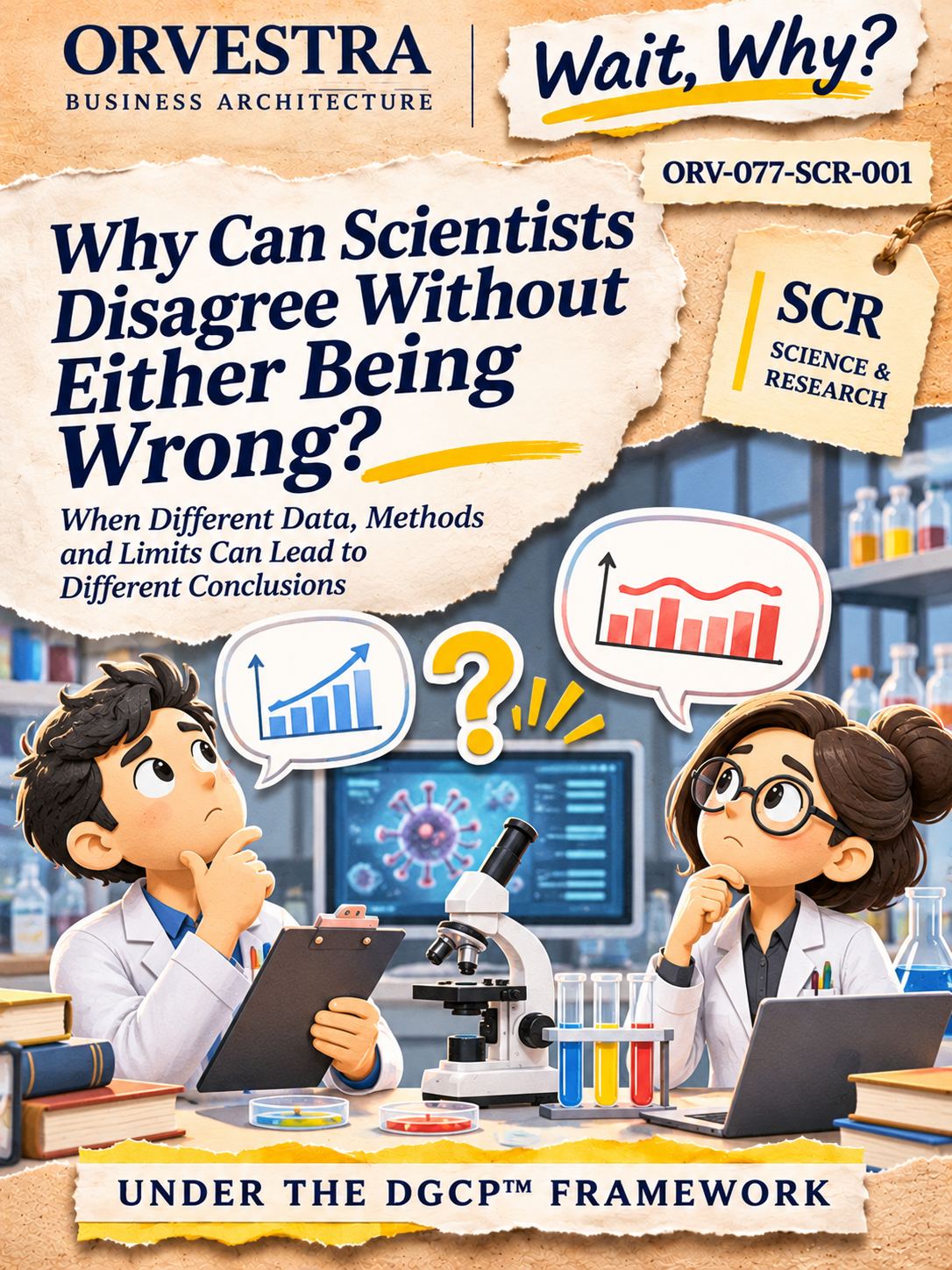
Wait, Why? · Science & Research
Why Can Scientists Disagree Without Either Being Wrong?
About this publication
Two scientists can investigate similar questions and reach different conclusions without either necessarily being wrong. Differences in research methods, sample selection, measurement, statistical interpretation, and study conditions can produce findings that appear contradictory.
This Wait, Why? article explores how scientific disagreement arises, why replication and uncertainty matter, and how researchers distinguish legitimate differences in evidence from methodological errors and unsupported claims. Drawing on examples from psychology and nutrition research, it explains why scientific conclusions must be evaluated in context rather than treated as competing opinions of equal validity.
- Publication
- Wait, Why?
- Primary domain
- Science & Research
- Producer
- ORVESTRA
- Department
- Business Architecture
- Rights
- P'Toh
- Framework
- DGCP™
- License
- DGCP | MMFARM-POL-2025
CID: bafkreignasdd42rqzt3wl24oo5lmhtey2m5fwp2ipr524ajngidvmhwjey
← Back to Knowledge Library